OEM/ODM Music Product Sample Process for Guitar Brands
A practical guide to the OEM/ODM sample process for guitar amplifiers, wireless systems, pickups and music accessories, from inquiry and quotation to testing and approval.
OEM Buyer Summary
This guide explains how a music-product brand can move from a buyer brief to a reviewed and approved OEM/ODM sample.
OEM/ODM Music Product Sample Process: From First Inquiry to Approved Prototype
Most OEM/ODM problems begin before production. The buyer sends a short message, the factory gives a rough price, a sample is made too quickly, and both sides later discover that important details were never confirmed. This can happen with guitar amplifiers, wireless systems, pickups, pedals, capos, and other music accessories.
A good sample process prevents these problems. It turns an idea into a clear specification, then turns the specification into a testable prototype. For brand owners, importers, and wholesalers, this process saves time and reduces the risk of mass production mistakes.
This guide explains how to manage the sample stage for OEM/ODM music products.
Step 1: Start With a Clear Product Direction
The first inquiry should not only ask for price. Price depends on design, materials, function, packaging, order quantity, certification, and target market.
A useful first inquiry includes:
– Product type
– Target market
– Expected retail price
– Estimated order quantity
– Required functions
– Branding needs
– Packaging style
– Certification requirements
– Reference products if available
– Desired launch timeline
For example, “portable guitar amp” is too broad. A better brief would say:
“We need a private label 15W portable electric guitar amplifier for beginner practice kits, with clean/distortion, Bluetooth backing track playback, rechargeable battery, headphone output, custom logo, English manual, and retail color box for EU market.”
That kind of brief gives the supplier enough context to suggest a realistic solution.
Step 2: Decide Between OEM and ODM
OEM and ODM are often used casually, but they are not the same.
OEM usually means the buyer has a specific design, requirement, or brand direction, and the supplier manufactures according to that plan. ODM means the supplier already has an existing product or platform that can be customized with branding, packaging, colors, or selected feature changes.
For many music product buyers, ODM is faster and safer for the first order. Existing platforms usually have known tooling, tested circuits, and shorter sampling time. OEM is better when the buyer needs a unique product or wants stronger differentiation.
Common ODM customization options:
– Logo printing
– Color changes
– Packaging artwork
– Manual language
– Accessory bundle
– Minor control panel changes
– Product listing support
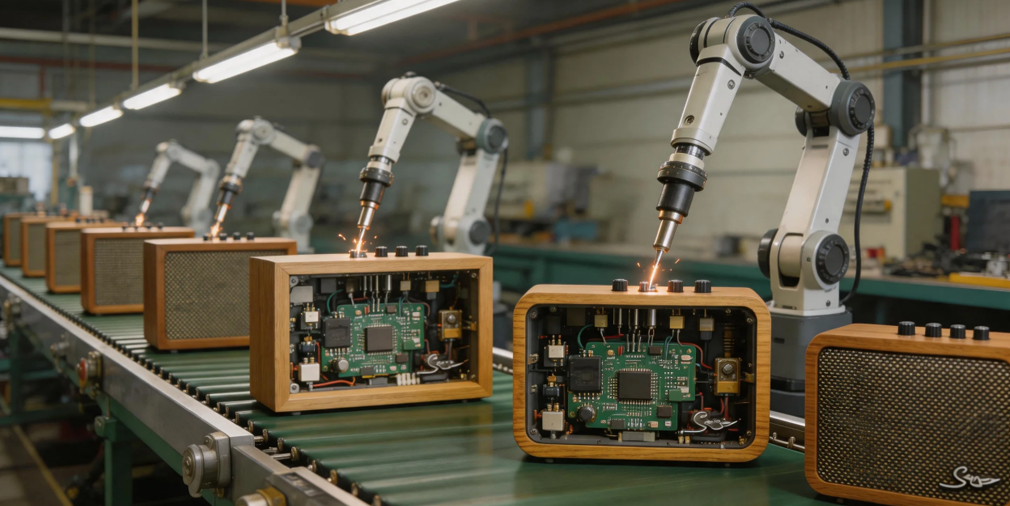
Common OEM development items:
– New circuit design
– New cabinet or housing
– Custom pickup structure
– New wireless system layout
– Tooling changes
– Feature redesign
The buyer should be honest about budget and timeline. Full custom development takes longer and costs more than private label customization.
Step 3: Confirm the Specification Before Sampling
Before the supplier builds or ships a sample, both sides should confirm the key specification. This avoids the common problem of receiving a sample that is technically “correct” but not suitable for the market.
For guitar amplifiers, confirm:
– Power rating
– Speaker size
– Channels and effects
– Battery or adapter power
– Bluetooth function
– Inputs and outputs
– Cabinet material
– Color and logo position
– Packaging
For wireless systems, confirm:
– Latency
– Range
– Frequency band
– Battery runtime
– Charging method
– Plug design
– Pairing method
– Multi-unit use
For pickups, confirm:
– Pickup type
– Output level
– Installation method
– Battery or passive design
– Effects or controls
– Cable and accessories
– Packaging
If the buyer does not know the exact specification, the supplier should help create one. That is part of a good OEM/ODM service.
Step 4: Quotation Should Explain What Is Included
A quotation should not be only a unit price. It should explain the commercial and technical assumptions behind the price.
A useful quotation includes:
– Product model or custom scope
– Unit price by quantity
– MOQ
– Sample cost
– Sample lead time
– Mass production lead time
– Packaging included or not
– Logo cost
– Tooling cost if needed
– Certification support
– Payment terms
– Shipping terms
If two suppliers quote very different prices, compare what is included. One price may include packaging and testing, while another may be a bare product price. For music products, quality control and packaging protection are not small details.
Step 5: Sample Testing Should Follow Real Use
When the sample arrives, do not only check appearance. Use it like a customer would use it.
For a guitar amp:
– Play clean and distortion tones
– Test headphone output
– Test Bluetooth playback
– Check noise at idle
– Run battery test
– Check cabinet vibration
– Review control labels
For a wireless system:
– Compare with a cable
– Walk around while playing
– Test range
– Test charging
– Check plug fit
– Test several units if available
For a pickup:
– Install it on different guitars
– Test output level
– Check noise
– Test controls and effects
– Review installation instructions
Buyers should write down feedback clearly. Instead of saying “sound is not good,” explain what is wrong: too noisy, too bright, not enough volume, distortion too harsh, Bluetooth too loud, battery life too short.
Step 6: Revision and Golden Sample
After feedback, the supplier may revise the sample. Once the buyer approves the final version, that sample should become the golden sample. The golden sample is the reference for mass production.
The golden sample should define:
– Appearance
– Color
– Logo position
– Sound and function
– Packaging
– Accessories
– Labeling
– Manual
If possible, keep one approved sample with the buyer and one with the factory. This helps both sides compare production goods against the same reference.
Step 7: Prepare for Mass Production
Before mass production starts, confirm:
– Final purchase order
– Final artwork
– Final packaging files
– Production lead time
– Inspection standard
– Spare parts or accessories
– Shipping marks
– Certification documents
– Pre-shipment inspection plan
For new buyers, it is better to be detailed at this stage than to fix mistakes later. A small error in carton labeling, manual wording, or accessory list can delay shipment.
Why a Structured Sample Process Matters
Music products are experience products. A buyer may approve a product visually, but customers judge it by sound, feel, noise, stability, and reliability. A structured sample process makes these points visible before mass production.
It also improves communication. The factory understands the buyer’s market. The buyer understands what is realistic. Both sides reduce guessing.
Sound Sentry Music supports OEM/ODM projects for guitar amplifiers, wireless instrument systems, guitar pickups, capos, and music accessories. Buyers can speed up the process by preparing product direction, target price, quantity, branding needs, and market requirements before requesting samples.
FAQ
How long does OEM/ODM sampling take?
It depends on the product and customization level. Private label samples from existing models are usually faster. Full custom development takes longer because design, tooling, testing, and revisions may be required.
Should buyers pay for samples?
In many B2B projects, sample fees are normal, especially for customized products. The important point is to confirm what the sample fee includes and whether it can be refunded or deducted after bulk order.
What is a golden sample?
A golden sample is the approved final sample used as the reference for mass production. It helps control appearance, function, packaging, and quality consistency.
Plan Your OEM/ODM Project
Share your target product, market, estimated quantity, branding, packaging and certification requirements with the SoundSentry Technical Team.
View Related Products Request Product Information or a Quote
OEM Buyer Checklist
- Provide the target market and product positioning.
- List required functions and non-negotiable specifications.
- Confirm logo, color, labeling and packaging requirements.
- Identify certification and documentation needs.
- Record sample comments and required revisions.
- Approve the final reference sample before production planning.
Continue with our OEM/ODM process, quality-control approach, certification guidance or request model-specific information.
Frequently Asked Questions for OEM Buyers
What should be included in an OEM buyer brief?
Include the target product, market, quantity estimate, required functions, branding, packaging and certification requirements.
Does sample approval replace production inspection?
No. The approved sample is a reference, while production and final inspection requirements should still be defined.
When is a sample ready for approval?
A sample is ready when the buyer has reviewed the agreed functions, appearance, branding, packaging and required documentation.