8 vs 10 vs 12 Inch Guitar Combo Amplifiers for Wholesale Buyers
Compare 8, 10 and 12 inch guitar combo amplifiers by cabinet, weight, voicing, testing, packaging and wholesale program requirements.
Quick answer: An 8-inch, 10-inch or 12-inch speaker changes the physical and acoustic design space of a guitar combo amplifier, but speaker diameter alone does not determine loudness, bass extension, tone or product quality. Driver sensitivity, power handling, enclosure volume, open- or closed-back construction, amplifier power, voicing, weight and cost all interact. Smaller formats can support compact practice products; larger formats can offer different output and low-frequency capability, but every model must be evaluated as a complete system.
For an importer, distributor or private-label buyer, speaker size also affects carton dimensions, container utilization, parcel cost, retail display, handle load and damage risk. A visually impressive 12-inch combo may be wrong for a portable beginner range, while a compact 8-inch unit may not meet the stage or clean-headroom target of another program.
This guide provides a sourcing framework for comparing 8-, 10- and 12-inch guitar combo amplifiers. It avoids universal performance claims because the final result depends on the specific driver, cabinet, electronics and test conditions.
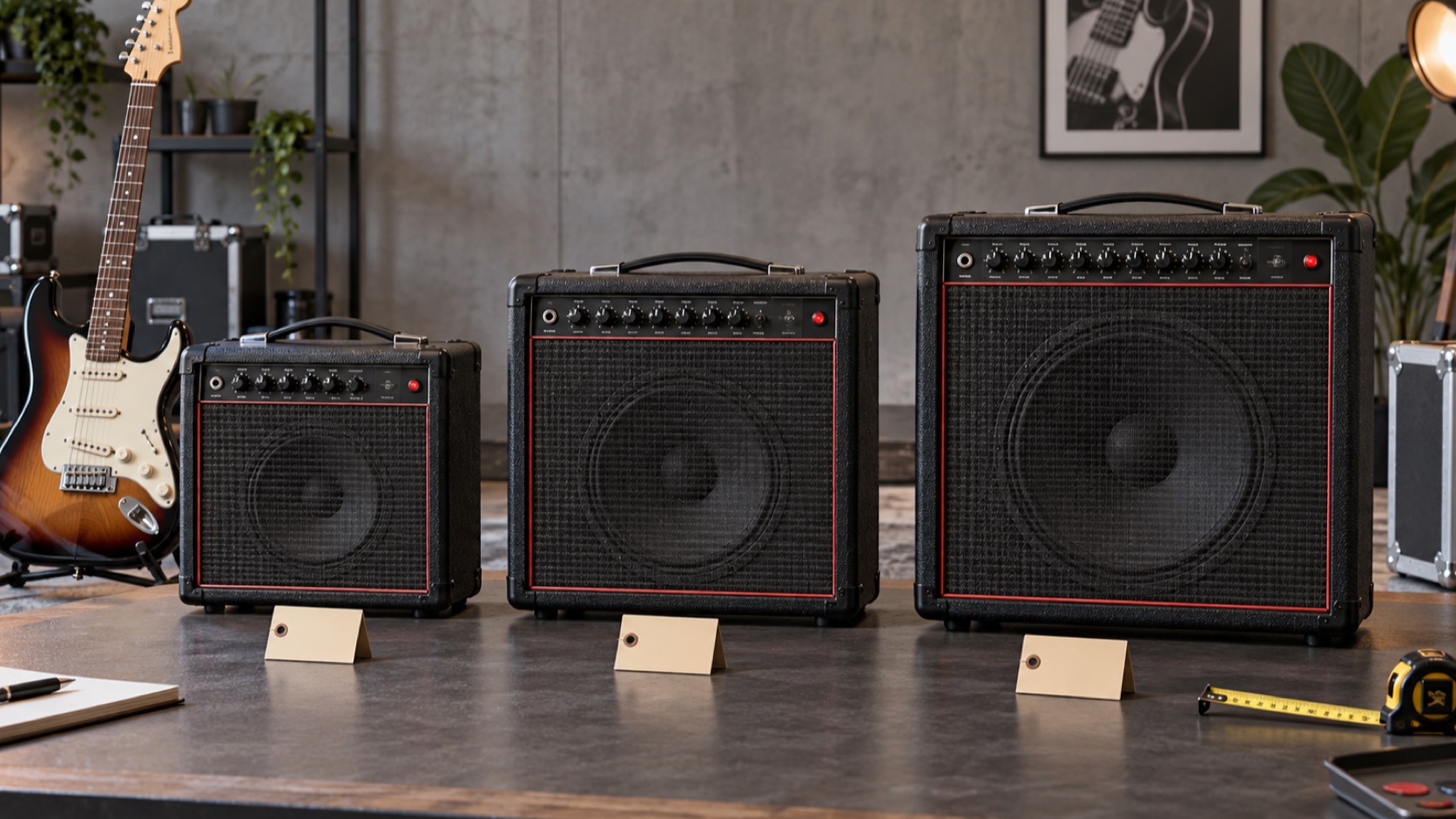
Editorial illustration: compare the complete cabinet, driver and amplifier system rather than diameter alone.
Define the use case before choosing speaker size
Start with the buyer and environment. A first amplifier for home practice, a classroom unit, a portable rehearsal combo and a retail stage-demo model have different priorities.
Document:
- Intended guitar type and pickup formats.
- Home, teaching, rehearsal, street-performance or stage use.
- Clean-headroom and overdrive expectations.
- Required channels, controls, effects and connectivity.
- AC-powered, battery-powered or dual-power architecture.
- Target net weight, carton size and carrying method.
- Local voltage and plug requirements.
- Target price position and warranty approach.
- Retail packaging, manual languages and claim limits.
Speaker diameter should follow this brief. If the brief says only “30-watt 10-inch combo,” critical product decisions remain undefined.
What speaker diameter does and does not tell you
Nominal diameter identifies a size class, not a full performance specification. Two 10-inch drivers can differ in cone, surround, voice coil, magnet, frame, sensitivity, impedance, resonance and power handling. Their cabinets and electronics can also be completely different.
A larger cone has more radiating area, but system output depends on excursion, sensitivity, amplifier power, frequency, cabinet and limiting. A smaller driver can sound full in a carefully voiced cabinet at appropriate levels. A larger driver can sound thin if the cabinet or tuning is unsuitable.
Do not use diameter as a proxy for watts. Electrical amplifier power and speaker size are related design choices, not interchangeable numbers. Request RMS or continuous power descriptions with stated test conditions where available, and avoid adding “peak” figures that cannot be compared across suppliers.
Typical role of an 8-inch combo
An 8-inch-class combo often supports compact home-practice, beginner, travel or desktop positioning. The smaller cabinet can reduce product size and shipping volume. It may be easier to carry and display in stores with limited space.
The design still needs adequate cabinet volume, structural stiffness and ventilation. Very small enclosures can create compromises in bass extension or efficiency, but those outcomes depend on the driver and voicing. A practice model may intentionally control low frequencies to reduce muddiness at close range.
Buyers should evaluate whether the control panel and jacks remain easy to use in the compact enclosure. A small cabinet can become crowded when it includes multiple channels, wireless functions, battery compartments or many rear connectors.
Typical role of a 10-inch combo
A 10-inch-class combo can occupy a middle position between compact practice products and larger performance-oriented models. It may offer more cabinet and driver capacity while remaining manageable for transport. This can suit lessons, rehearsal, home recording or general-purpose retail ranges.
However, “middle size” does not automatically mean balanced performance. Driver sensitivity, cabinet construction, power section and voicing still determine the product. Compare actual net weight and external dimensions; some 10-inch combos are close to compact 12-inch models, while others are much smaller.
The 10-inch platform can be useful when a buyer needs stronger perceived capability than an entry-level mini combo without accepting the full carton and weight of a larger model. Validate that positioning with listening, handling and logistics data.
Typical role of a 12-inch combo
A 12-inch-class combo is common in products intended for rehearsal, stage use or players who expect a larger cabinet format. The driver and enclosure may support different low-frequency extension, output and dispersion from smaller systems, but the result varies widely.
Larger cabinets add shipping volume and often weight. The handle, baffle, corners, feet and chassis mounting experience greater loads. Packaging must manage the mass of the transformer, speaker and cabinet during drops and vibration. A 12-inch model therefore needs more than a scaled-up carton.
Retailers may value the familiar appearance and stage positioning, but importers should calculate landed logistics and damage exposure before deciding that the larger format is commercially stronger.
Side-by-side sourcing comparison
| Area | 8-inch class | 10-inch class | 12-inch class |
|---|---|---|---|
| Common positioning | Compact practice or beginner | General-purpose practice/rehearsal | Rehearsal or stage-oriented |
| Cabinet | Smallest design space | Mid-size design space | Largest design space |
| Portability | Often easiest, verify weight | Moderate, model dependent | Often heavier, verify handle/load |
| Logistics | Usually smallest carton | Moderate carton | Largest carton and pallet impact |
| Acoustic result | Driver/cabinet dependent | Driver/cabinet dependent | Driver/cabinet dependent |
| Buyer priority | Size, usability, value | Versatility and balance | Output target, structure, logistics |
These are planning tendencies, not guarantees. Use actual samples and data for the chosen models.
Speaker specification beyond diameter
Request the driver’s nominal impedance, power handling method, sensitivity method where available, frequency-response context, magnet and frame construction, mounting dimensions and net weight. Confirm whether the speaker is a standard platform or a custom-voiced component.
The nominal impedance must match the amplifier design. If the product provides an external-speaker output, define the safe load and switching behavior. Incorrect labeling can create service risks, so the rear panel and manual should be reviewed against the approved circuit.
Inspect cone, surround, spider, voice coil, frame, terminal and adhesive process. These details affect consistency and reliability. A speaker sample approved by sound should be connected to a controlled component specification and change-notice requirement.
Cabinet volume and construction
Measure external dimensions and calculate the usable internal volume after subtracting chassis, bracing, driver and battery spaces. Confirm panel material and thickness, joints, baffle mounting, back-panel design and internal damping where used.
An open-back cabinet interacts with the room differently from a closed or partially closed design. This affects the player’s perception and microphone placement. Do not describe one approach as universally superior. Test it in the intended environment.
Rattles can come from the baffle, back panel, chassis, handle, corner hardware, grille, control knobs or loose wires. Use swept tones and playing tests at relevant levels to find mechanical noise before approval.

Editorial illustration: the driver, baffle, enclosure volume and mechanical structure form one system.
Planning a private-label combo amplifier range?
Send the intended use, speaker size, power architecture, controls, voltage markets and target carton limits through Contact Us. Available platforms and samples must be confirmed for the project.
Amplifier power and clean headroom
Power claims require test conditions. Ask whether the stated figure is continuous or RMS power, the load impedance, frequency, distortion limit, supply voltage and channel configuration. Do not compare a continuous figure from one supplier with an unexplained maximum figure from another.
Clean headroom is not determined by watts alone. Power supply, amplifier topology, speaker sensitivity, voicing and limiting affect the usable clean level. Test with the intended pickups and control settings. A high-output humbucker may drive the input differently from a lower-output single-coil pickup.
If overdrive is part of the product, evaluate the transition from clean to driven sound at several master and gain settings. Confirm that noise and oscillation remain controlled at extreme settings without basing the whole approval on extreme knob positions.
Frequency response and voicing
Guitar amplifiers are musical systems, not full-range laboratory speakers. Their response is intentionally shaped by the preamp, power section, driver and cabinet. A measurement can help compare units and detect variation, while listening confirms whether the voicing suits the range.
Use a consistent microphone or electrical test method, position and room. Record guitar, pickup, strings, cable and settings. Where the amplifier includes cabinet simulation, headphone output or USB audio, test those paths separately because they may not match the internal speaker output.
Avoid promising that a 12-inch model has “more bass” or an 8-inch model is “brighter” without testing the specific products. Those shortcuts can be contradicted by voicing and cabinet design.
Portability is more than net weight
Measure cabinet dimensions, center of gravity, handle clearance and grip comfort. A lighter product can still be awkward if the handle is narrow or the cabinet hits the user’s leg. A heavier product needs handle, fastener and cabinet strength suitable for repeated lifting.
For battery-powered models, include the battery in the declared weight and carrying test. Confirm how users access or charge it. If the battery is not user replaceable, service documentation and transport requirements should match the selected technology and destination rules.
Perform repeated lift testing and inspect handle hardware, top panel and cabinet joints. Consider a strap or side handles only if they fit the product and packaging design.
Control panel and connectivity
Define required inputs, channels, gain, tone controls, effects, auxiliary input, headphone output, line output, footswitch, Bluetooth or USB features. Each function adds circuit, software, labeling and test requirements.
On a compact 8-inch model, crowded controls can reduce usability. On larger models, rear-mounted connectors may be difficult to see. Review the product at standing, seated and floor positions. Use clear labels and adequate contrast.
Connectivity claims must match the hardware and firmware. If Bluetooth is included, identify whether it supports audio playback, control or both. Do not imply a function that the selected implementation does not provide.
Power supply and destination markets
Confirm whether the amplifier uses an external adapter, internal universal supply or market-specific mains configuration. Record rated input, frequency, plug, fuse, earth arrangement and approved cord. Labels, manual and carton should match the destination configuration.
Applicable safety, EMC, radio, energy or chemical requirements depend on product architecture and destination. Buyers should confirm the compliance route with qualified specialists and obtain the relevant reports or documentation for the exact model. A report for a different power supply or wireless module may not cover the shipped configuration.
Do not publish broad certification claims before document and model verification.
Build a controlled sample test
Evaluate every size on the intended use case, not only at maximum volume. Use repeatable guitar passages or re-amped material plus functional measurements.
Check:
- Clean and driven behavior with representative pickups.
- Noise, hum and hiss at practical and extreme settings.
- Control sweep, channel switching and effects.
- Internal-speaker output and any external outputs.
- Rattles, buzzes and intermittent connections.
- Thermal behavior after a defined operating period.
- Power cycling, mute behavior and startup transients.
- Handle, feet, corners and cabinet stability.
- Headphone, auxiliary, USB or wireless functions where included.
Use several samples in the pilot batch. One amplifier may hide speaker or assembly variation.
Speaker and amplifier protection
The complete system should be evaluated under foreseeable operating conditions. Test approved control extremes, strong input signals and relevant supply conditions. Protection or limiting should avoid unsafe or destructive behavior while preserving the intended musical response.
Inspect speaker lead routing and terminal retention. Leads should not contact the cone or rattle against the cabinet. Secure heavy components and verify that heat-producing parts have adequate clearance and ventilation.
If the product includes an external speaker connection, test switching, impedance labeling and user instructions. Where there is no such function, do not add language that encourages users to open the cabinet.
Packaging and logistics comparison
Record product dimensions, net weight, carton dimensions, gross weight and pallet pattern for each size. Calculate container and warehouse impact using the actual packout, not the bare cabinet. A larger product can reduce units per carton, pallet or container and increase parcel surcharges.
Packaging must protect the heavy speaker, chassis and transformer. Molded foam or structured pulp should support the cabinet without pressing on knobs, jacks or grille cloth. The carton should resist handle puncture and corner crush.
Validate the pack with an agreed distribution test appropriate to the channel. After testing, inspect cosmetics, cabinet joints, speaker alignment, electronics and sound. A carton that looks intact can still contain a shifted chassis or loosened speaker.

Editorial illustration: speaker size changes carton engineering, shipping efficiency and damage exposure.
Production and batch control
Every finished amplifier needs a functional test covering input, controls, speaker, outputs, switches, indicators and power. Add model-specific tests for effects, wireless, battery, USB or footswitch functions.
Use a controlled audio source and load where appropriate. Sample measurements can cover output power under defined conditions, noise, current, frequency checkpoints and thermal behavior. Speaker checks may include impedance, rub/buzz screening and comparison with a reference unit.
Visual inspection should cover cabinet finish, grille, corners, handle, feet, control alignment, labels, serial or lot identification and included accessories. Record rework and repeat affected tests.
Change control for critical parts
Require review before changes to the speaker, power transformer or adapter, power amplifier, power supply, cabinet panels, baffle, grille, damping, handle, feet, firmware, protection settings or packaging.
Even a speaker with the same diameter and nominal impedance can change sensitivity, frequency response, weight or mounting. A cabinet-material substitution can change structure and sound. Reapproval should be proportional to the affected risks.
Commercial comparison
Normalize quotations by speaker, amplifier power definition, cabinet, effects, wireless functions, adapter or mains cord, packaging, manuals, compliance documentation and testing. Separate tooling, artwork, samples and optional accessories.
Confirm MOQ by model, voltage, plug and finish. Mixed-market orders may create separate stock-keeping units and documentation. Ask how speakers, handles, boards and power supplies are identified for spare-parts and warranty support.
The lowest unit price can become expensive if carton volume, damage rate or service complexity is ignored.
Common sourcing mistakes
Choosing speaker diameter as a tone guarantee
Diameter is one design variable. Test the complete driver, cabinet and amplifier.
Comparing unexplained watt figures
Use the same load, frequency, distortion and supply conditions before comparing power.
Ignoring gross carton size
Landed cost and warehouse capacity depend on the packed product, not only unit price.
Approving sound but not rattles
Use sweeps, playing and handling tests to locate cabinet and hardware noise.
Substituting a same-size speaker without reapproval
Nominal size and impedance do not guarantee the same performance or fit.
Frequently asked questions
Is a 12-inch guitar combo always louder than an 8-inch combo?
No. Loudness depends on amplifier power, speaker sensitivity, excursion, cabinet, frequency and test conditions. Compare the actual systems.
Which speaker size is best for a beginner amplifier?
There is no universal answer. An 8-inch format can support compact practice positioning, while 10- or 12-inch models may fit different expectations. Consider use, budget, weight and logistics.
Can wattage be compared without distortion data?
Not reliably. Request the load, frequency, distortion threshold and supply condition associated with the rating.
Does a larger speaker always provide more bass?
No. Driver parameters, enclosure and voicing determine low-frequency behavior. Test the specific product.
What should an importer request with samples?
Request dimensions, weights, driver and power specifications, control/functions list, electrical configuration, test data, packaging information and applicable compliance documentation.
What requires reapproval after the golden sample?
Changes to the speaker, cabinet, baffle, electronics, power supply, firmware, handle or packaging should be assessed and retested as appropriate.
Conclusion
An 8-, 10- or 12-inch speaker size is a starting point for product architecture, not a complete performance claim. Wholesale buyers should connect the size to the intended player, cabinet, driver, amplifier, portability and logistics. The strongest program uses controlled samples, defined power data, repeatable sound and functional tests, packaging validation and component change control.
Explore SoundSentry’s guitar amplifier category and send your amplifier brief with the use case, speaker format, power architecture, controls, voltage markets and carton limits. Available platforms, samples and commercial terms must be confirmed for the selected program.
Plan Your OEM/ODM Project
Share your target product, market, estimated quantity, branding, packaging and certification requirements with the SoundSentry Technical Team.
View Related Products Request Product Information or a Quote