Alnico vs Ceramic Guitar Pickups for OEM Programs
Compare Alnico and ceramic guitar pickups by design, output, fit, testing, sourcing and batch control before approving an OEM program.
Quick answer: Alnico and ceramic magnets can both support successful guitar-pickup designs. Alnico is a family of aluminum-nickel-cobalt alloys, while ceramic pickup magnets are commonly ferrite materials. Their magnetic properties differ, but magnet material alone does not determine output, frequency response, dynamics or perceived tone. Coil geometry, winding, magnet dimensions, steel parts, pole spacing, pickup height, pot values and the guitar itself all contribute. An OEM buyer should therefore approve a complete pickup design and production control plan, not select a magnet from a tone adjective.
For a guitar brand, distributor or factory, the practical decision is broader than “warm Alnico” versus “powerful ceramic.” A higher-grade or larger Alnico magnet can behave differently from a smaller one. A ceramic design can be engineered for moderate output, and an Alnico design can be wound for high output. Generalizations may help a retail conversation, but they are too vague for an RFQ, golden sample or purchase agreement.
This guide explains how to compare the two platforms without overpromising. It covers product positioning, mechanical fit, electrical data, controlled listening, magnet verification, sample approval and batch inspection. Exact values and final performance must be confirmed on the selected pickup and guitar platform.
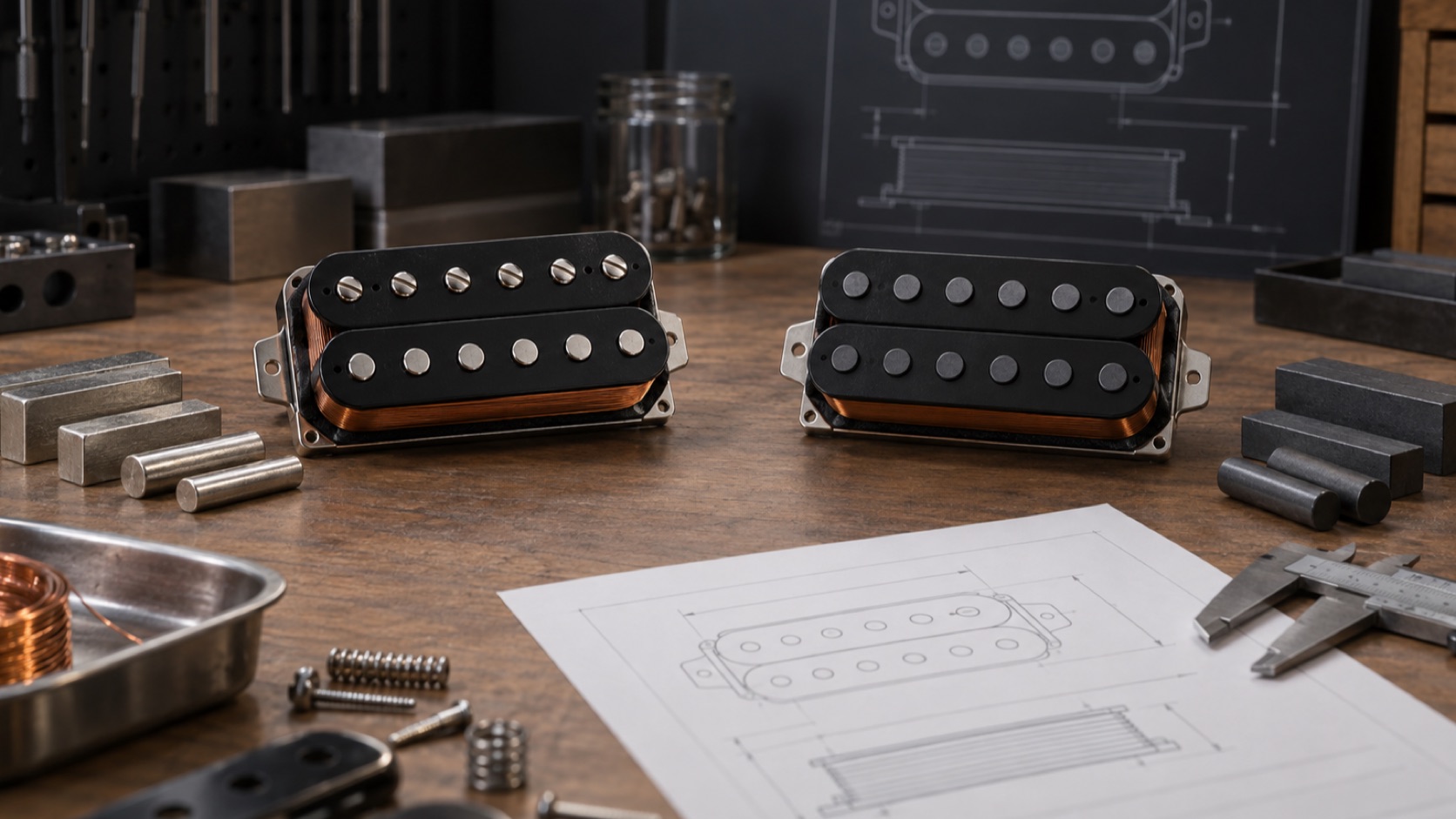
Editorial illustration: compare the complete pickup assemblies, not loose magnet labels in isolation.
Start with the guitar program, not the magnet
The first document should describe the instrument and buyer, because the same pickup can behave differently in another guitar. Define the guitar type, scale length, string count, bridge and string spacing, pickup positions, cavity dimensions and control circuit. Add the target player, likely gain range, price position and the role of the model in the product line.
Useful questions include:
- Is the guitar intended for clean, edge-of-breakup, high-gain or mixed use?
- Does the range need a traditional visual style or a contemporary covered design?
- Is the pickup part of a matched neck-and-bridge set?
- Are coil split, series/parallel or phase options required?
- What pot values, capacitor, switch, jack and cable are used?
- What output balance is expected between positions and strings?
- Which finish, cover, pole-piece color and branding details are needed?
- What evidence will be used to approve tone and production consistency?
Once this brief is stable, a supplier can propose an existing platform or a modified design. Without the brief, two samples may differ in several variables, making the magnet comparison unreliable.
What Alnico means in a pickup specification
“Alnico” is not one single magnetic recipe. Pickup discussions often mention grades such as Alnico 2, Alnico 3, Alnico 4, Alnico 5 or Alnico 8, but the grade name is only one part of the specification. Magnet dimensions, orientation, magnetization condition, aging, contact with steel parts and the surrounding magnetic circuit also matter.
An RFQ should identify the agreed grade and physical format, such as a bar magnet or magnetized pole pieces. It should also identify the magnet dimensions, magnetization direction and the measurable acceptance method used by the supplier. Avoid relying on appearance: different materials or grades can look similar after assembly.
The design may use the magnet with a baseplate, keeper bar, screws, slugs or blade. Those steel parts shape the magnetic circuit. Changing their alloy, dimensions or spacing can change the result even if the magnet grade remains unchanged. That is why the approved bill of materials should cover the entire magnetic structure.
What ceramic means in a pickup specification
Ceramic guitar-pickup magnets are generally ferrite magnets. They can provide a different combination of magnetic properties, cost, availability and physical behavior from Alnico. However, “ceramic” does not define a finished pickup sound. The supplier still chooses magnet dimensions, coil design, steel parts and the relationship between the magnet and strings.
In some designs, a ceramic bar sits beneath the coils and transfers flux through steel poles. Other architectures may use blades or different arrangements. A buyer should request a dimensioned construction description and approve the complete design. If the supplier later changes the ceramic grade or dimensions, the effect should be assessed rather than treated as an invisible substitution.
Ceramic magnets can also be brittle. That does not automatically create a field failure, because magnets are normally protected inside the pickup, but handling and assembly controls should prevent chips or cracks. The inspection plan should define whether exposed edges, chips or fractures are acceptable.
Avoid universal tone claims
Retail descriptions frequently associate Alnico with smoothness, warmth or vintage response and ceramic magnets with brightness, compression or high output. These words can describe particular pickups, but they are not laws of the materials. Coil turns, inductance, resistance, capacitance, eddy-current effects, pickup height and amplifier settings can outweigh a simple material label.
For procurement, replace adjectives with controlled comparisons. Ask whether the design meets an approved output range, position balance, noise condition and reference response when installed in the specified guitar. Listening remains important, but record the setup so another team can repeat it.
| Decision area | Alnico platform questions | Ceramic platform questions |
|---|---|---|
| Magnet identity | Grade, dimensions and magnetization | Ferrite grade, dimensions and magnetization |
| Magnetic circuit | Poles, screws, slugs, keeper and baseplate | Bar, blades, poles and steel transfer parts |
| Electrical design | Coil geometry, turns, wire and connections | Coil geometry, turns, wire and connections |
| Mechanical fit | Cover, tabs, height and pole spacing | Cover, tabs, height and pole spacing |
| Approval | Golden sample and reference guitar | Golden sample and reference guitar |
| Production control | Incoming magnet and completed-pickup checks | Incoming magnet and completed-pickup checks |
The table deliberately shows similar procurement questions. Magnet material changes a design variable; it does not remove the need to control the rest of the pickup.
Compare complete electrical data
DC resistance is commonly listed because it is easy to measure, but it is not a complete measure of pickup output or sound. Resistance varies with wire diameter, length and temperature. Two pickups with the same resistance can have different inductance, capacitance, magnetic structures and response.
Ask for the data that the supplier can measure consistently, with test conditions. Depending on the design, this can include DC resistance at a stated temperature, inductance at a stated frequency, polarity, phase, continuity and output under a defined excitation or reference-string procedure. If gauss or surface-flux measurements are used, define the instrument, probe position, orientation and tolerance.
The most valuable specification is one tied to an approved sample and test fixture. A long list of numbers without repeatable methods can create false precision.
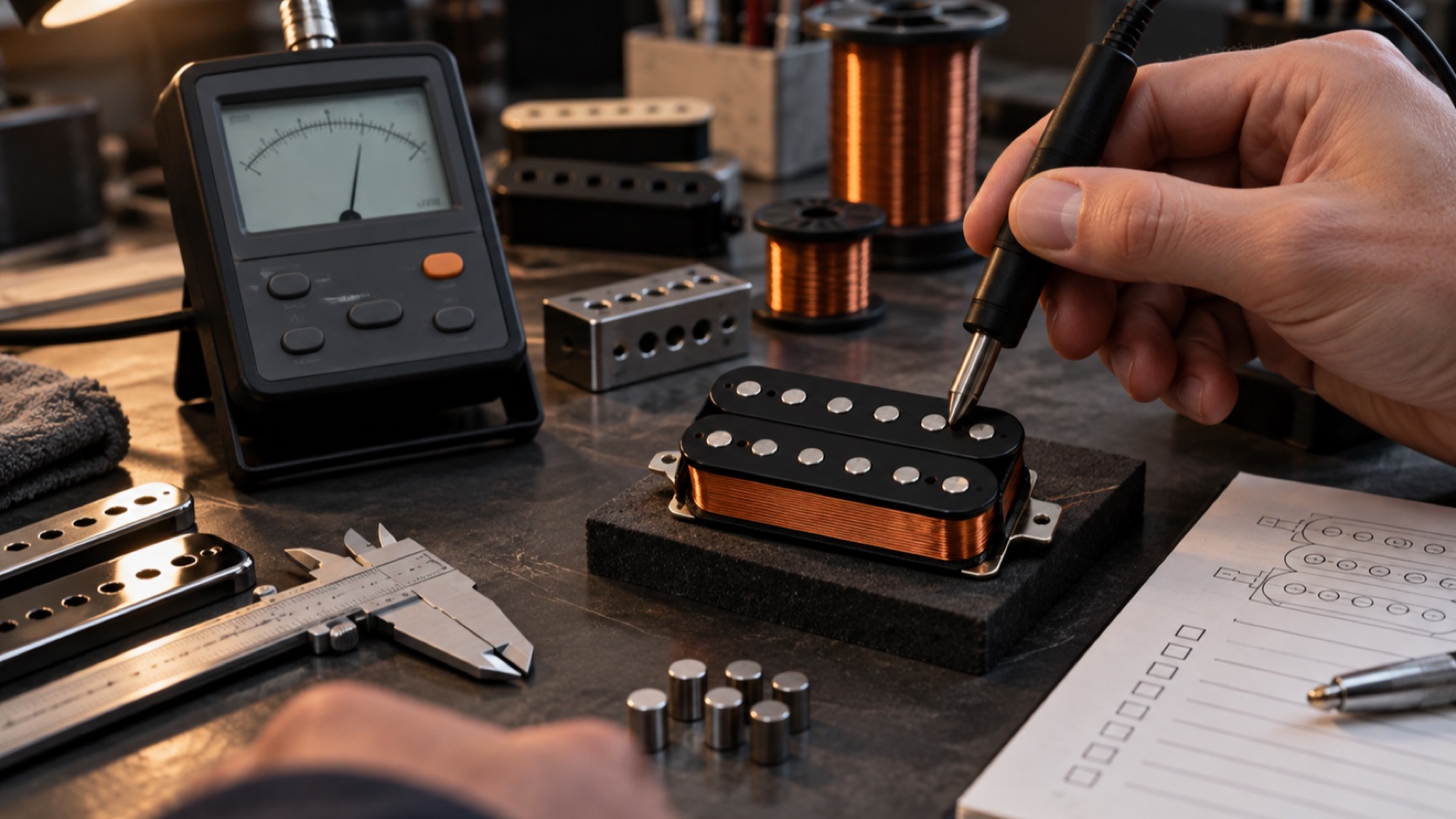
Editorial illustration: measurement location and test method must be consistent before limits become meaningful.
Planning a private-label pickup range?
Share the guitar format, string spacing, cavity drawing, control circuit and target positioning through Contact Us. Available platforms and sample options must be confirmed for the actual program.
Mechanical fit comes before sound approval
A pickup that cannot be installed cleanly is not an approved sample. Confirm housing length, width and depth, mounting-tab geometry, screw centers, lead exit, connector clearance and adjustment range. Include the cover when checking dimensions.
Check pole or blade relationship to the strings in both pickup positions. Bridge spacing may differ from neck spacing. Extended-range guitars, tremolo bridges and nonstandard layouts require extra care. Visual alignment alone is not the only performance criterion, but the approved geometry should be intentional and documented.
Measure the guitar cavity and route, not only the pickup. Wire bends, connectors, shielding and mounting hardware consume space. Build at least one production-representative prototype before freezing routing drawings.
Control circuit and loading matter
Passive pickups interact with the guitar’s pots, capacitor, switch, cable and amplifier input. If a sample is evaluated with one pot value and production uses another, the result may change. Pot tolerance also matters, so record the measured components in the reference guitar.
Define the wiring diagram, pot values and taper, tone capacitor, switch functions, output jack and any coil options. If a cover, long cable or extra switching is added after approval, repeat the relevant tests. The pickup is one part of a signal system.
For matched sets, check neck and bridge balance with the planned height range. Do not force balance only by winding labels; installation height, magnet geometry and guitar position contribute.
Build a repeatable listening test
Use the same guitar platform, strings, tuning, pickup height, controls, cable, interface or amplifier, gain structure and playing material. Record those conditions. If possible, use a re-amping or controlled excitation method alongside human playing to improve repeatability.
Evaluate clean and driven conditions relevant to the product. Listen for string balance, neck/bridge balance, transient behavior, sustain, control response, noise and undesirable microphonics. Avoid deciding from one loud comparison: higher output can sound more impressive even when the level difference is the main change. Level-match where the purpose is to compare response rather than output.
Use several evaluators and record their observations against defined goals. A golden sample, reference recordings and written setup are more useful together than any one item alone.
Noise, shielding and microphonics
Noise performance depends on coil architecture, phase relationship, shielding, grounding, cable routing and the test environment. A humbucker is intended to reduce common-mode hum under its designed conditions, but poor wiring or a ground fault can undermine the benefit. A single-coil format may be more sensitive to environmental hum, while shielding still helps with some interference sources.
Potting and mechanical assembly can affect microphonic behavior. Specify the approved process where relevant, but do not assume that more potting is always better. The process should match the product target and be controlled for temperature, time and material.
Test tap response, high-gain stability and normal playing in a controlled rig. Define unacceptable squeal or intermittent noise in a way the factory can reproduce.
Sample sequence for OEM approval
A disciplined sequence reduces repeated revisions:
- Requirement sample: confirms general format, target and fit direction.
- Tuning sample: adjusts winding, magnet structure, cover or circuit choices.
- Production-representative sample: uses the intended bill of materials and process.
- Pilot batch: checks assembly, variation, packaging and inspection flow.
- Golden sample: becomes the signed physical reference after approval.
Record every change between stages. If an Alnico and ceramic option are both evaluated, keep their other variables as controlled as practical or clearly document the differences. Otherwise, the result is a comparison of two whole designs—which can still be commercially useful, but should be described accurately.
Magnet and component verification
Material declarations and supplier records can support control, but incoming inspection should be risk-based. For critical designs, the pickup supplier may use magnetic measurements, dimensional checks and controlled source records. The brand should agree which evidence accompanies samples and production lots.
Do not ask a finished-goods inspector to identify magnet alloy by sight. Instead, use traceable material control upstream and verify completed-pickup characteristics with repeatable tests. Where laboratory material analysis is required, define the method and who is responsible before ordering.
Batch consistency and production tests
Production control should focus on characteristics that matter to function and customer experience. Possible checks include continuity, DC resistance, inductance, polarity, phase, output, noise, switching, visual finish, wire length and hardware completeness. The exact plan depends on the pickup architecture and risk.
Set limits from design evidence and pilot data. A tolerance copied from an unrelated pickup may be too narrow, too wide or simply irrelevant. Define measurement temperature and equipment. Use fixtures that position the pickup consistently.
Sample several units across a lot, not only the first finished piece. Compare results with the golden sample and keep lot records. If a failure is reworked, identify it and repeat the full affected test sequence.
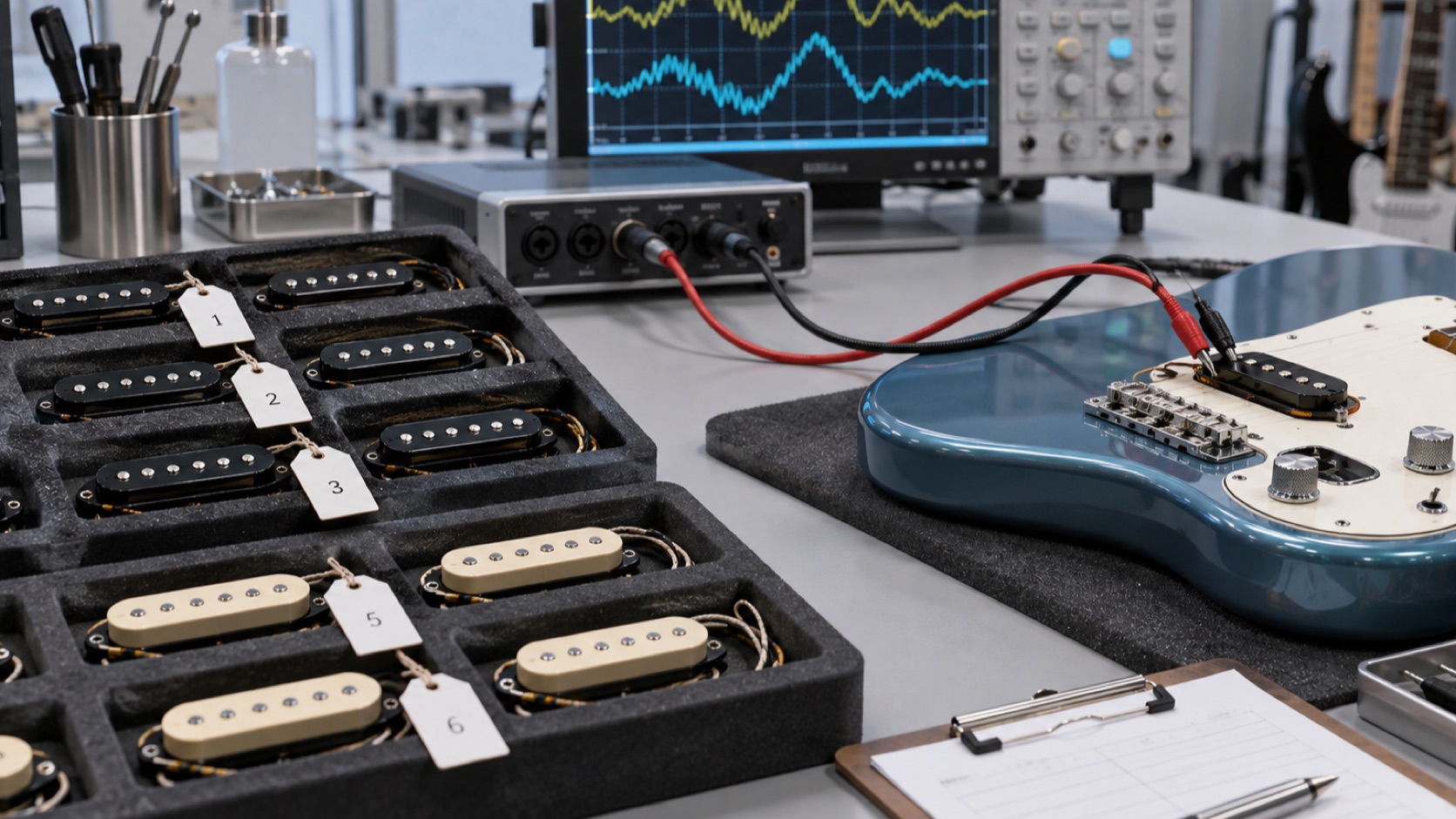
Editorial illustration: batch approval combines traceable measurements, functional testing and comparison with the golden sample.
Change control prevents silent drift
The purchase specification should require review before changes to:
- Magnet grade, dimensions, source or magnetization process.
- Coil wire, turns, tension or winding pattern.
- Bobbins, poles, screws, slugs, blades, keeper or baseplate.
- Covers, plating, potting material or adhesive.
- Lead wire, connector, hardware or packaging.
- Test method, fixture or acceptance limit.
Some substitutions may be acceptable, but they should not bypass evaluation. A change can affect fit, sound, cosmetics, soldering or long-term reliability even when the pickup still passes a basic continuity test.
Packaging and production-line preparation
Factory bulk packaging should protect leads, connectors, covers and pole pieces. Screws and springs should be contained so they cannot scratch finished parts. Clearly identify neck and bridge positions, finish and lot. Avoid relying only on similar wire colors.
Provide the guitar assembly team with a drawing showing orientation, wiring, ground points, spring or tubing placement and initial height. Run a pilot build and note wire-pinching risks, awkward soldering steps and adjustment limits. The final guitar test should confirm every switch position, control sweep, noise condition and output balance.
Normalize the commercial comparison
Compare quotations on the same scope. Separate pickup price from covers, mounting hardware, harnesses, custom tooling, sample charges, packaging and additional testing. Confirm MOQ by design and finish, not only by total order. Ask how replacement neck and bridge units are supplied and how lot traceability supports warranty review.
Do not assume one magnet family is automatically lower risk or better value. A stable, documented pickup that fits the program can be more valuable than a nominally preferred magnet with uncontrolled variation.
Common sourcing mistakes
Choosing by a single tone adjective
Words such as warm, aggressive or vintage are subjective. Translate them into a reference sample and test setup.
Comparing resistance as if it were output
Resistance alone does not determine signal level or response. Review the complete electrical and magnetic design.
Approving the pickup outside the target guitar
Fit, height, pots, cable and instrument construction affect the result. Use a production-representative platform.
Allowing silent magnet substitution
Material or dimension changes should trigger documented review and, where necessary, reapproval.
Skipping pilot-batch measurements
One excellent sample does not prove production consistency. Inspect a meaningful set across the pilot lot.
Frequently asked questions
Are Alnico pickups always lower output than ceramic pickups?
No. Output depends on the complete pickup design, magnet geometry, coil and test conditions. Either magnet family can be used in different output ranges.
Which Alnico grade is best for an OEM guitar?
There is no universal best grade. Choose a complete design that meets the guitar’s target, then control the approved grade, dimensions and magnetization.
Can DC resistance identify the magnet type?
No. DC resistance mainly describes the coil’s resistance under stated conditions. It does not identify magnet material.
Should a buyer request gauss values?
They can be useful when the probe position, instrument, orientation and acceptance method are defined. A value without a repeatable method is difficult to compare.
Can the same pickup use either magnet without other changes?
Physical replacement may be possible in some architectures, but performance can change. Treat the alternative as a new configuration and test it in the target guitar.
What should be retained after approval?
Keep signed drawings, bill of materials, wiring diagram, test methods, measured reference data, golden samples, recordings, change history and pilot-lot results.
Conclusion
The useful question is not whether Alnico or ceramic is universally better. It is which complete pickup design fits the instrument, customer, control circuit and production system. OEM buyers should specify the whole magnetic and electrical assembly, verify mechanical fit, use controlled listening and measurement, approve a production-representative sample and require change control.
Review SoundSentry’s guitar pickup category and send your project requirements with the guitar format, string spacing, cavity drawing, wiring and target positioning. Available designs, samples and commercial terms must be confirmed for the selected program.
Plan Your OEM/ODM Project
Share your target product, market, estimated quantity, branding, packaging and certification requirements with the SoundSentry Technical Team.
View Related Products Request Product Information or a Quote