Wireless Guitar System Import Documents and Compliance Checklist
Use this importer checklist to review RF, battery, safety, labeling, transport and production records for wireless guitar systems.
Quick answer: Importers should request a model-specific document set that connects the exact wireless guitar system, radio band, hardware revision, battery, charger, labeling and destination market. A generic certificate logo or an unrelated test report is not enough. Review model numbers, applicant or manufacturer, standards, test dates, frequency settings, antenna design, battery identification and artwork before approving production or shipment. Requirements differ by country and route, so qualified compliance and logistics professionals should confirm the final scope.
Wireless guitar systems combine radio electronics, audio performance, rechargeable batteries, USB charging, consumer packaging and international shipping. Each element can create a different document question. A supplier may have a report for a similar model, but a different radio module, antenna, battery cell or charging case can change its relevance.
This article gives distributors, importers and private-label brands a buyer-owned method for organizing the review. It is not legal advice and does not claim that one list applies everywhere. The objective is traceability: every claim, label and file should point to the exact product revision being purchased.
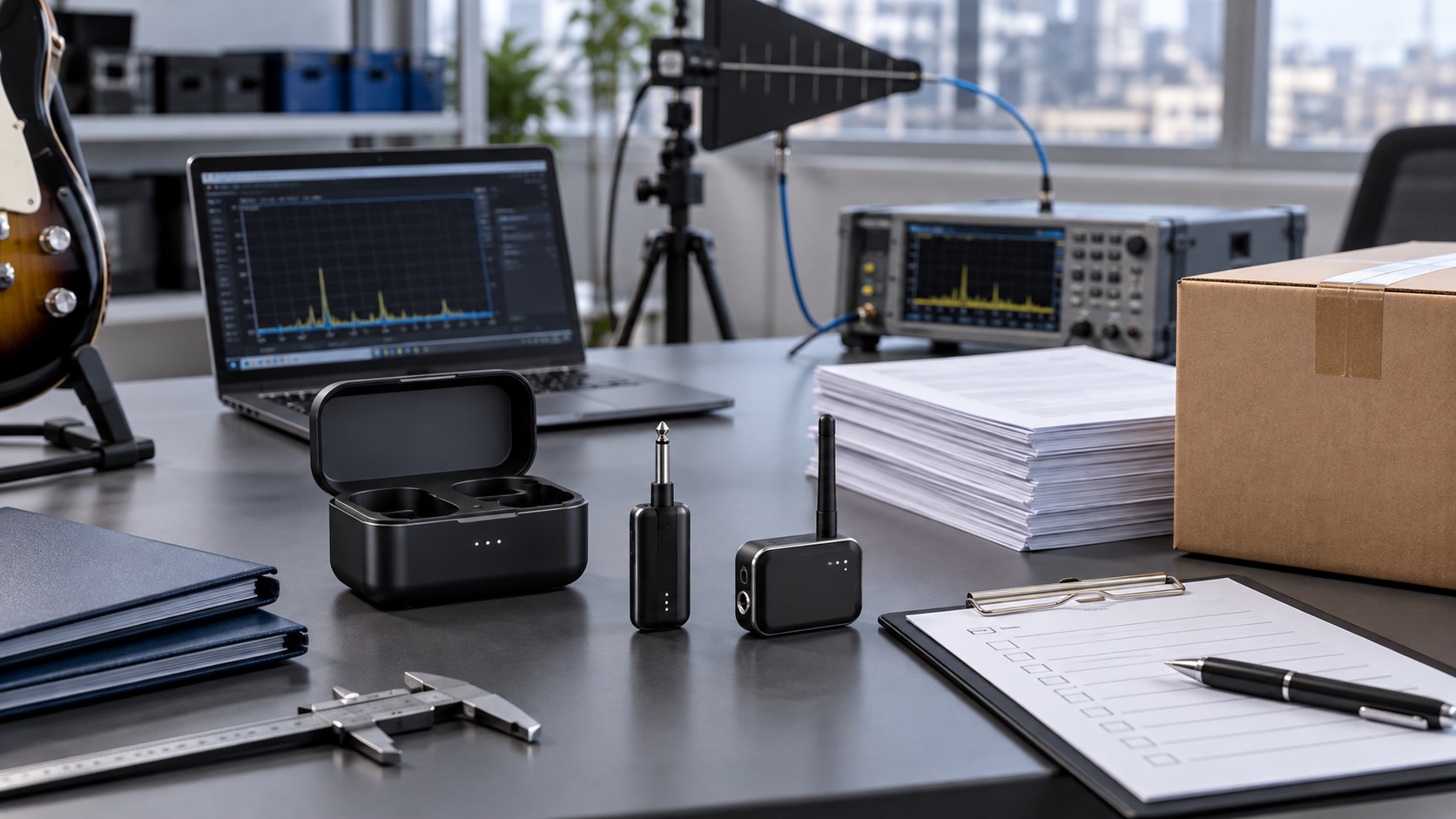
Editorial illustration: the product, radio configuration, battery and document register must describe the same revision.
Define the product and destination before requesting certificates
Do not start with “send all certificates.” Start with a product identity sheet and market list. Compliance scope depends on what the system is, where it will be sold and how it will be shipped.
Record:
- Product name, internal model number and retail model number.
- Transmitter, receiver and charging-case identifiers.
- Hardware and firmware revision where relevant.
- Radio frequency band and channel behavior.
- Antenna type and whether it is internal, external or replaceable.
- Power input, battery configuration and charging accessories.
- Audio connectors and supported instrument types.
- Intended countries, sales channels and importer entities.
- Packaging languages, labels and manual versions.
- Shipping route and whether batteries are installed or packed separately.
Ask the supplier to confirm which features are included in the quoted configuration. A catalog page may show optional charging cases, adapters or display functions that are not part of every model.
Build a document register instead of an email folder
A document register lets the buyer see gaps and prevent files from being mixed across models. Use one row for each document with fields such as:
| Field | Purpose |
|---|---|
| Document name and number | Identifies the file |
| Product/model covered | Links it to the order |
| Applicant, manufacturer and lab | Shows the parties named |
| Standard or regulation | States the evaluation basis |
| Issue date and revision | Helps detect outdated files |
| Hardware/firmware/battery reference | Confirms configuration relevance |
| Destination market | Shows where the file may matter |
| Review status | Requested, received, gap found or approved |
| Reviewer and date | Creates accountability |
| Open action | Records missing evidence or corrections |
Store the report, certificate or declaration behind the register entry. Avoid renaming files so aggressively that original document numbers disappear.
Radio and spectrum documentation
Wireless guitar systems intentionally transmit radio energy. Destination markets can set permitted bands, power limits, test methods, labeling and registration or authorization processes. A 2.4 GHz or 5.8 GHz description alone does not prove market acceptance.
Request evidence that identifies the exact operating frequencies, modulation or access method, channel behavior, output power, antenna and tested model. Compare those details with the sample and user manual. If users can select settings, confirm that prohibited configurations are not exposed in the destination version.
Check whether the applicant and manufacturer names match the commercial arrangement. Private-label products may need specific declarations, technical files or local responsible-party information. Do not copy a supplier’s certification mark onto new artwork until its relevance and permitted use are confirmed.
For the United States, European Union, United Kingdom, Canada and other markets, different radio frameworks and responsible-party duties may apply. The importer should use a qualified laboratory or compliance adviser to confirm current requirements for each destination rather than treating a previous shipment as permanent approval.
EMC and electrical safety questions
Radio testing and electromagnetic compatibility are related but not interchangeable. Ask which emissions and immunity evaluations apply to the complete system, including the charging case or supplied adapter where relevant.
If the product uses only low-voltage USB power, buyers sometimes assume there is no safety review. Battery charging, accessible connectors, overheating, insulation and included mains adapters can still require attention. If an adapter is supplied, identify its model and market approvals. If only a cable is included, packaging should not imply that every charger is compatible.
The technical file should explain input ratings, normal use, charging status, environmental limits and warnings. Compare those statements with the actual labels and manual.
Battery and charging records
Rechargeable transmitters, receivers and charging cases may each contain cells or packs. Ask for a battery schedule listing manufacturer, model, chemistry, nominal voltage, capacity, pack arrangement, protection and installation location.
Transport documentation often depends on the exact cell or battery and how it is shipped. Obtain the relevant test summary and shipping information for the selected configuration, then confirm applicability with the freight provider. Do not assume a test summary for one cell covers a substituted cell.
Charging documentation should identify connector type, input rating, supplied cable or adapter, charge time under stated conditions and whether the device can operate while charging. If a charging case is included, treat it as a controlled subassembly with its own battery, contacts, protection and indicators.
Require supplier notification before changes to the cell, pack, charging IC, connector, cable or adapter. These changes can affect performance, transport paperwork, labels and user instructions.
Restricted substances and material declarations
Destination markets and customers may request restricted-substance declarations, test reports or supplier material records. Ask what the file covers: one component, a bill of materials or the finished product. A generic statement without model, date or authorized signature may not support the buyer’s technical file.
Components to track include printed circuit boards, solder, cables, plastic housings, metal finishes, batteries and packaging. Private-label buyers should agree how updated declarations will be provided when components change.
Environmental obligations can also include product, battery or packaging registration and end-of-life responsibilities. These duties may belong to the importer or local responsible party rather than the factory. Confirm market-specific obligations with a qualified adviser.
Product labels and packaging artwork
Label review should happen before mass printing. Create an artwork checklist covering product model, electrical input, battery information where required, manufacturer or responsible-party details, country of origin, radio or compliance marks where authorized, recycling symbols, serial or lot code and warnings.
The transmitter, receiver, charging case, retail box and manual may not have identical space or marking requirements. Small devices may use alternate label methods only under defined rules. Do not assume the retail box can replace every device label.
Verify that the model shown on the report, declaration, label, manual and invoice is consistent. Hyphens, suffixes and private-label model names should be mapped clearly.
Packaging claims also need evidence. Avoid unqualified statements such as “zero latency,” “interference free,” “works worldwide” or a range value without test conditions. Marketing copy should reflect the approved product and realistic use environment.
User manual and installation information
The manual is part of the compliance and customer-support package. It should identify controls, indicators, charging method, compatible instrument connection, pairing, channel selection, storage, cleaning, troubleshooting and safe disposal.
For wireless systems, include guidance on:
- Correct transmitter and receiver orientation.
- Frequency or channel selection if user-accessible.
- Expected behavior in congested environments.
- Charging and low-battery indication.
- Use with active and passive pickups where supported.
- Cable or adapter requirements.
- Separation, ventilation and operating conditions.
- Destination-specific regulatory statements when required.
Translate safety and mandatory information with appropriate review. Mechanical translation can introduce ambiguous warnings or inconsistent model names.
Verify the sample against the documents
Document review cannot be separated from product review. Use the exact sample identifier and compare hardware, radio settings, antenna, connectors, battery, charging case and labels with the files.
Inspect device information screens or software only within the normal user interface. Record firmware version when it affects radio behavior or functions. If a test mode exists, it should be used only by qualified personnel under controlled conditions.
Conduct functional tests for pairing, audio, latency, noise, dropout behavior, range under stated conditions, battery indication and charging. These tests do not replace accredited regulatory evaluation, but they can reveal that the sample differs from the documented configuration.
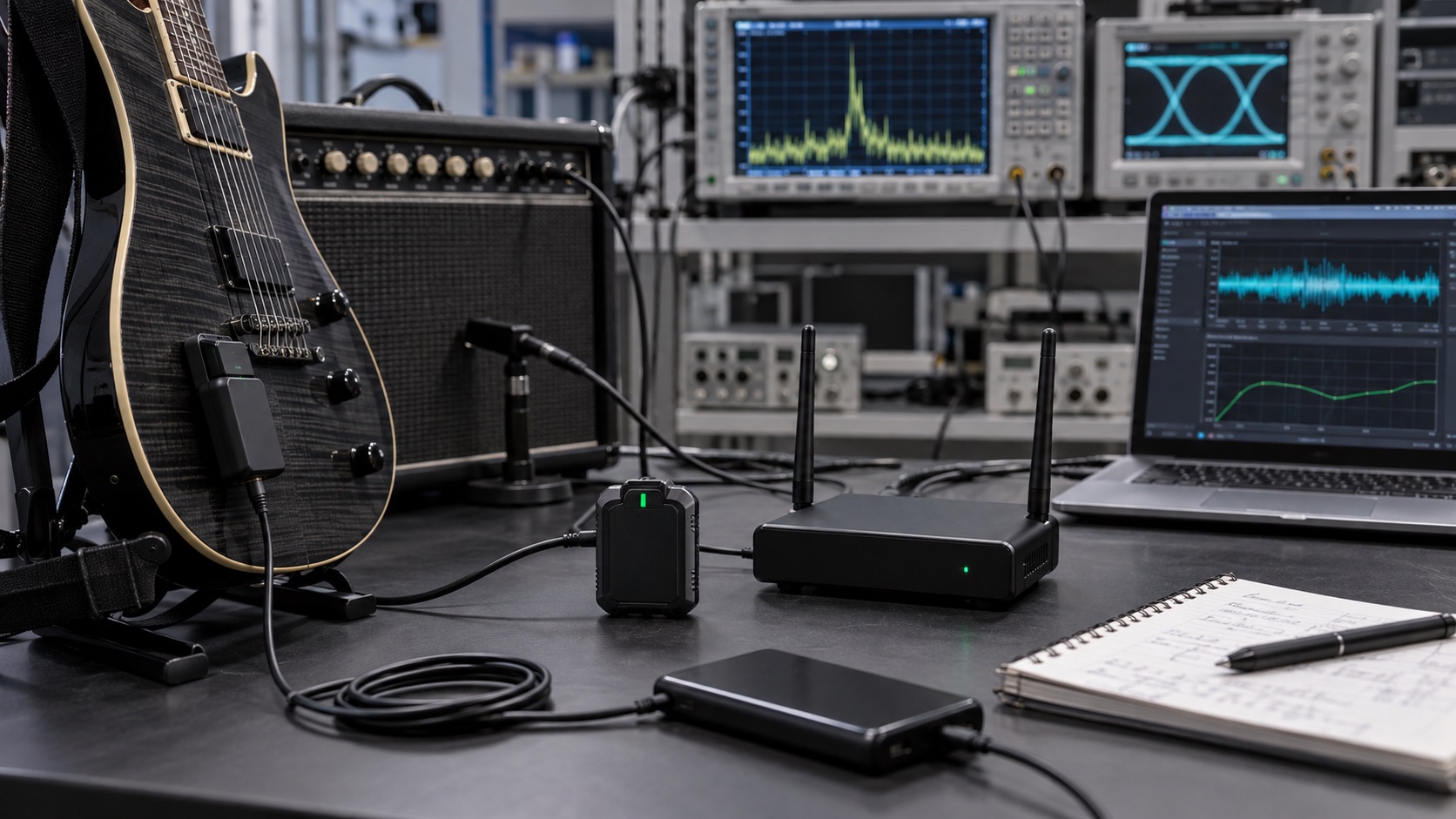
Editorial illustration: functional testing should confirm that the production-intent sample matches the documented radio configuration.
Preparing a wireless-system import order?
Send the target countries, radio band, charging configuration, packaging languages and expected quantity through Contact Us. Model availability and document scope must be confirmed for each destination.
Test reports: what importers should actually inspect
Receiving a PDF is not the same as completing a review. Check:
- Report number, date, page count and revision.
- Laboratory identity and relevant accreditation scope.
- Applicant and manufacturer named.
- Model numbers and family-model explanation.
- Product photographs and internal photographs.
- Radio module, antenna and operating modes.
- Power supply and battery used during tests.
- Standards and versions applied.
- Test results, limits and any deviations.
- Signatures or authorization and document integrity.
If several models are covered as a family, request the technical explanation showing why differences do not change the result. A similar enclosure color is not a technical family rationale.
Redacted reports may protect confidential information, but the buyer still needs enough evidence to connect the document to the ordered product. If the supplier cannot provide a complete file, ask the compliance adviser what alternative evidence is acceptable.
Declarations and certificate limits
Different markets use different combinations of testing, declarations, supplier documentation, registrations and certificates. The word “certificate” is often used loosely in sourcing conversations.
Identify what each file actually is. A declaration is a responsible party’s statement. A test report records evaluation. A certificate may be issued under a specific scheme. A transport test summary relates to battery transport evidence. One does not automatically replace another.
Confirm who is legally responsible for issuing or holding the document and whether private labeling changes the name or model mapping. Keep signed final versions in the technical file.
Production change control
Wireless products are especially sensitive to silent substitutions. A replacement radio module, antenna, crystal, amplifier, battery, charging IC, PCB layout, enclosure material or cable can affect the evidence set.
Include a written change-notification requirement in the purchase agreement. The supplier should describe the proposed change, reason, affected lots, implementation date and relevant retest or document update. The buyer should approve before shipment.
Link the final bill of materials and firmware to a product revision. Use a lot code or serial method that allows field complaints to be traced to the production configuration.
Pre-shipment inspection and file closure
Before shipment, verify product and documentation together:
- Model, frequency version and firmware where relevant.
- Transmitter, receiver and charging-case pairing.
- Battery and charging accessories.
- Product labels and retail artwork.
- Manual language and revision.
- Carton marks and quantities.
- Serial or lot-code format.
- Functional sampling and charging indication.
- Document-register status and unresolved actions.
- Shipping paperwork matching the actual battery configuration.
Do not close a document gap by changing the filename or adding a logo to artwork. If evidence is missing, resolve the technical or market question before shipment.

Editorial illustration: pre-shipment inspection should verify the same configuration approved in the technical file.
Market-specific review planning
Create a matrix with markets as columns and requirements as rows. Include radio authorization, EMC, safety, battery, restricted substances, recycling, labeling, manual language, local responsible party and registrations. Mark each item as confirmed, not applicable, pending or blocked.
Do not copy a matrix from an unrelated product. A plug-in receiver, rechargeable charging case and supplied mains adapter can create different questions from a simple battery-powered transmitter pair.
Review requirements again when adding a country. “Global version” is a commercial phrase, not proof that every band, label and registration is valid everywhere.
Commercial and logistics questions
Document work affects price and lead time. Ask whether the quotation includes existing reports only, document updates, private-label model mapping, new testing, local registration support or artwork review. Separate these items so offers can be compared fairly.
Confirm sample and production timelines around testing. Do not schedule mass production before the critical configuration is frozen. A late antenna or battery change can invalidate earlier work and printed packaging.
Share the battery configuration with the freight provider before booking. Confirm packing method, quantity limits, labels and documents for the chosen air, sea or courier route.
Common importer mistakes
Accepting a logo screenshot as evidence
A logo does not identify the tested model, standard or responsible party. Review the supporting file.
Using a report for a similar product
Model-family coverage must have a technical basis. Compare internal parts, antenna, radio settings and power.
Ignoring the charging case
A charging case can contain its own battery and electronics and must be included in the configuration review.
Printing packaging before document review
Model names, ratings, warnings and authorized marks may change during review.
Assuming one region’s evidence applies worldwide
Radio, labeling and responsible-party requirements vary. Review each destination.
Shipping after an uncontrolled component substitution
Battery, radio and antenna changes can affect both compliance and transport documents.
Frequently asked questions
What documents should an importer request for a wireless guitar system?
Request a model-specific register covering radio, EMC, safety as applicable, battery and transport, restricted substances, declarations, labels, manual, bill of materials and change control. Exact requirements depend on destination and configuration.
Is CE or FCC marking alone enough?
No. A mark is not a substitute for the underlying technical evidence, responsible-party duties and correct model labeling. Qualified advisers should confirm the applicable process.
Does a 2.4 GHz product work legally in every country?
Not automatically. Permitted frequencies, power, test methods, labels and authorization processes can differ. Review each destination.
What battery information should be checked?
Check cell or pack manufacturer and model, chemistry, voltage, capacity, protection, installation, relevant test summary, shipping configuration and change-control status.
Can a private-label brand use the supplier’s test reports?
Possibly, depending on the market, model relationship and documentation. The buyer should confirm model mapping, responsible-party roles and any declaration or registration changes with a compliance professional.
When should compliance review begin?
Begin before the sample and artwork are finalized. Early review can identify frequency, component, label or documentation gaps before mass production.
Conclusion
A reliable wireless guitar system import file is a chain of matching evidence. The ordered product, radio configuration, antenna, battery, charging accessories, labels, manual, reports and shipping documents should all point to the same controlled revision.
Review SoundSentry’s wireless instrument system category and send your sourcing brief with target countries, frequency band, charging configuration and order scope. Available models, documentation and commercial terms must be confirmed for each market.
Plan Your OEM/ODM Project
Share your target product, market, estimated quantity, branding, packaging and certification requirements with the SoundSentry Technical Team.
View Related Products Request Product Information or a Quote