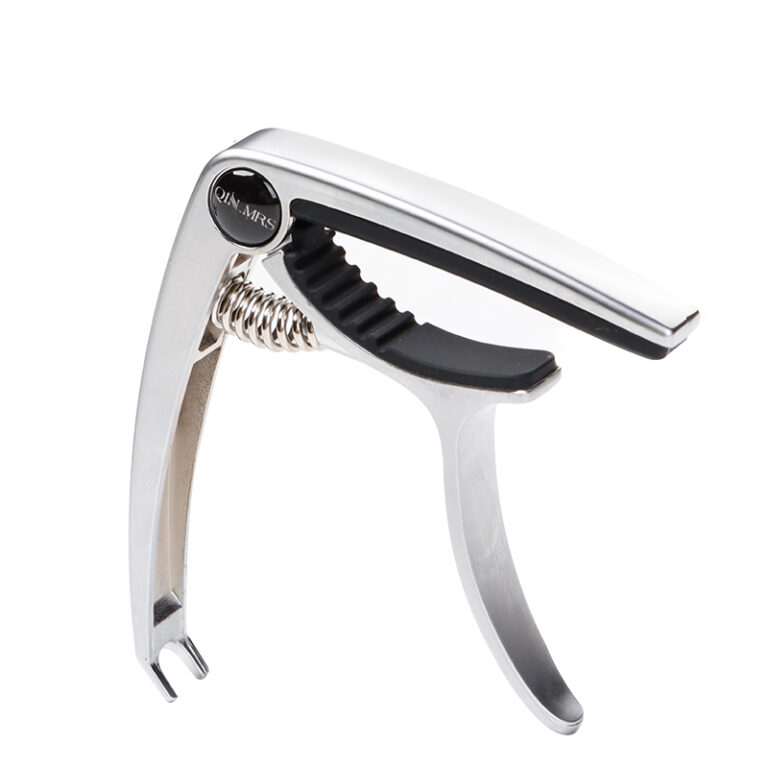
Aluminum vs Zinc Alloy Guitar Capos: A Wholesale Buyer’s Guide
Compare aluminum and zinc alloy guitar capos by weight, finish, clamp design, testing, packaging and private-label sourcing risk.
Quick answer: Aluminum and zinc alloy can both support commercially successful guitar capo programs. Aluminum is often selected for lower weight, clean anodized finishes and a technical appearance. Zinc alloy can support more substantial shapes, plated finishes and a heavier feel. Material name alone does not determine tuning stability, durability or perceived quality. Wholesale buyers should compare the complete capo: geometry, spring force, pad profile, hinge fit, surface finish, neck compatibility, packaging and production consistency.
A capo looks simple, but the buyer is purchasing a small mechanical system that must press six strings evenly without damaging the neck or pulling the instrument unnecessarily sharp. Two capos with similar photographs can behave very differently because of jaw curvature, pad hardness, spring selection, machining or casting tolerance, and assembly alignment.
This guide helps distributors, music-store buyers and private-label product managers compare aluminum and zinc alloy guitar capos without turning one material into a universal winner. It provides a practical specification, sample-test and production-inspection framework. Exact materials, finishes, dimensions, commercial terms and compatibility must be confirmed for the selected model.
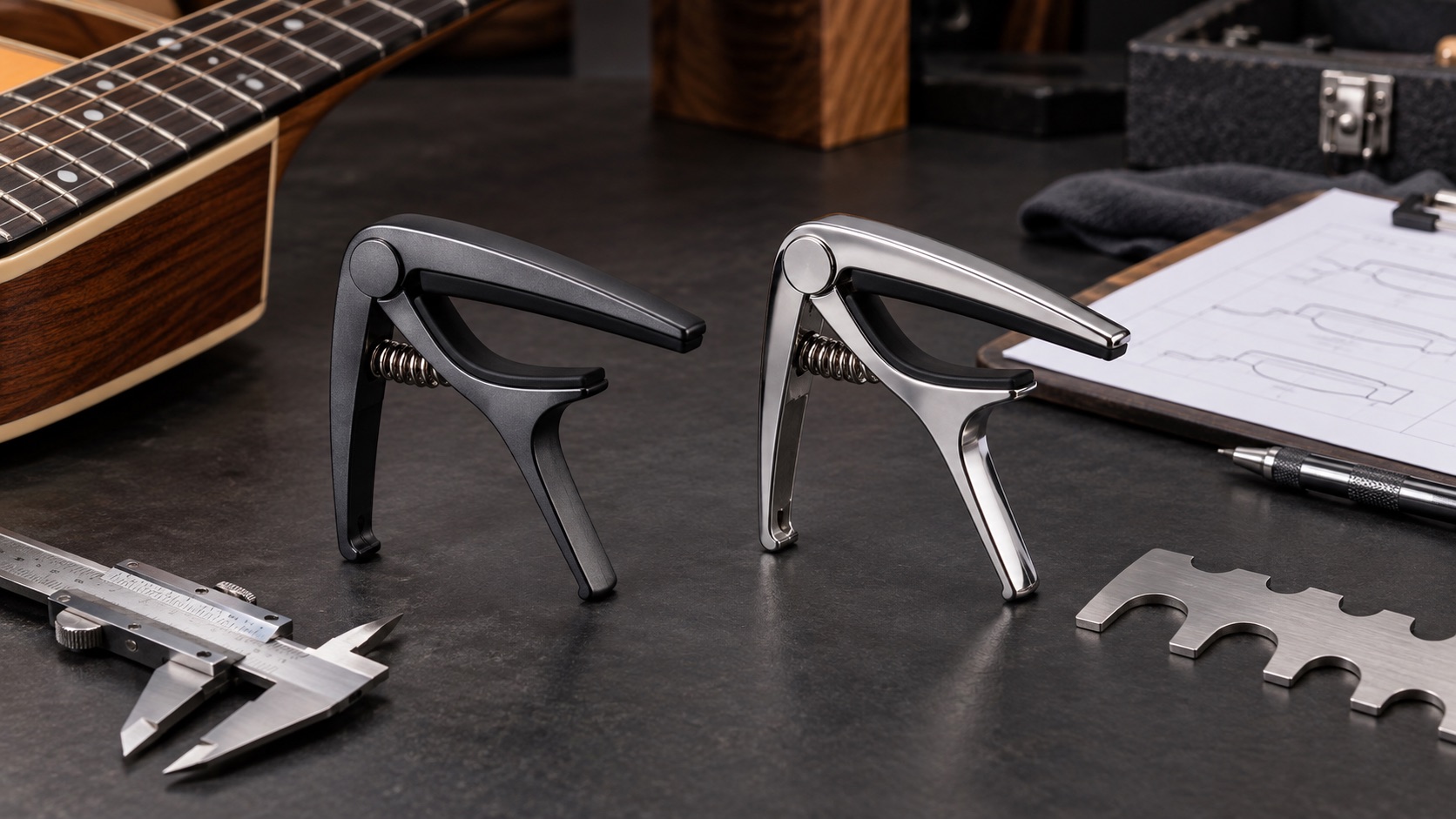
Editorial illustration: compare complete capo designs, not just the material named in a quotation.
Start with the target guitar and retail role
Before comparing materials, define who will use the capo and on which instruments. A low-cost acoustic accessory near the checkout counter has a different commercial brief from a premium private-label capo sold in a gift box. A classical guitar, a steel-string acoustic guitar and an electric guitar can have different fingerboard widths, radii, string tensions and neck finishes.
Write a short buyer-owned use-case statement that covers:
- Guitar types and neck profiles the product must fit.
- Expected retail price position and channel.
- One-hand operation requirements.
- Target product weight and visual style.
- Required finishes, colors and logo method.
- Retail packaging, barcode and manual needs.
- Mixed-color or mixed-model order expectations.
- Destination markets and restricted-substance documentation needs.
This brief prevents a common sourcing mistake: selecting a capo because its finish looks attractive in a catalog, then discovering that its pad, spring or curvature is unsuitable for the intended assortment.
What aluminum and zinc alloy mean in practice
“Aluminum capo” and “zinc alloy capo” are broad commercial descriptions, not complete specifications. Buyers should request the actual material grade or supplier declaration when it matters, the forming process, surface treatment and any component materials that contact the instrument.
Aluminum capo bodies
Aluminum bodies are commonly associated with die casting, extrusion or machined parts, depending on the design and price level. Aluminum can provide a favorable strength-to-weight relationship and works well with anodized or coated finishes. A lighter capo may feel unobtrusive on the neck and can reduce shipping weight across a large order.
However, “aluminum” does not guarantee precision. Thin sections can flex, porous castings can affect finish quality, and poor deburring can leave sharp edges. An anodized surface may vary in color between production lots. The buyer still needs dimensional control, spring selection and finish standards.
Zinc alloy capo bodies
Zinc alloys are often used for complex die-cast shapes and can produce a dense, substantial hand feel. They can support polished, plated, painted or textured surfaces. This can suit gift-oriented, vintage or visually decorative product lines.
The higher density generally makes a comparable capo heavier. Poor casting or plating control can create pits, bubbles, thin coverage or corrosion concerns. Weight may be perceived as premium by one customer and unnecessarily heavy by another. Again, the material is only one part of the design.
Compare the total assembly, not the bare frame
The main body may be aluminum or zinc alloy, while the pivot, spring, pin, screw, pad and grip materials are different. Ask the supplier to identify each functional part. A strong frame with an inconsistent spring or poorly bonded pad will still create returns.
Build a comparison table with at least these fields:
| Field | Why it matters | Evidence to request |
|---|---|---|
| Body material and process | Affects weight, form and finish options | Material declaration and process description |
| Net weight | Influences user feel and shipping | Measured approved sample |
| Jaw width and curvature | Determines neck and string coverage | Drawing plus measured sample |
| Spring specification | Controls clamp force and consistency | Controlled component specification |
| Pivot and pin construction | Affects alignment and cycle life | Drawing and sample inspection |
| String pad material/profile | Affects pressure distribution | Material and hardness range |
| Neck-contact pad | Protects instrument finish | Bonding and surface inspection |
| Surface treatment | Affects appearance and durability | Finish master and test method |
| Logo process | Affects legibility and wear | Artwork sample |
| Packaging | Prevents cosmetic damage | Packed sample and drop plan |
If a field is unknown, record it as pending. Do not replace missing supplier information with assumptions copied from another capo.
Weight, stiffness and user perception
Weight is easy to measure but easy to misinterpret. A lighter aluminum capo can feel modern and convenient. A heavier zinc alloy product can feel solid and visually substantial. Neither sensation proves that the product clamps evenly or lasts longer.
Measure several samples rather than one. Record net product weight and packed weight. Compare the distribution, not only the average. A surprising variation may indicate inconsistent casting, hardware or pads.
Check frame stiffness by applying and releasing the capo normally while observing jaw alignment. The test should not become an unsafe overload experiment. The purpose is to identify flex, twist or interference during intended operation. If the design depends on thin arms or a long lever, the supplier should define the controlled dimensions that protect alignment.
Clamp force and tuning stability matter more than material name
A capo must apply enough force to stop the strings cleanly, but excessive force can make operation difficult and pull notes sharp. The required balance depends on spring rate, lever geometry, pad shape, fret height, string gauge and neck profile.
Use a repeatable musical test on representative guitars:
- Tune the open guitar using a consistent tuner.
- Fit the capo at agreed fret positions, close to the fret but not on top of it.
- Check every string for clean sound and unwanted buzzing.
- Record pitch change without correcting the tuning first.
- Remove and refit the capo several times.
- Repeat on the neck profiles included in the product brief.
- Inspect the instrument-contact surfaces after testing.
The objective is not to claim that a capo never changes pitch. Fret height, setup, fingerboard radius, string condition and placement all influence the result. The objective is to compare samples under the same conditions and define an acceptable behavior for the intended product.
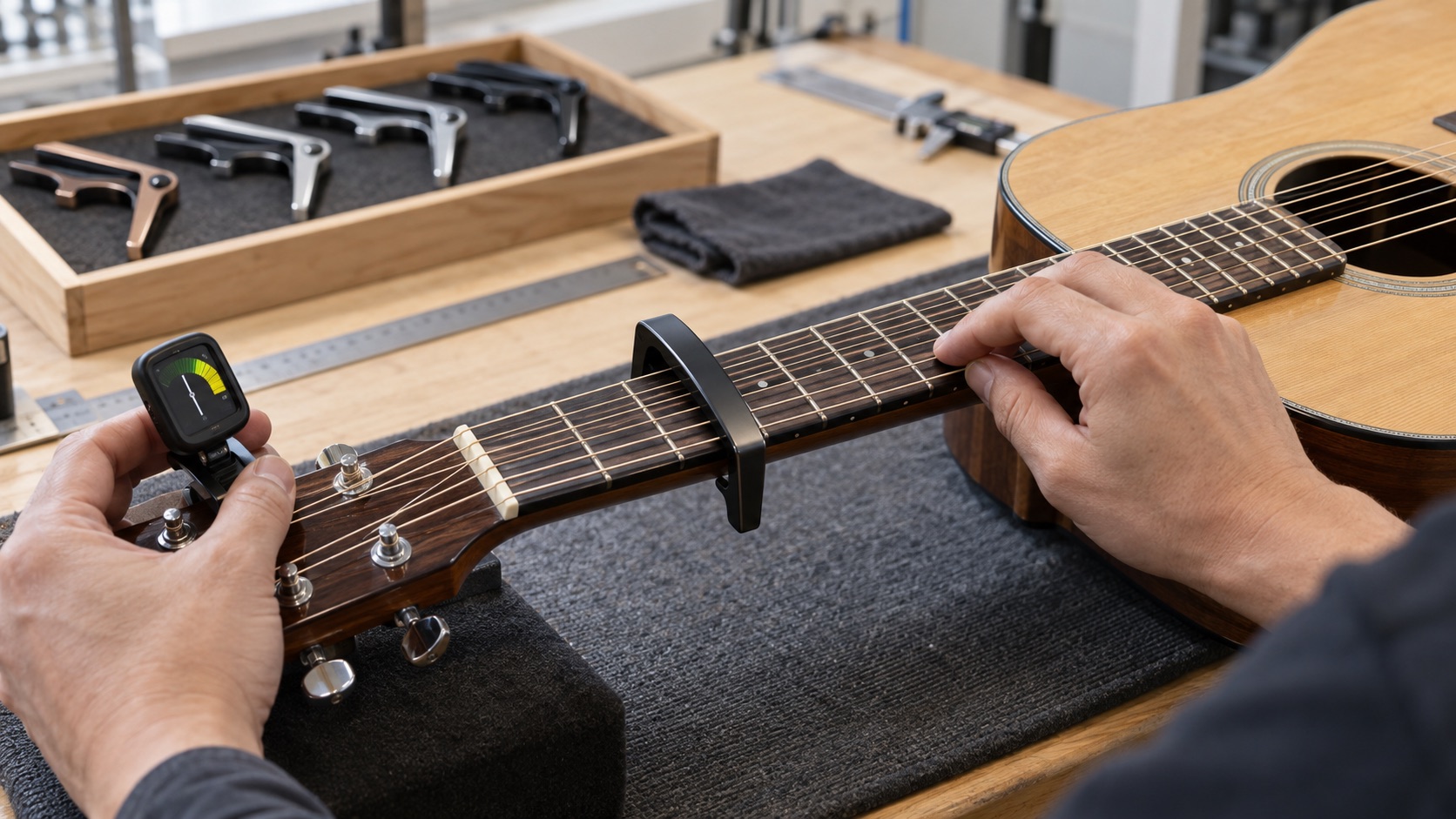
Editorial illustration: tuning and buzz checks should be repeated on representative neck profiles.
Developing a capo assortment?
Send the target guitar types, finish direction, packaging scope and planned quantity through Contact Us. Available platforms, logo methods and order terms must be confirmed for the selected model.
Pad design and neck protection
The string pad should follow the intended fingerboard profile closely enough to distribute pressure across all strings. Inspect the pad for molding marks, hard edges, contamination, gaps and inconsistent bonding. Compare hardness and resilience between samples. A pad that is too soft may deform or wear; a pad that is too hard may require more spring force and leave pressure marks.
The rear neck-contact pad also matters. It should cover the contact area, remain securely bonded and avoid exposed metal edges. Test on clean, representative instrument finishes and follow the guitar maker’s care guidance. No supplier should promise universal compatibility with every aged, damaged or specialty finish without evidence.
After repeated fitting cycles, inspect both pads for movement, tearing, compression set or adhesive release. Record the cycle method so later production samples can be compared with the approved reference.
Finish and color consistency
Aluminum and zinc alloy support different finish systems, but buyers should evaluate the actual production process rather than assume a material guarantees a look. Define color, gloss, texture and acceptable cosmetic boundaries using a signed physical sample or controlled reference.
Inspect high-visibility areas and hidden areas around pivots, springs and pads. Look for sharp edges, burrs, casting pits, coating buildup, incomplete plating, stains and color mismatch. Operate the capo repeatedly and check whether contact points scratch or chip under normal use.
For colored programs, agree how lots will be judged. Digital artwork and screen photographs are not reliable color masters. If exact brand color is important, the supplier should submit physical finish samples before packaging artwork is finalized.
Logo choice also affects durability. Laser marking, printing, embossing or attached badges have different limits. Approve size, position, contrast and wear expectations on the actual finish.
Durability testing for sample approval
Create a realistic test plan tied to the intended retail position. It may include repeated open-close cycles, pivot inspection, pad adhesion, spring consistency, controlled low-height handling tests and finish rub checks. Define the method and acceptance criteria before testing.
Avoid spectacular but meaningless demonstrations. A video of one capo supporting an extreme load does not prove that the product fits guitars, protects finishes or stays consistent across production. A better plan uses several samples and records the failures relevant to normal use.
After cycling, repeat the tuning, buzz and one-hand operation checks. Inspect spring noise, hinge looseness, side play and alignment. Compare the tested pieces with an uncycled control sample.
Acoustic, electric and classical guitar compatibility
Many steel-string acoustic and electric guitars can share a capo platform, but neck width and fingerboard radius still vary. Classical guitars commonly have wider, flatter fingerboards and different string behavior. Do not label one model “universal” without a compatibility basis.
A practical assortment may use separate models:
- Curved-pad capo for common steel-string acoustic and electric guitar applications.
- Wider or flatter model for classical or selected flat-radius instruments.
- Compact lightweight model for entry and travel channels.
- Premium finish model for gift or private-label positioning.
If one design is offered for several guitar types, list the tested neck-width and radius range instead of making an unlimited claim. Buyers can then match the product description to real sample evidence.
Packaging and private-label decisions
Capos are visually sensitive products. A loose item can rub against its own spring or neighboring parts during transport. Review the retail box, blister, pouch or insert with the actual finished capo. Confirm that the product cannot move enough to scratch high-visibility surfaces.
Packaging approval should cover:
- Product name and compatibility wording.
- Material wording that matches the selected body.
- Color or finish identification.
- Logo and artwork version.
- Barcode location and scan test.
- Country-of-origin and importer information where applicable.
- Care and placement instructions.
- Carton quantity, dividers and shipping marks.
Do not release “aircraft aluminum,” “premium alloy” or similar claims without a specific, supportable basis. Simple accurate descriptions build more trust than decorative material language.
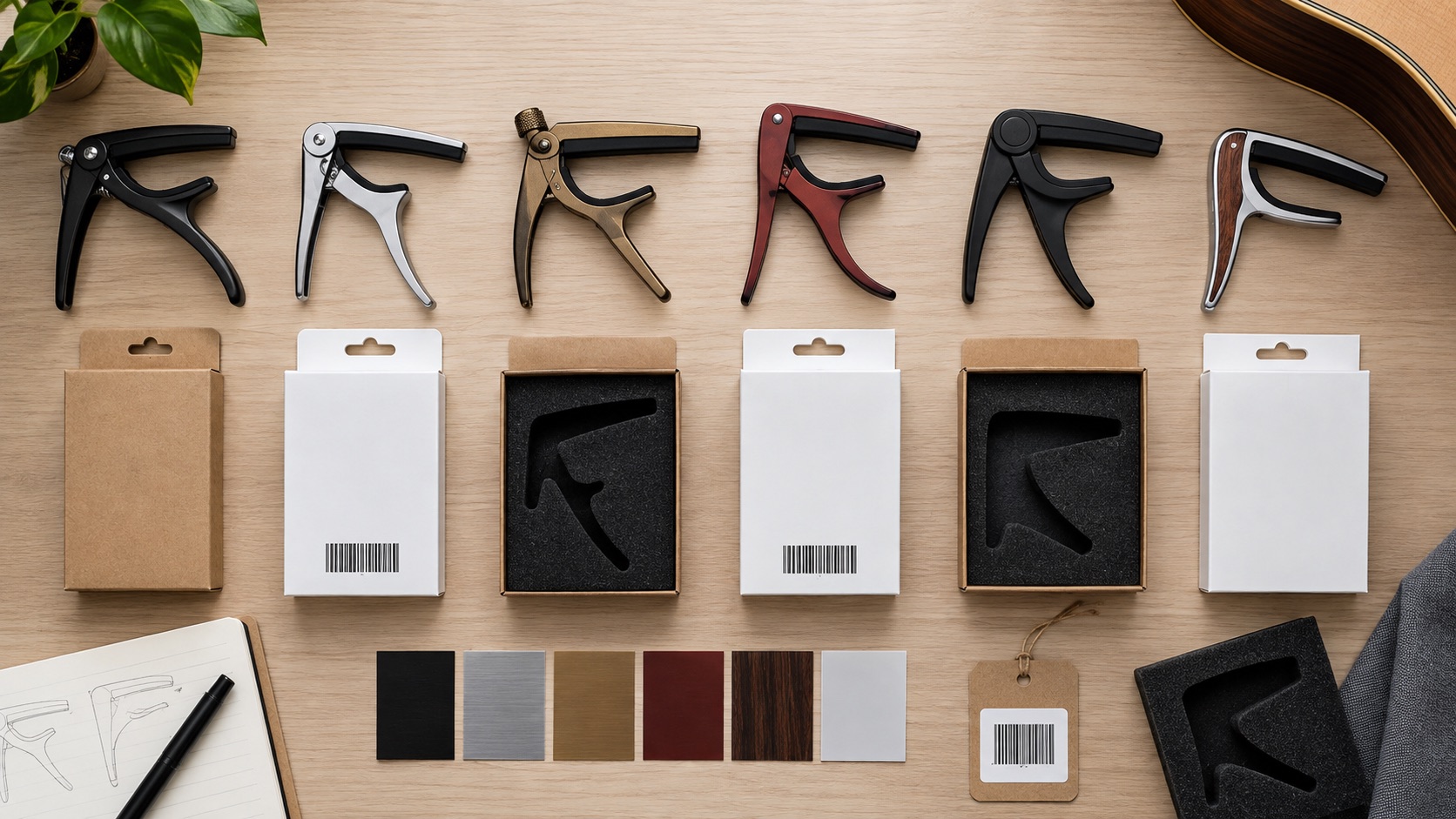
Editorial illustration: approve the product, finish and retail packaging as one controlled configuration.
Normalize wholesale quotations
Two capo quotations may include different springs, pads, finish processes, packaging and logo methods. Compare price only after the scope is normalized. Separate product cost, tooling, logo setup, packaging, insert, artwork changes, samples and inspection.
Record minimum order quantity by model, color and packaging version. A headline MOQ may apply only to the total order, while each color has a separate minimum. Confirm mixed-color rules, spare packaging, production lead time and replacement handling.
Ask how material or component substitutions are controlled. The purchase specification should require approval before changes to the body material, spring, pad, pin, coating or packaging. A visually similar substitution can change clamp behavior or finish durability.
Production inspection checklist
Use the approved sample and signed specification as the baseline. A practical pre-shipment inspection can include:
- Model, color, finish and logo confirmation.
- Dimensions and weight on a defined sample.
- One-hand operation and jaw alignment.
- Spring, pivot and pad installation.
- Fit, buzz and tuning checks on a reference neck or fixture.
- Cosmetic inspection under agreed lighting.
- Cycle or functional sampling when specified.
- Packaging, barcode, accessory and carton verification.
- Quantity and shipping-mark confirmation.
Define sample size and acceptance criteria in the purchase agreement. “Quality good” is not an inspection method. Each critical issue should have an observable pass/fail rule.
Common wholesale sourcing mistakes
Choosing only by product weight
Weight affects feel, but it does not prove clamp quality or durability. Evaluate geometry, spring force, pads and fit together.
Assuming every aluminum capo is premium
Material labels do not reveal casting, machining, deburring or finish control. Inspect the actual approved sample and production lot.
Calling one curved capo universal
Neck widths and radii vary. State tested compatibility and use separate models when necessary.
Approving a finish from a screen image
Use a physical color and surface reference for production control.
Ignoring packaging movement
An excellent finish can arrive scratched if the insert does not restrain the capo.
Frequently asked questions
Is aluminum better than zinc alloy for guitar capos?
Not universally. Aluminum is often lighter and works well with anodized finishes. Zinc alloy can support detailed shapes and a heavier feel. The better choice depends on the product brief, geometry, spring, pads, finish quality and retail position.
Which material is more durable?
Durability depends on the alloy, section thickness, casting or machining quality, pivot design, spring, coating and use. Compare finished samples with a defined cycle and inspection plan instead of relying on material name alone.
Do heavier capos stay in tune better?
Not necessarily. Tuning behavior is influenced mainly by clamp force, pad profile, placement, fret height, strings and neck geometry. Weight is not a reliable substitute for a tuning-stability test.
Can one capo fit acoustic, electric and classical guitars?
Some designs cover several steel-string acoustic and electric guitars, but classical necks are often wider and flatter. Confirm the tested range and avoid an unlimited universal-fit claim.
What should a private-label buyer approve before production?
Approve the complete configuration: body material, dimensions, spring, pivot, pads, finish, color, logo, packaging, compatibility wording and inspection criteria.
How should importers compare capo wholesale prices?
Normalize the specification and packaging first. Then compare complete scope, MOQ by variant, tooling, logo cost, sample charges, lead time, change control and replacement handling.
Conclusion
The aluminum-versus-zinc-alloy question is useful only when it leads to a complete product comparison. Wholesale buyers should connect material and process to measurable weight, controlled geometry, spring behavior, pad protection, finish quality, packaging and batch inspection.
Review SoundSentry’s current guitar accessory range and send your project requirements with target guitar types, finishes, branding scope and expected quantity. Product availability, sample options and commercial terms should be confirmed for the selected capo platform.
Plan Your OEM/ODM Project
Share your target product, market, estimated quantity, branding, packaging and certification requirements with the SoundSentry Technical Team.
View Related Products Request Product Information or a Quote