Before sourcing a wireless acoustic guitar pickup, define what “wireless” must do. It may describe Bluetooth backing-track playback, a wireless microphone function or a dedicated link carrying the live guitar signal. Those are different signal paths, and they should not be grouped under one unchecked feature.
This distinction matters for brands and distributors. A sample may pair with a phone perfectly and still send the guitar signal through a cable. That product is Bluetooth-enabled, but it is not automatically a wireless guitar transmitter.
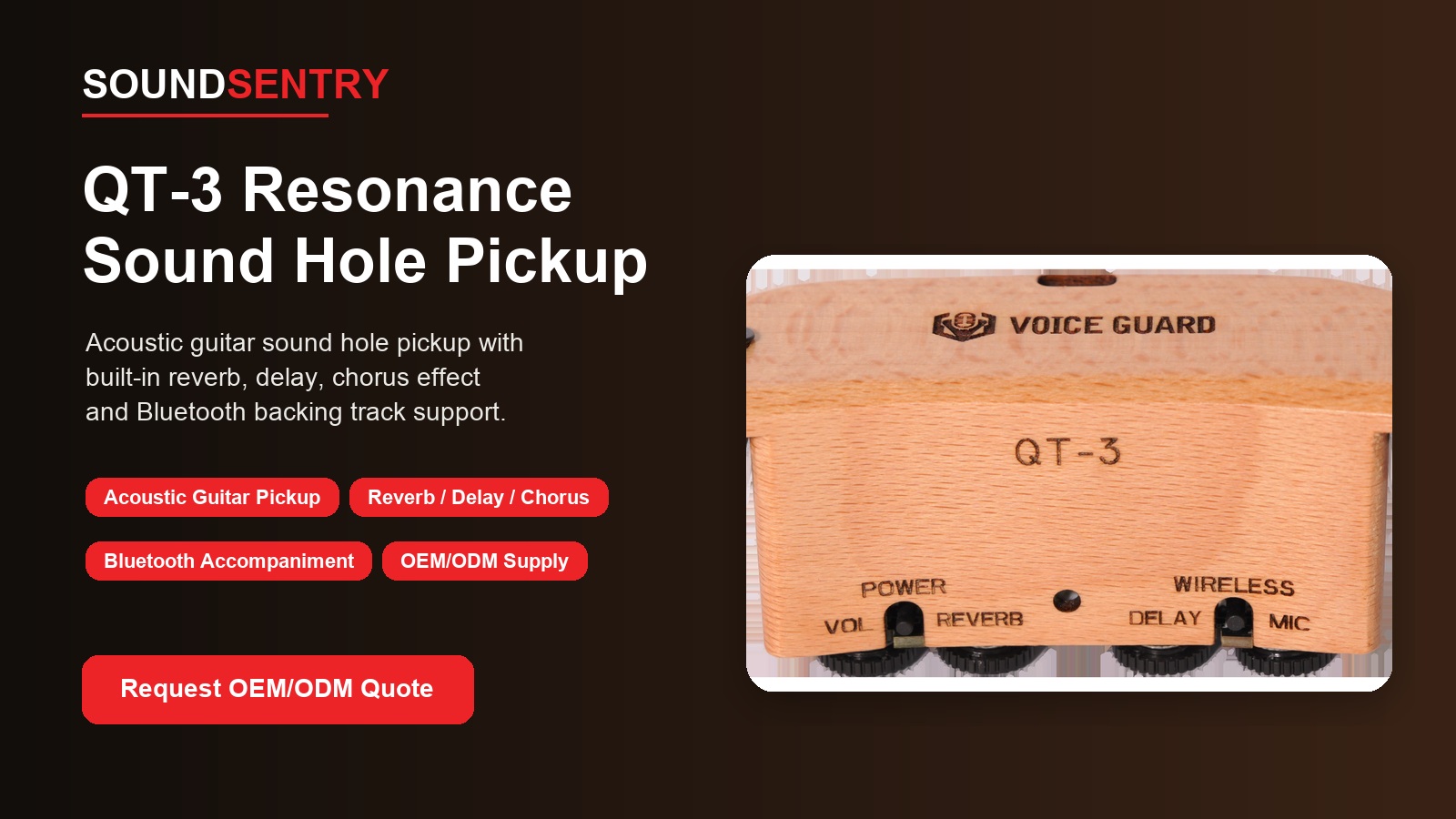
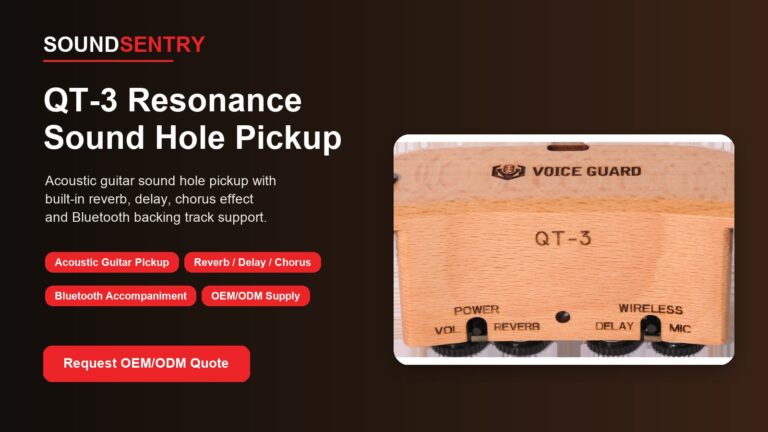
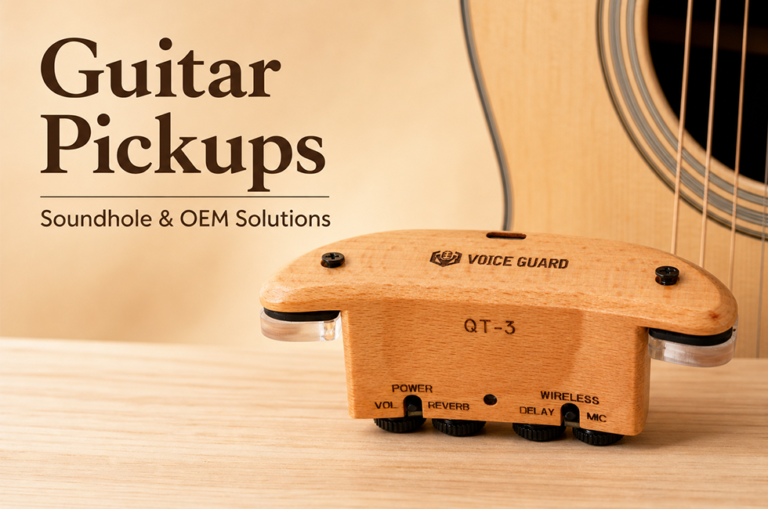
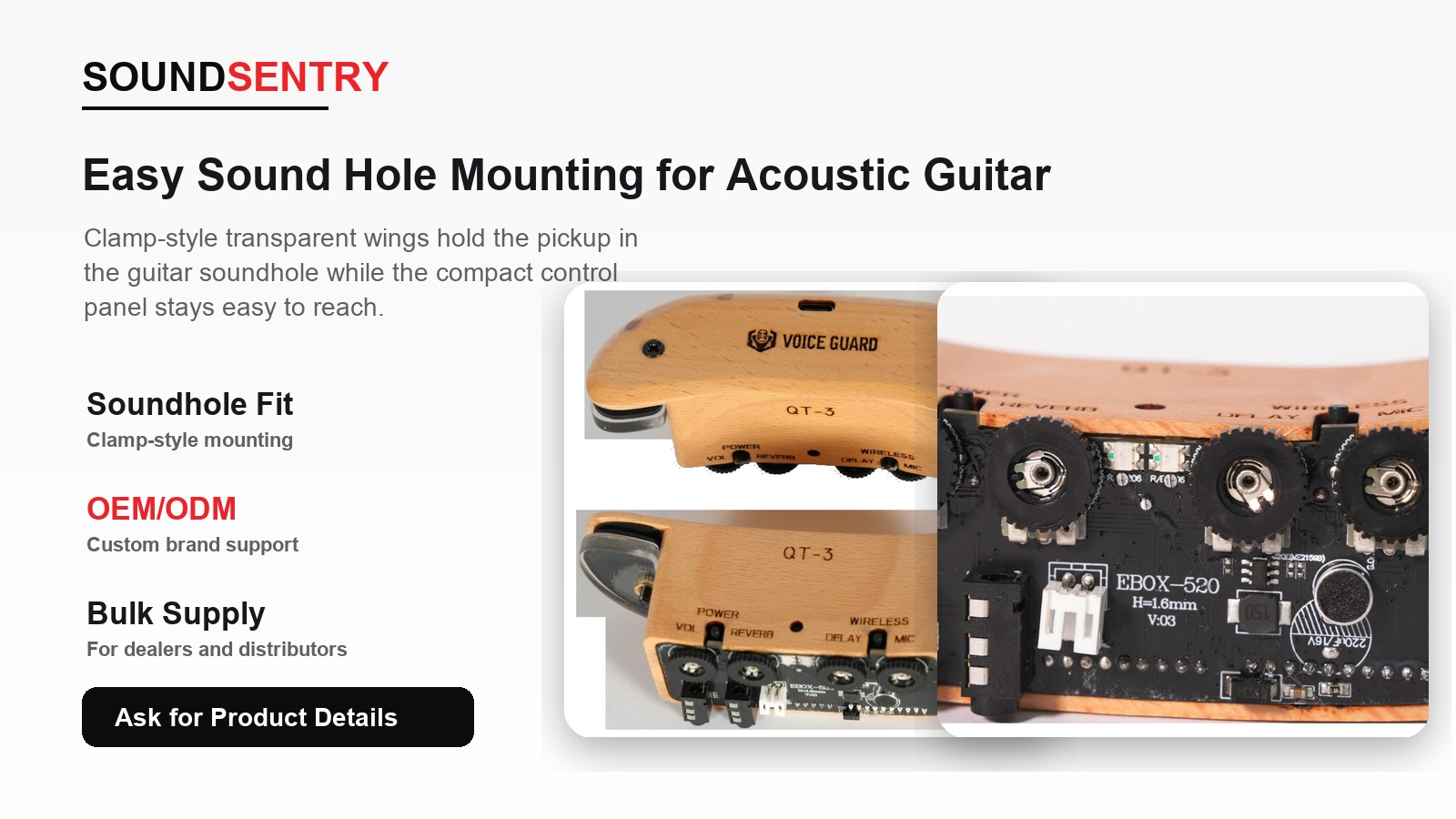
QT-3 is used here as an effects-equipped sound-hole pickup reference. Its Bluetooth function is backing-track playback, which should be specified separately from live guitar-signal transmission.
“Wireless pickup” can describe three different products
| Product architecture | What travels wirelessly | What the buyer must verify |
|---|---|---|
| Pickup with a conventional output | Nothing in the guitar signal path | Pickup fit, output, noise, controls and connection to the next device |
| Pickup with Bluetooth playback or control | Phone audio or control data | Pairing, reconnection, phone compatibility, level control and the exact audio-routing behavior |
| Pickup connected to a dedicated transmitter and receiver | Live guitar signal | Complete signal path, playing response, interference behavior, power, receiver output and multi-unit operation |
The product page, packaging and user manual should use the same description. If the front of the box says “wireless pickup” while the manual only describes Bluetooth music playback, buyers and end users will understand the product differently.
Draw the signal path before discussing components
A one-line block diagram can prevent several rounds of sample confusion. Start at the strings and end at the speaker, recording every stage in between.
For an effects-equipped sound-hole pickup, the path may include the pickup element, preamp, effects processing, output connection, amplifier and speaker. Bluetooth backing tracks may enter the system as a separate source that is mixed with the guitar signal. The live guitar path can still remain wired.
For a true wireless guitar link, add the instrument transmitter, radio connection and receiver. Then define where the receiver connects: amplifier input, pedalboard, mixer or another device.
Ask the supplier to mark these items on the diagram:
- the source of the live guitar signal;
- where pickup gain and effects are applied;
- what Bluetooth carries;
- where phone audio is mixed;
- whether a microphone is built in or connected separately;
- the output feeding the amplifier or PA;
- every battery or charging point.
If two people cannot describe the same signal path after reading the brief, it is not ready for sampling.
Bluetooth playback is useful—but name it accurately
Bluetooth backing-track playback is a practical function for lessons, home practice and product demonstrations. It lets the player add audio from a phone without connecting a separate music cable.
It should be tested as its own workflow:
- Pair representative phones.
- Restart the product and check reconnection.
- Play a backing track while the pickup is active.
- Confirm how phone level and guitar level are adjusted.
- Check what happens when a call or notification interrupts playback.
- Move out of connection range, return and observe recovery.
Do not use the Bluetooth version number as proof of the final experience. The implemented function, hardware, firmware, audio routing and phone behavior matter more to the buyer than the number printed in a feature list.
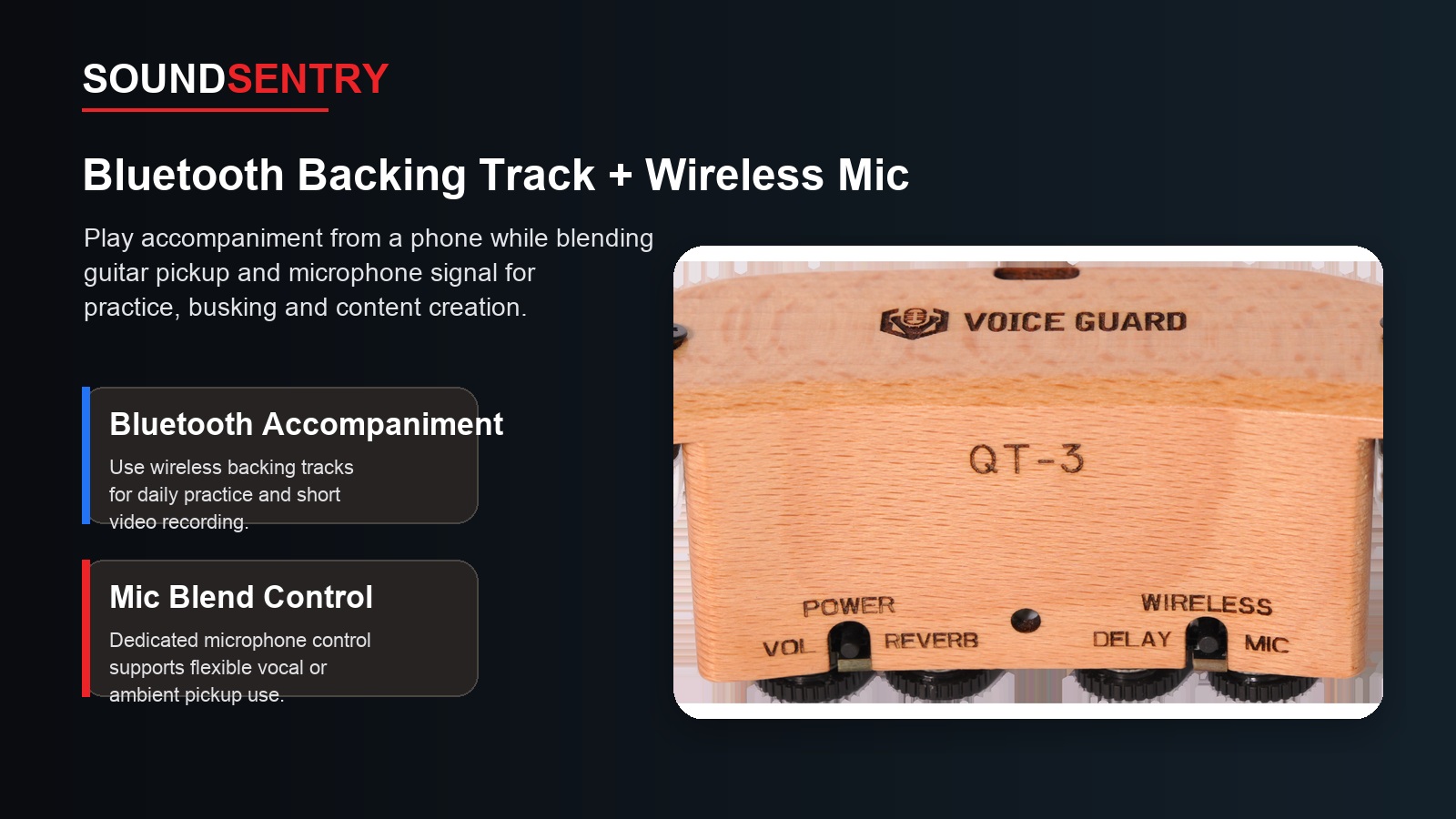
On the current QT-3 configuration, Bluetooth is specified for backing-track playback. The pickup, microphone and playback functions should be recorded separately in the sample-approval sheet.
A live wireless guitar signal needs a different test
When the player’s actual guitar signal travels wirelessly, the complete transmitter–receiver system becomes part of the instrument path. Approval should include both measurement and a practical playing test.
Define the test before the sample arrives:
- Which guitar and pickup output will be used?
- Where will response be measured from and to?
- Which amplifier, mixer or monitor completes the path?
- How many wireless systems must operate in the same room?
- What other phones, routers or radio devices will be active?
- What should the user hear during interference or reconnection?
- How will low-battery behavior be indicated?
Avoid adopting a fixed range, delay or battery claim from a module sheet. Confirm performance on the production-intent product and record the test conditions behind any public claim.
For more detail, see the wireless audio technology comparison and our wireless instrument system OEM buyer guide.
Fit still comes before wireless features
A sound-hole pickup must work mechanically before its electronic features matter. Acoustic guitars vary in sound-hole dimensions, rosette thickness, top shape, string clearance and the space available around the player’s picking hand.
Install the sample on representative guitars from the intended market. Check mounting stability, contact surfaces, cable or transmitter position and access to the controls. Photograph each installation and note the guitar used.
“No drilling” is a useful mounting approach, but it does not mean universal fit. A product return caused by poor fit will not be solved by adding another wireless function.
Our sound-hole pickup sample-approval checklist covers installation, tone, effects, controls, accessories and approval records in more detail.
Power planning changes with every added function
Pickup electronics, effects, Bluetooth playback, a microphone and a wireless transmitter may not share the same power demand or charging behavior. The buyer should identify which parts use the internal battery and which accessories require separate charging.
For a rechargeable product, agree on:
- charging connector and supplied cable;
- indicator behavior during charging and normal use;
- operation while charging, if required;
- low-power warning and shutdown behavior;
- storage instructions;
- the conditions used for any battery test.
State the test volume, effect use, Bluetooth use and wireless-transmission state when comparing battery results. Without those conditions, two battery tests may describe different products.
Use QT-3 as a function-definition example
The current QT-3 resonance sound-hole pickup combines sound-hole mounting, acoustic pickup operation, reverb, delay and chorus effects, Bluetooth backing-track playback and USB-C rechargeable operation.
For an OEM/ODM discussion, those functions should be approved one by one. Buyers should confirm guitar fit, effect response, pickup output, microphone behavior where selected, Bluetooth pairing, charging, accessories, logo, labels and packaging on the physical sample.
QT-3 should not be presented as proof that every Bluetooth pickup sends the live guitar signal wirelessly. If a project requires that function, add the transmitter–receiver architecture and its acceptance tests to the brief.
OEM sample-approval checklist
- Define “wireless” in one sentence.
- Draw the live guitar and Bluetooth signal paths separately.
- List the pickup, effects, microphone, playback and transmitter functions.
- Test fit on representative guitars.
- Record pickup output, noise, controls and effect behavior.
- Test pairing, reconnection and phone-audio mixing.
- Evaluate the complete transmitter–receiver path if live guitar audio is wireless.
- Define power, charging and low-battery behavior.
- Confirm accessories, labels, manual language and packaging.
- Review destination-market documentation before freezing the sample.
Lay out the pickup, mounting parts, charging accessories and packaging items together before approving the sample.
Frequently asked questions
Does Bluetooth in an acoustic pickup mean the guitar signal is wireless?
No. Bluetooth may be used for backing-track playback, app control or another function while the live guitar signal remains wired. Confirm the signal path and user workflow instead of relying on the Bluetooth label.
What should an OEM buyer test for a wireless guitar signal?
Test the complete transmitter–receiver path with the intended guitar, output device and monitoring setup. Include playing response, interference, reconnection, power behavior and operation with multiple systems where required.
Can one pickup combine effects, Bluetooth and wireless guitar transmission?
It can be discussed as a product architecture, but each function adds hardware, firmware, power, testing and compliance considerations. Confirm the available configuration during engineering and sample evaluation.
What information should be included in the inquiry?
Send the target guitar types, required pickup and wireless functions, intended use environment, branding, accessories, packaging, destination market and estimated order quantity. Separate required functions from features that are open to engineering review.
Prepare the inquiry around the signal path
SoundSentry Music develops guitar pickups, wireless instrument systems, amplifiers and effects products for OEM/ODM and private-label projects. Browse our guitar pickup range and wireless instrument systems, then send the intended signal path and product requirements through our contact page.
We will use that information to confirm which functions should be included in the sample and quotation. Product specifications, documentation and project timing are confirmed for the agreed configuration.
Plan Your OEM/ODM Project
Share your target product, market, estimated quantity, branding, packaging and certification requirements with the SoundSentry Technical Team.
View Related Products Request Product Information or a Quote