Wireless Audio Solutions for Guitars: WiFi vs Bluetooth vs Proprietary
OEM Buyer Summary
This comparison helps OEM buyers select a wireless technology according to application, latency, range, power, pairing and product-cost requirements.
The right wireless technology depends on what the product must carry. Backing-track playback, app control and a live guitar signal are three different jobs. Treating them as one feature is how product briefs become confusing and samples fail the wrong test.
For most OEM projects, the first decision is not “Which wireless standard is best?” It is “What must happen wirelessly, and what delay or interruption would the player actually notice?”
The short answer
- Bluetooth is usually the practical choice for phone compatibility, backing-track playback and some control functions.
- WiFi makes sense when the product needs network-based audio, higher data capacity, software integration or communication between several connected devices.
- A dedicated wireless link is usually evaluated for live instrument transmission, where the transmitter and receiver are designed as one system and the playing response must remain predictable.
None of the three is automatically better. A practice amplifier and a stage transmitter solve different problems, even when both are described as “wireless.”
Start by defining the signal
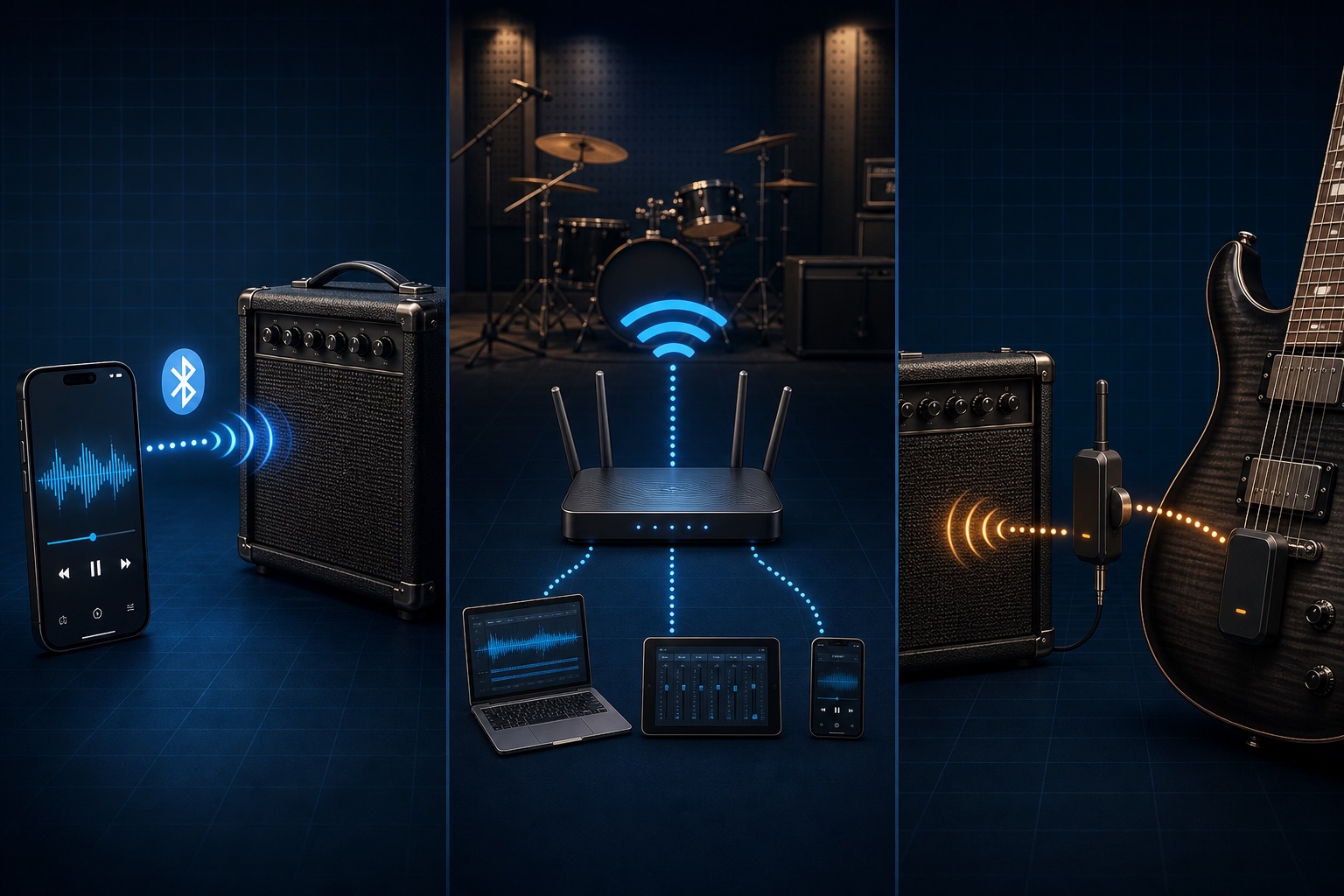
Before selecting a module or protocol, write down what travels over the link.
| Wireless job | What the user expects | First route to evaluate |
|---|---|---|
| Phone music or backing tracks into an amplifier | Easy pairing and broad phone compatibility | Bluetooth audio playback |
| App-based editing or control | Stable connection and clear reconnect behavior | Bluetooth data/control or WiFi, depending on the app architecture |
| Live guitar signal from instrument to amplifier | Responsive playing feel and reliable recovery from interference | Dedicated instrument wireless link |
| Audio shared across rooms or networked devices | Network discovery, synchronization and software support | WiFi-based audio |
| Firmware update or product setup | Safe update process and clear failure recovery | Bluetooth or WiFi data connection |
This table is a starting point, not a final specification. The same product may use more than one radio function. If so, each function should have its own requirement and test case.
When Bluetooth is the sensible choice
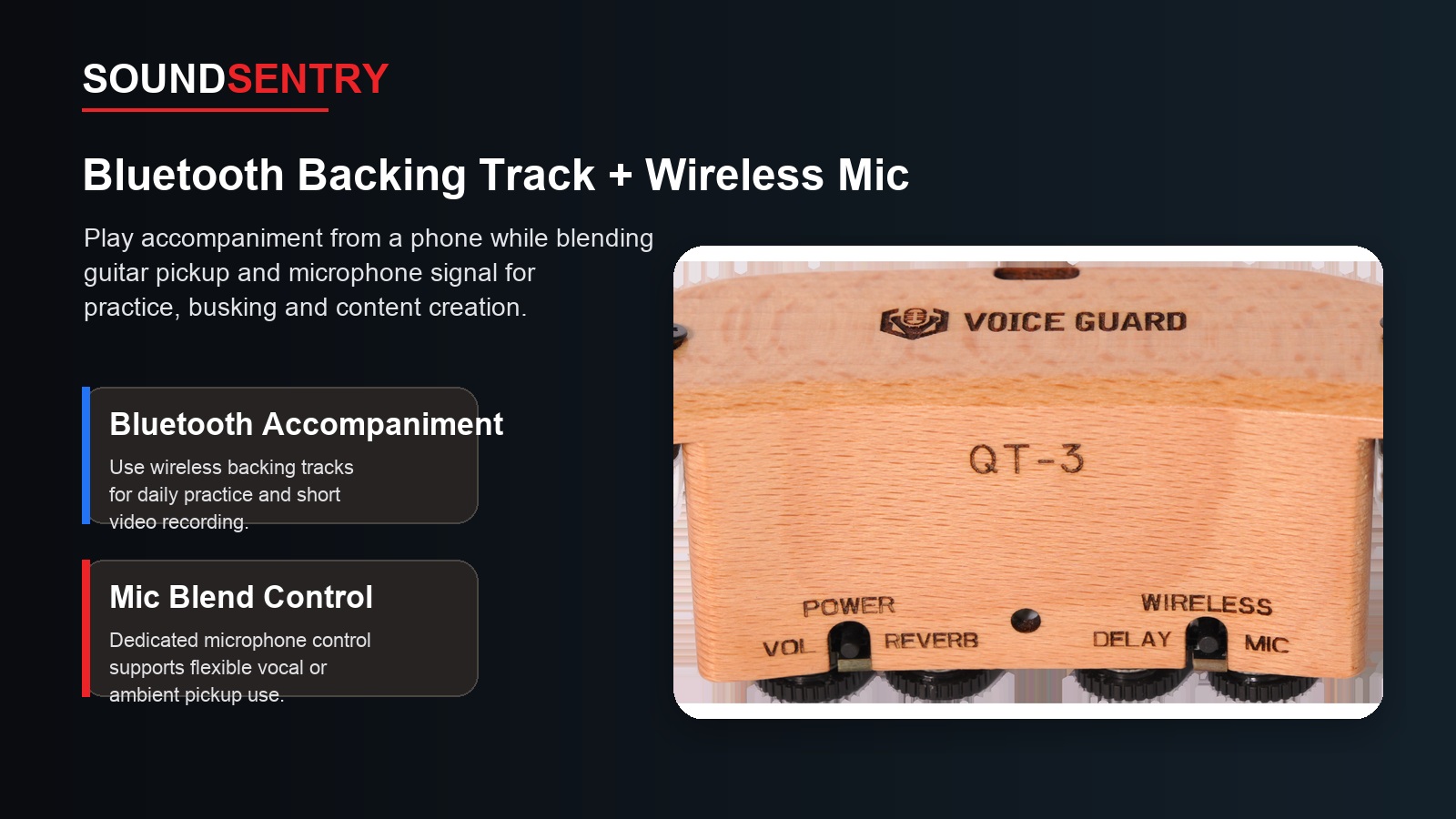
Bluetooth is familiar to end users and well suited to consumer-device interaction. In a guitar amplifier, it can let a player stream a lesson, drum loop or backing track from a phone. It can also support app control where the hardware and software have been designed together.
That does not mean a product labelled “Bluetooth” can carry a live guitar signal without noticeable delay. Bluetooth version numbers, codec names and module data sheets do not prove the response of the finished product. The complete path matters: source device, radio implementation, buffering, audio processing and output stage.
An OEM buyer should therefore specify the Bluetooth function in plain language:
- Play music from a phone through the amplifier.
- Adjust effects or presets through an app.
- Send control or MIDI data.
- Carry the live instrument signal.
These statements lead to different hardware, firmware and validation work. If the supplier simply writes “Bluetooth supported,” the requirement is not complete.
When WiFi deserves consideration
WiFi becomes relevant when the product belongs to a wider connected system. It can support network discovery, software updates, cloud or local services, multi-device communication and audio distribution. It also introduces more variables than a closed transmitter–receiver pair.
The user’s router, network traffic, setup flow and software maintenance can all affect the experience. For this reason, WiFi should not be chosen only because it appears to offer more bandwidth or range on paper. The buyer also needs to define:
- whether the product works without internet access;
- how it joins or changes networks;
- what happens when the network disappears;
- which phones, computers or routers must be supported;
- who maintains the app, firmware and security updates;
- whether several devices must stay synchronized.
For real-time playing, evaluate the complete implementation under realistic network conditions. A controlled bench demonstration is not enough to establish stage performance.
Why dedicated guitar wireless systems are different
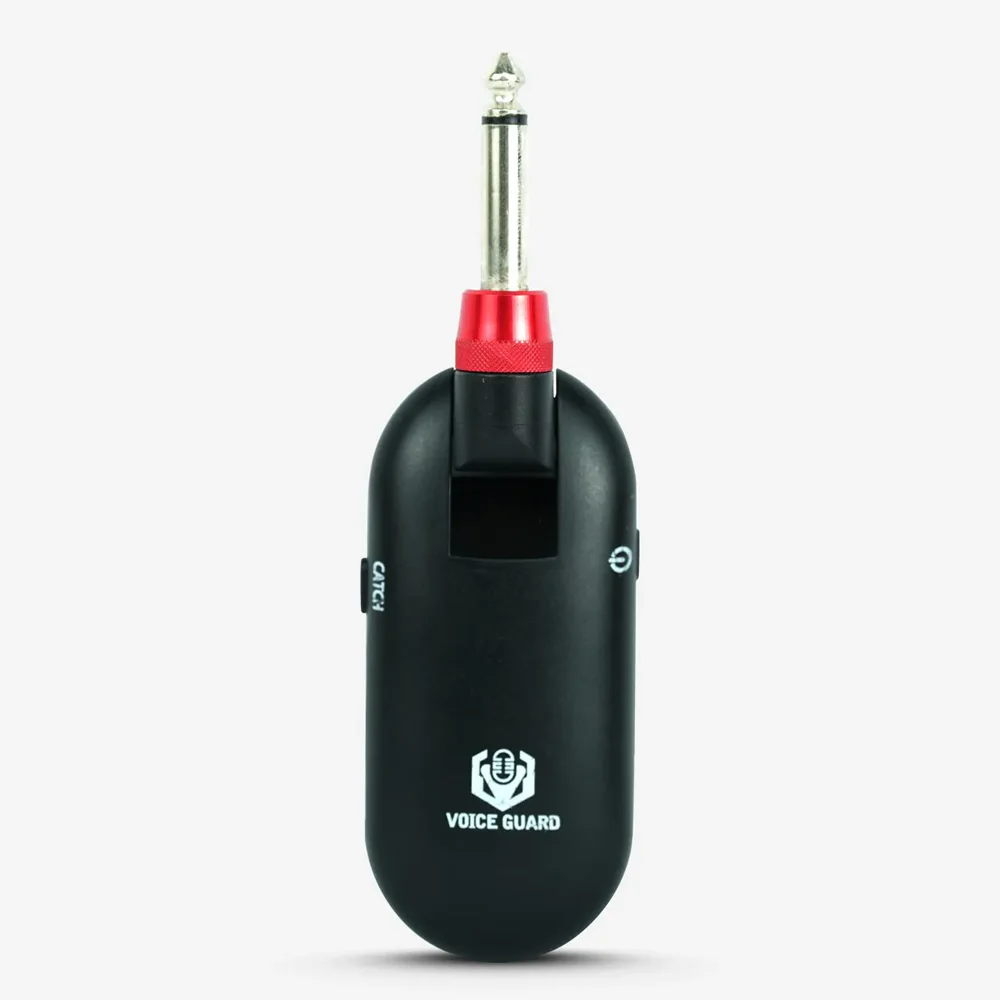
A dedicated instrument system normally includes a transmitter and receiver designed to work together. The system does not need to accept audio from every phone or computer. That narrower job gives the product team more control over pairing, buffering, channel behavior and the audio path.
This architecture is often the first one to evaluate for live guitar transmission. It is not automatically immune to interference, and its range cannot be judged from a frequency label alone. Antenna position, the player’s body, nearby radio traffic, obstructions, power management and receiver placement all matter.
For an OEM project, the useful questions are practical:
- Does the system reconnect without an audible surprise?
- What happens when several systems operate in the same room?
- Does the transmitter fit different guitar jack positions?
- Is the receiver output appropriate for the intended amplifier or pedalboard?
- Can the battery state be understood before a performance?
- Are charging, storage and low-battery behaviors clearly defined?
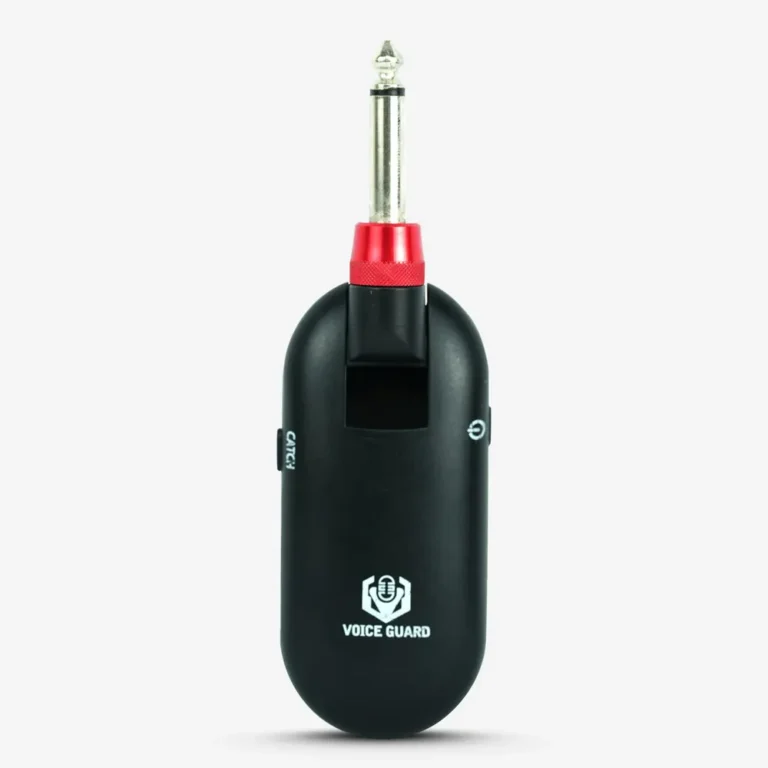
SoundSentry Music’s wireless instrument systems can be evaluated as product references, but the function and test result must be confirmed for the exact model under discussion.
A better way to compare wireless options
Avoid a table that declares one technology the winner in every category. Use a project-specific scorecard instead.
1. Playing response
Define the signal path and the measurement points. Test end-to-end delay in the finished product, not only the radio module. Then add a player evaluation using the intended instrument and monitoring setup.
2. Operating environment
Write down where the product will be used: bedroom, classroom, retail demonstration area, rehearsal room or stage. Include nearby phones, routers and other wireless systems in the test environment.
3. Pairing and recovery
Time the first connection, reconnection and recovery after power loss or interference. Check what the user hears during each event. A fast radio link can still create a poor product if the pairing flow is unclear.
4. Power and charging
Confirm the power source, charging connector, indicator behavior, low-power warning and storage mode. Battery claims should be measured on the production-intent configuration and recorded with the test conditions.
5. Market requirements
Radio functions affect the compliance route. Define the intended sales markets before approving the design, and confirm documentation for the exact product rather than relying on a component label. See our electronic product certification guide for the questions to prepare.
What to put in an OEM wireless brief
A useful brief can fit on one page if the decisions are specific:
- Product type and target user.
- Wireless job: live audio, playback, control, update or a combination.
- Transmitter and receiver form factor.
- Required inputs, outputs and connector orientation.
- Pairing and multi-unit behavior.
- Test environment and acceptance method.
- Battery, charging and indicator requirements.
- Branding, finish and packaging.
- Intended sales markets and documentation needs.
- Estimated order quantity for quotation and planning.
The specification should distinguish “required,” “preferred” and “open for engineering review.” That gives the supplier room to recommend a workable architecture without quietly changing a critical use case.
Frequently asked questions
Is Bluetooth suitable for a live guitar signal?
Do not decide from the Bluetooth label alone. Standard phone-to-speaker playback and real-time instrument transmission are different applications. If live guitar audio is required, test the complete product for end-to-end delay, stability and recovery under the intended conditions.
Is WiFi better because it has more bandwidth?
Not necessarily. Bandwidth is only one part of the design. Network setup, traffic, buffering, synchronization, software support and power use can be more important to the finished experience.
When should an OEM buyer consider a dedicated link?
Consider it when the transmitter and receiver can be treated as one system and the main job is predictable live instrument transmission. The decision still requires product-level testing and target-market compliance review.
Plan the product around the use case
SoundSentry Music develops electronic music products including guitar wireless systems, amplifiers, pickups and effects products. To discuss a wireless project, send the target use case, intended markets, connector format, required functions, branding and estimated quantity through our contact page.
We will use those details to identify the questions that should be resolved before sampling. Model-specific specifications and documentation are confirmed during the OEM/ODM evaluation.
Plan Your OEM/ODM Project
Share your target product, market, estimated quantity, branding, packaging and certification requirements with the SoundSentry Technical Team.
View Related Products Request Product Information or a Quote
OEM Buyer Checklist
- Define whether the link carries live instrument audio, control data or backing tracks.
- Set an acceptable latency target and test method.
- Define range and interference test conditions.
- Compare power and battery implications.
- Review pairing and multi-device behavior.
- Confirm target-market radio requirements.
Continue with our OEM/ODM process, quality-control approach, certification guidance or request model-specific information.
Frequently Asked Questions for OEM Buyers
Is Bluetooth audio always suitable for live guitar transmission?
No. Standard Bluetooth audio playback and a dedicated low-latency instrument link serve different use cases and should be evaluated separately.
When is a proprietary wireless link useful?
It can be considered when a product requires tighter control of latency, pairing or system behavior, subject to design and market requirements.
How should an OEM buyer choose a wireless approach?
Start with the use case, acceptable latency, range, power, interference environment, product cost and target-market requirements.