Wireless Guitar System OEM Buyer Guide for Brands
A B2B guide for wireless guitar transmitter and receiver OEM projects, covering latency, range, battery life, interference, charging, QC and sample testing.
OEM Buyer Summary
This guide helps brands translate a wireless guitar-system concept into a buyer specification, sample test plan and OEM quotation request.
Wireless Guitar System OEM Buyer Guide: Latency, Range, Battery and Real-World Testing
A wireless guitar system is easy to sell when the promise is simple: no cable, more freedom, clean signal. It is also easy to disappoint customers if the product is not tested properly. Guitar players notice latency, dropouts, weak batteries, noisy output, and fragile plugs very quickly.
For OEM and private label buyers, a wireless guitar transmitter and receiver project should be judged by real use, not only by a specification sheet. The product may look small, but it needs solid RF design, stable pairing, reliable charging, and consistent audio performance.
This guide explains what buyers should decide before ordering samples and what to test before mass production.
Latency Is the First Question
Latency means the delay between playing a note and hearing the sound from the amplifier. For guitar, even a small delay can feel uncomfortable. Players may not know the exact number in milliseconds, but they will feel when the response is slow.
For most wireless guitar systems, buyers should look for low-latency performance suitable for practice and live use. The supplier should be able to provide a tested latency figure and explain the test method.
Ask:
– What is the total system latency?
– Is the number measured from input to output?
– Was it tested with the final hardware?
– Does latency change when the battery is low?
– Is latency consistent across units?
Do not rely only on “low latency” wording. Ask for a number and then test the sample with actual playing.
Range Claims Need Realistic Testing
Wireless range is often advertised under ideal conditions. In real use, the player may be in a rehearsal room, on a small stage, near phones, Wi-Fi routers, metal stands, pedals, and other wireless devices. These conditions can reduce stability.
During sample testing, check range in three situations:
– Open room with clear line of sight
– Rehearsal room with people and equipment
– Retail or home environment with Wi-Fi nearby
Walk around while playing. Turn your body. Put the transmitter at different angles. Check for short dropouts, noise bursts, or tone changes.
For most customers, stable usable range is more important than the biggest possible distance. A product that works reliably at a normal stage distance is better than a product that claims a long range but drops out in daily use.
2.4GHz Is Common, But Interference Matters
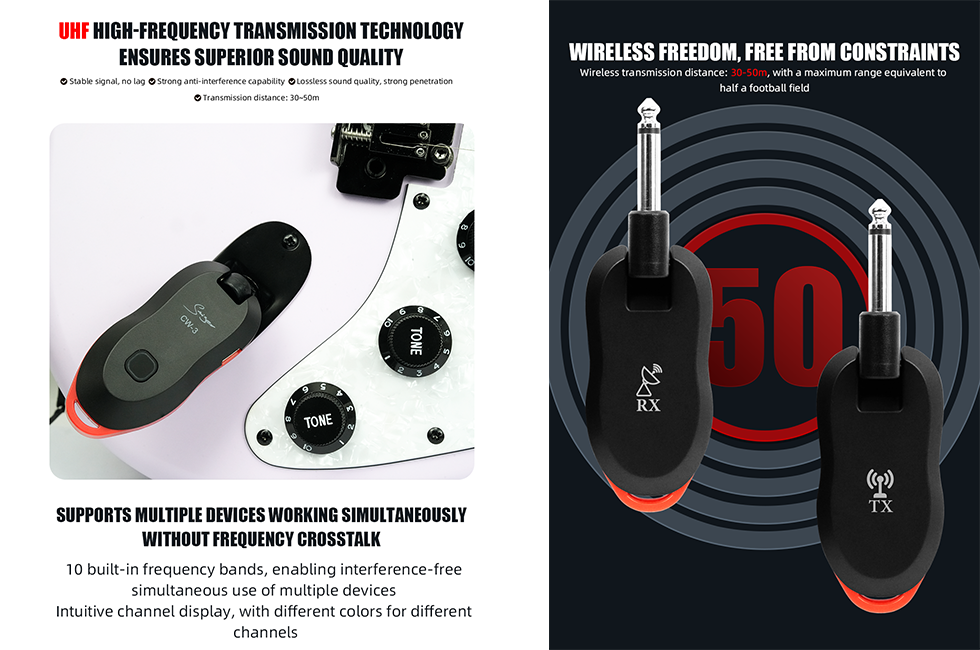
Many wireless guitar systems use 2.4GHz transmission. This band is popular because it is globally practical and suitable for compact devices. The challenge is that many other devices also use the same band.
OEM buyers should ask how the system handles interference:
– Does it automatically select channels?
– How fast does it reconnect after interference?
– Can several sets be used at the same time?
– Has multi-unit testing been done?
– Is the antenna position protected by the housing design?
If the target customer includes bands, schools, or small venues, multi-unit performance matters. One player using a wireless system at home is different from five students using multiple systems in the same room.
Battery Life and Charging Design
Battery performance is one of the most visible customer experience points. A wireless system that dies during practice will not be forgiven easily.
Buyers should check:
– Transmitter battery capacity
– Receiver battery capacity
– Charging time
– Runtime at normal use
– Low battery indication
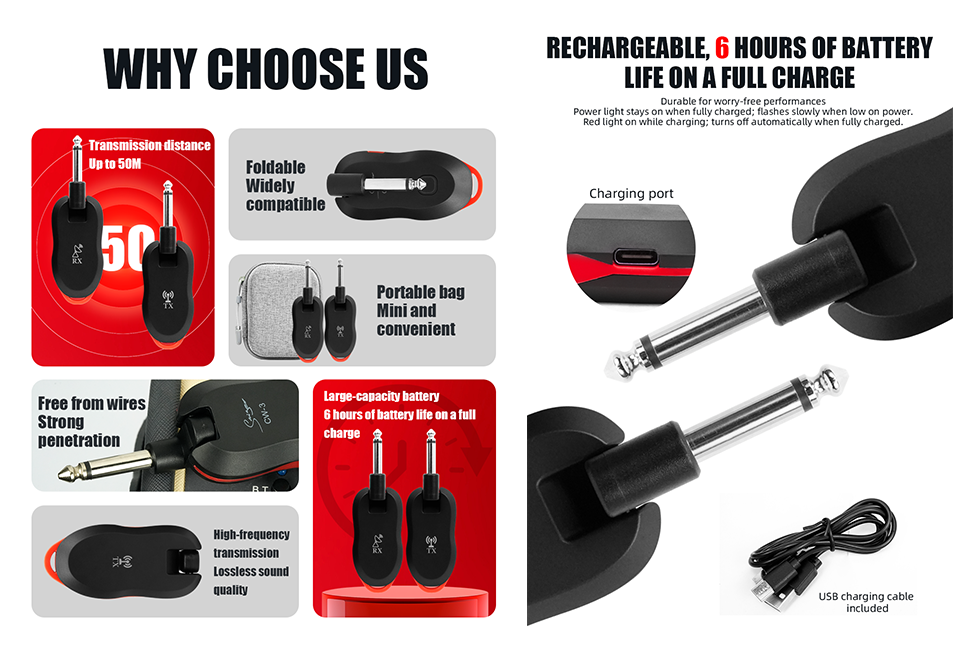
– USB-C or charging case design
– Protection against overcharging
– Battery shipping documents
If the transmitter and receiver have different runtimes, make sure the product manual explains charging behavior clearly. If a charging case is included, test whether both units sit securely inside the case and charge consistently.
Plug Design and Mechanical Strength
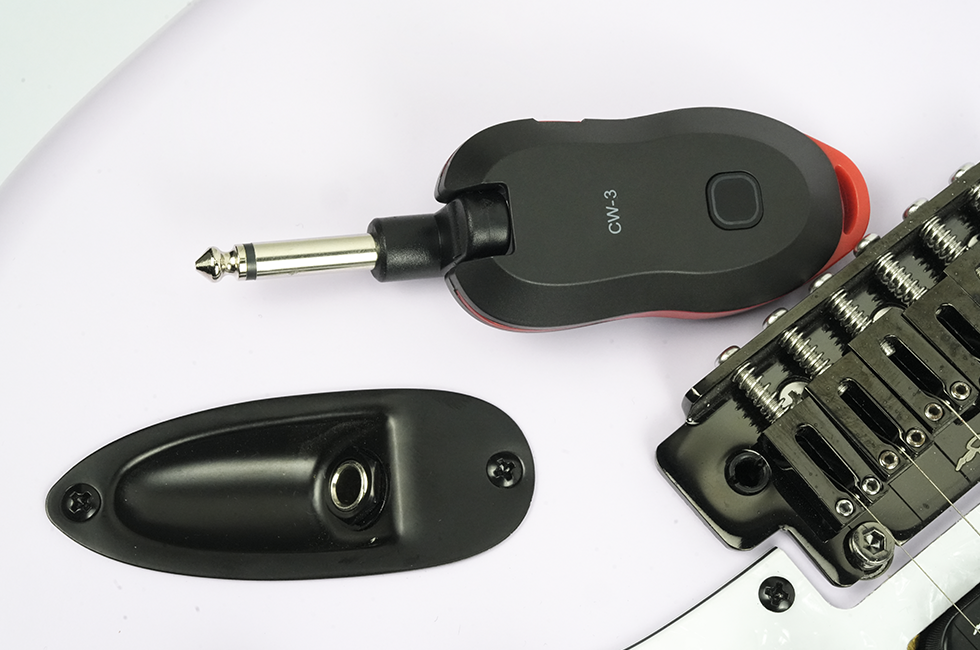
Wireless systems are small, but the plug area takes a lot of stress. Players rotate the transmitter, step near the cable area, place guitars on stands, and put gear into gig bags. A weak plug design can become a common failure point.
Check:
– Plug rotation stiffness
– Housing strength around the jack
– Fit with Strat-style recessed jacks
– Fit with Les Paul-style side jacks
– Fit with active basses and acoustic-electric guitars
– Noise when moving the plug
If the system will be sold broadly, compatibility testing should include several guitar body types. A design that fits one electric guitar may not fit all instruments comfortably.
Audio Quality: Do Not Ignore the Tone
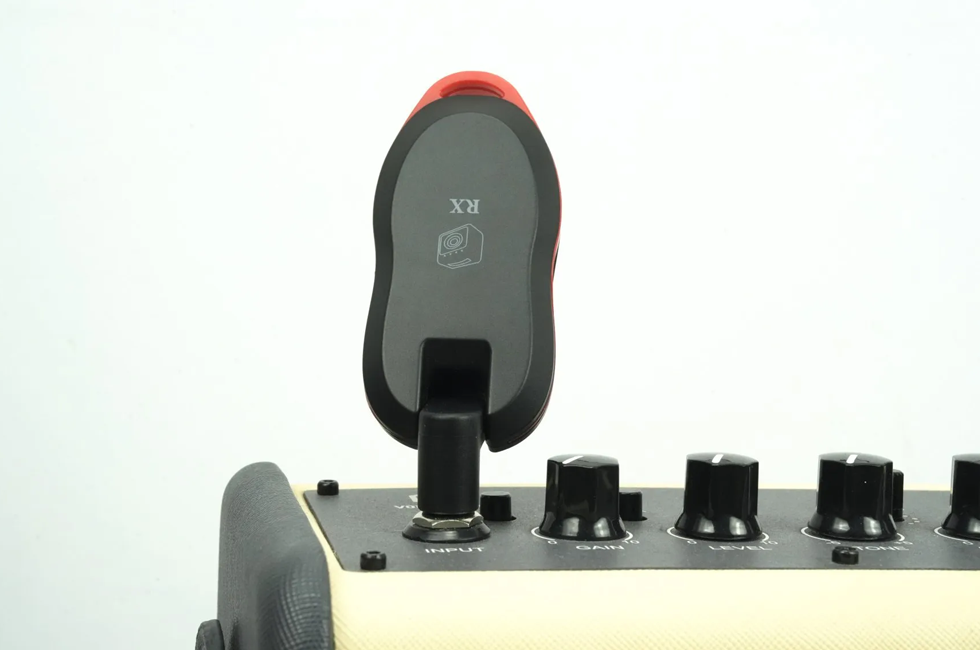
Some wireless systems are technically stable but change the guitar tone. The sound may become thinner, darker, compressed, or noisy. Guitar players compare wireless systems against a cable, so the tone difference should be small.
Simple test method:
- Play guitar through a short cable.
- Play the same guitar through the wireless system.
- Compare clean tone, high-gain tone, and volume response.
- Listen for noise, treble loss, and dynamic change.
Use both single-coil and humbucker guitars if possible. Single-coil pickups can reveal noise problems, while high-output humbuckers can reveal clipping or compression.
Packaging for Private Label Sales
Wireless systems are often sold as giftable accessories or online impulse purchases. Packaging should protect the product and make the function clear.
Useful packaging elements include:
– Clear transmitter and receiver labels
– Charging cable included
– Quick start guide
– Pairing instructions
– Compatibility notes
– Runtime and charging information
– Brand logo and barcode
Avoid manuals that are too vague. Many after-sales questions come from pairing confusion, charging misunderstanding, or unclear LED indicators.
QC Before Shipment
Wireless systems should not be checked only by appearance. Functional testing is necessary.
Recommended QC items:
– Pairing test
– Audio signal test
– Latency spot check
– Charging test
– Battery indicator test
– Plug movement test
– Noise floor test
– Range spot check
– Cosmetic inspection
– Accessory and packaging check
For mass production, buyers can discuss AQL inspection and whether 100% functional testing is needed. For wireless audio products, 100% pairing and audio output testing is often a wise choice.
Final Thought
A good wireless guitar system should disappear during playing. The guitarist should stop thinking about the device and focus on the instrument. That only happens when latency, range, battery life, plug design, and audio quality are handled together.
For OEM buyers, the safest path is to test samples in the same way customers will use them. Do not approve a wireless product based only on appearance and claimed range. Play it, move with it, charge it, compare it with a cable, and test more than one unit.
Sound Sentry Music supports OEM/ODM music accessories and wireless instrument system projects for brands, wholesalers, and retailers. Buyers can prepare target price, desired range, battery requirement, packaging style, and market certification needs before requesting samples.
FAQ
What latency is acceptable for a wireless guitar system?
Lower is better, but the most important point is whether the system feels natural while playing. Ask for a measured figure and test the actual sample with clean and distorted tones.
Can several wireless guitar systems be used at the same time?
Some systems support multi-unit use better than others. Buyers should test several pairs together if the target customers include bands, schools, or rehearsal spaces.
What is the biggest quality risk in wireless guitar systems?
Common risks include unstable connection, weak battery life, fragile plug design, tone loss, and unclear pairing instructions.
Plan Your OEM/ODM Project
Share your target product, market, estimated quantity, branding, packaging and certification requirements with the SoundSentry Technical Team.
View Related Products Request Product Information or a Quote
OEM Buyer Checklist
- Define the intended player and use environment.
- Confirm transmitter and receiver form factors.
- Specify charging method and battery indicators.
- Define acceptable latency and the test method.
- Confirm frequency or protocol requirements for the target market.
- Specify branding, accessories and packaging.
Continue with our OEM/ODM process, quality-control approach, certification guidance or request model-specific information.
Frequently Asked Questions for OEM Buyers
What information should a wireless-system buyer provide?
Provide the target market, use environment, instrument type, expected quantity, charging preference, branding and packaging requirements.
Should range be evaluated only in open space?
No. Open-space range is only one condition; buyers should also evaluate representative indoor, obstructed and interference conditions.
Why should specification and test results be separated?
A stated specification may use defined laboratory conditions, while real use depends on the environment, equipment and test method.