Guitar Amplifier Quality Control Checklist for OEM Buyers
A practical QC checklist for OEM guitar amplifiers, covering incoming parts, assembly, audio testing, burn-in, battery checks, packaging and pre-shipment inspection.
OEM Buyer Summary
A practical checklist for reviewing an OEM guitar amplifier sample and defining production and final inspection requirements.
Guitar Amplifier Quality Control Checklist for Importers and OEM Buyers
Quality control for guitar amplifiers is not only about whether the unit powers on. A guitar amp is judged by sound, noise, control feel, cabinet stability, safety, packaging, and consistency from one unit to the next. For importers and OEM buyers, a weak QC process can turn a good-looking product into a costly after-sales problem.
This checklist is written for brands, wholesalers, and retailers ordering guitar amplifiers from an OEM or ODM supplier. It focuses on practical inspection points that should be discussed before mass production, not after the shipment is ready.
Start QC Before Production
The first quality decision happens during sample approval. A buyer should never approve mass production with vague feedback such as “sample is okay.” The approved sample should become the production reference, often called the golden sample.
Before production starts, confirm:
– Final power rating and speaker size
– Control panel layout
– Clean and distortion channel behavior
– Built-in effects
– Bluetooth function if included
– Battery runtime if rechargeable
– Logo and color
– Packaging artwork
– Manual and label information
– Accessories included in the box
If the golden sample is not clear, factory inspectors and buyer-side inspectors will not have a reliable reference later.
Incoming Parts Inspection
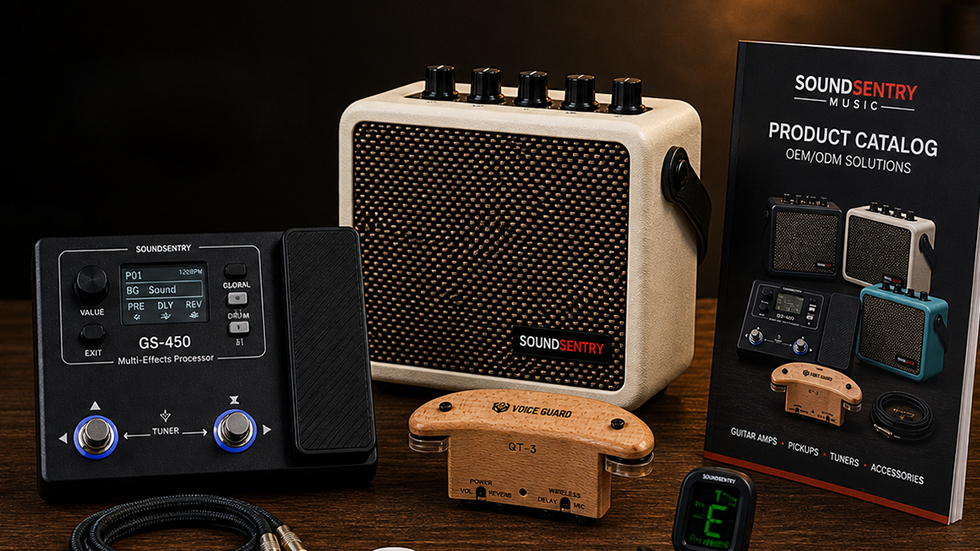
Many amplifier problems begin with parts. A stable guitar amp needs consistent speakers, circuit boards, potentiometers, switches, batteries, adapters, cabinets, screws, and packaging materials.
For OEM orders, ask the supplier how incoming materials are checked. Important items include:
– Speaker impedance and visual condition
– PCB appearance and solderability
– Potentiometer value and shaft feel
– Switch movement and contact stability
– Adapter output and safety marking
– Battery capacity and protection board
– Cabinet finish and grille quality
– Printed panel color and alignment
Incoming inspection is especially important when the product uses rechargeable batteries or Bluetooth modules. A small change in component source can change runtime, noise, or wireless stability.
Assembly Inspection
Assembly quality affects both reliability and user experience. Inspectors should check more than the outside appearance.
Useful assembly checks include:
– Screws tightened evenly
– No loose parts inside the cabinet
– Speaker mounted securely
– Wires routed away from heat or vibration points
– Knobs aligned correctly
– Input and output jacks fixed firmly
– Switches move cleanly
– Battery compartment or charging port is secure
– No glue marks, scratches, or dirty grille cloth
For portable amps, shake testing can reveal loose parts. The test does not need to be dramatic. A gentle movement is often enough to hear whether something inside is not fixed properly.
Audio Function Testing
A guitar amplifier must be tested with a guitar signal, not only a test tone. The inspector should check basic functions with both low and moderate volume.
Test points:
– Clean channel clarity
– Distortion channel noise and gain range
– Tone control response
– Reverb, chorus, delay or other effects
– Headphone output
– Aux input or Bluetooth playback
– Master volume behavior
– Noise level with no playing
– Cabinet vibration at higher volume
Listen for sudden volume jumps, scratchy controls, hiss, hum, rattling, and weak output. These issues are easy to hear but easy to miss if the inspection only checks power-on status.
Battery and Charging Test
If the amp is rechargeable, battery testing should be part of QC. Buyers should confirm how many units are checked for charging and runtime. For some orders, a full runtime test on every unit may be impractical, but charging function should be verified.
Check:
– Charging indicator behavior
– USB-C or adapter port fit
– Charging time on sample units
– Runtime at normal volume
– Battery protection function
– Heat during charging
– Battery label and shipping documents
Battery-related claims should be conservative. A realistic six-hour claim is better than an eight-hour claim that only works at very low volume.
Bluetooth and External Audio Testing
If Bluetooth is included, it should be tested as a real practice feature. Pair a phone, play backing tracks, and check volume balance between guitar and music.
Confirm:
– Pairing speed
– Reconnection after power cycling
– Bluetooth volume
– Noise when paired but silent
– Playback stability at room distance
– No interference with guitar signal
For beginner practice amps, Bluetooth is often a key selling point. If it fails, customers may see the entire product as low quality even if the guitar channel works.
Burn-In and Reliability Checks
Burn-in testing helps reveal early failures. The right burn-in process depends on the product type and target price, but some level of continuous operation testing is useful for amplifiers.
Possible checks:
– Continuous power-on test
– Audio signal running for a fixed time
– Charging and discharging cycle for battery models
– Temperature check near power components
– Re-test after burn-in
Burn-in is not only for premium products. Even entry-level amps benefit from basic reliability screening, especially before export shipment.
Packaging Inspection
Packaging protects the product and shapes the buyer’s first impression. A guitar amp may pass function tests but still fail commercially if packaging arrives damaged or unclear.
Check:
– Carton strength
– Foam or insert fit
– Product cannot move inside the box
– Manual included
– Power adapter correct
– Barcode and shipping marks correct
– Color box print quality
– Logo and model information accurate
For online sellers, packaging must survive courier handling. A retail carton that looks good on the shelf may still need outer protection for e-commerce shipping.
Pre-Shipment Inspection
Before shipment, the buyer can arrange final inspection. The standard should be agreed in advance. For guitar amplifiers, inspection should include appearance, function, packaging, quantity, and carton marking.
For higher-risk orders, buyers may request:
– AQL inspection
– Random audio testing
– Drop test for packaging
– Battery document review
– Photo report
– Video function check
The goal is not to create paperwork for its own sake. The goal is to catch problems while they can still be corrected.
What Buyers Should Agree With the Supplier
Before production, buyers should discuss the inspection method in writing. This does not need to be complicated, but it should be clear. For example, confirm which functions are tested on every unit, which items are checked by sampling, and what happens if a batch fails inspection.
Useful points to agree include:
– Whether every amp receives power-on testing
– Whether every amp receives basic audio testing
– How Bluetooth models are paired and checked
– How many battery units receive runtime testing
– What cosmetic defects are acceptable
– How carton damage is handled
– Whether the buyer receives production photos
– Whether a pre-shipment video is required
Buyers should also decide who pays for rework if the goods fail inspection. This is easier to discuss before production than after cartons are packed.
Common QC Mistakes
One common mistake is testing only the first sample and then assuming mass production will match it. In reality, component batches, assembly workers, and packaging materials can change during production. A golden sample helps, but production still needs inspection.
Another mistake is checking only loud volume. Many customers use practice amps at low volume, especially at home. Low-volume tone, hiss, and headphone output are important for real users.
Finally, do not forget the manual. Wrong adapter information, unclear Bluetooth steps, or incorrect charging instructions can create support problems even when the amplifier itself is working.
Final Thought
Guitar amplifier QC should match the way customers use the product. They turn knobs, play clean and distorted tones, connect headphones, stream backing tracks, charge the battery, and carry the amp around. A useful inspection process follows the same behavior.
Sound Sentry Music supports OEM/ODM guitar amplifier projects with sample development, private label options, and production quality control. Buyers preparing a new amp order should confirm the golden sample, testing standard, packaging requirements, and inspection process before mass production begins.
FAQ
What is the most important QC test for guitar amplifiers?
Audio function testing is essential, but it should be combined with appearance, safety, charging, Bluetooth, and packaging checks. A guitar amp is both an electronic product and a user experience product.
Should every guitar amp be tested before shipment?
For many OEM orders, basic power and function testing should be done on every unit. Detailed audio, runtime, and packaging tests may follow sampling plans depending on order size and buyer requirements.
What is a golden sample?
A golden sample is the approved reference unit for mass production. It defines appearance, sound, function, packaging, and accessories.
Related Sample Approval Guide
Factory inspection works best when the approved sample was documented clearly from the start. Before production begins, use this portable guitar amp sample approval checklist to confirm functions, controls, power, branding, accessories, and packaging against one agreed reference.
Plan Your OEM/ODM Project
Share your target product, market, estimated quantity, branding, packaging and certification requirements with the SoundSentry Technical Team.
View Related Products Request Product Information or a Quote
OEM Buyer Checklist
- Inspect enclosure, controls, labels and connections.
- Test clean, drive, effects and Bluetooth functions where applicable.
- Check power, charging, headphone and recording functions by model.
- Review packaging, accessories and documentation.
Explore products, review our factory information, quality-control approach, OEM/ODM process or request model-specific information.
Frequently Asked Questions for OEM Buyers
Should every amplifier use the same QC checklist?
No. The checklist should reflect the model, selected functions, target market and agreed acceptance criteria.
Why retain an approved sample?
It provides a physical reference for appearance, controls, functions, sound, branding and packaging.
When should packaging be reviewed?
Review packaging during sample approval and again during final inspection according to the project requirements.