Private-Label Guitar Pedals: Existing Platform vs ODM Development
A B2B guide to choosing an existing pedal platform, a configured variant or ODM development and controlling samples, artwork and approvals.
Quick answer: Choose the smallest development scope that creates a meaningful, supportable difference for the target buyer. An existing pedal platform can reduce technical changes and concentrate work on configuration, artwork and packaging. ODM development can provide deeper differentiation, but it requires a clearer product brief, more validation and stronger revision control. Neither route has a universal MOQ, cost or lead time.
“Private label,” “OEM” and “ODM” are often used loosely in guitar-effects discussions. One supplier may call a logo and carton change OEM; another may use OEM for a buyer-owned design. A buyer can avoid confusion by describing the exact scope rather than negotiating around labels.
This guide helps brands, distributors and retailers decide how far a pedal project should depart from an existing platform. It covers functions, enclosure, graphics, firmware, samples, commercial questions and production approval without assuming that every supplier offers the same options.
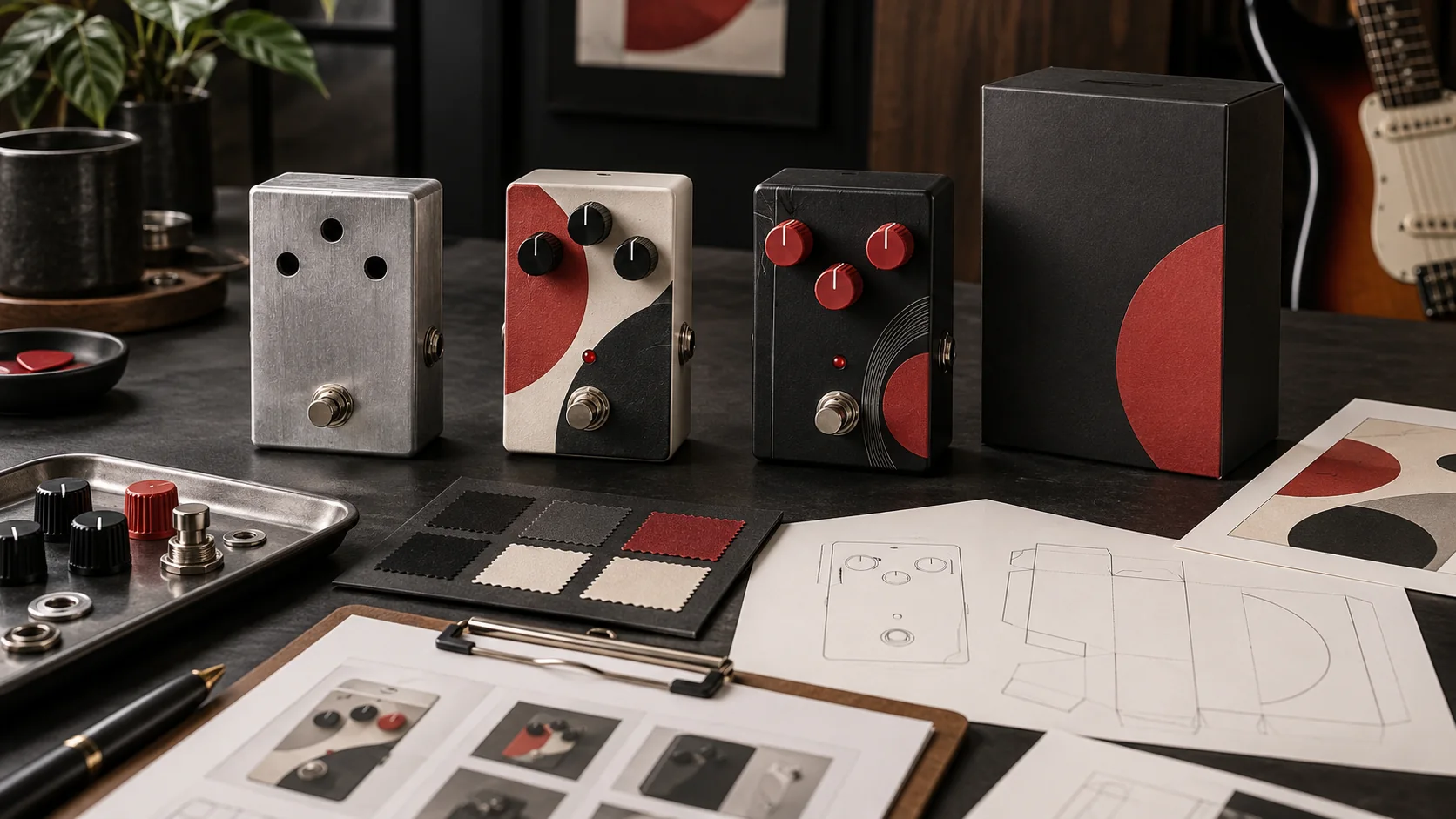
Editorial illustration: development scope should be visible in the product, artwork and approval record.
Define the three practical project routes
Existing platform with private labeling
The buyer selects a developed product and changes defined presentation elements, such as logo, color, labels, manual or packaging. The core electronics and operating logic normally remain unchanged. This route may be suitable when speed, a controlled first order and category coverage matter more than exclusive architecture.
Confirm exactly which elements can change. A color shown in a mockup may require a different process or quantity. A renamed control may not be acceptable if it misrepresents the actual function. Packaging and manual copy still need their own approval.
Configured platform
A middle route uses an existing technical base while allowing selected functional or physical options. Examples might include choosing among supported effect sets, control layouts, connectors, presets, enclosure treatments or accessory packages. The availability of each option is model- and supplier-specific.
This route can create a clearer market difference without starting every subsystem from zero. It also creates more combinations to test. The order reference must identify the exact option set rather than relying on the original platform name.
ODM development
ODM work involves deeper product definition or modification. Depending on the project, it may include signal-path behavior, effect algorithms, firmware, user interface, enclosure, mechanical design, power arrangement or a combination of these. A buyer should not assume that “ODM” automatically means exclusive ownership or a completely new design. Ownership, reuse rights and exclusivity require written agreement.
Start with a market and use-case brief
Before discussing circuits or colors, define the product’s role. Identify the target player, instrument, performance setting, price position, sales channel and the problem the pedal should solve. Describe why a dealer or player would choose it instead of another item already in the range.
Separate requirements into three groups:
- Mandatory: functions or constraints required for the product to enter the range.
- Preferred: improvements that strengthen the proposition but can be reviewed against cost or schedule.
- Future: ideas that belong in a later revision and should not destabilize the first project.
Include physical size, power expectations, inputs and outputs, control count, switching behavior, bypass expectation, preset or app needs, accessories, packaging and manual languages. If the product is a multi-effects unit, list the modules and workflow rather than requesting “many effects.”
Compare the routes with a decision matrix
Use this as a buyer’s comparison framework, not a list of options SoundSentry promises for every model. The supplier must confirm which platform, configuration changes or development work it can actually quote.
| Compare | Existing platform | Configured platform | ODM development |
|---|---|---|---|
| Buyer brief | Target use, market, quantity range and presentation needs | Base platform plus each requested change | Required product behavior, development scope and acceptance plan |
| Standard options versus new work | Confirm what the named version already includes | Mark every change as a supported option or new development | Define the functions and boundaries to be developed |
| Records to request | Approved sample and specification revision | Change list and sample revision tied to the base platform | Agreed milestones, validation records and handover documents |
| Sample approval | Approve the exact version and presentation | Approve both platform version and modified sample | Record stage approvals separately from the final production reference |
| Rights and maintenance | Follow the written agreement for the existing platform | Agree rights and support for each changed element | Negotiate firmware, design files, tooling, reuse and maintenance in writing |
| Cost and timing questions | Confirm quotation, availability and presentation work | Confirm the effect of changes and retesting | Confirm development scope, iterations and contractual milestones |
Mark unconfirmed cells as pending in the project brief. Do not infer MOQ, price, timing, exclusivity or IP ownership from the route name.
Avoid assigning fixed values before the supplier reviews the brief. A platform route is not always faster if requested artwork or packaging is complex. ODM is not always the strongest commercial choice if the proposed difference is difficult for customers to understand.
Ask one central question: Which product difference will be visible, useful and defensible at launch? If the answer is only a logo, do not build an unnecessarily broad engineering project. If the target workflow cannot be achieved on the platform, presentation changes alone will not solve the problem.
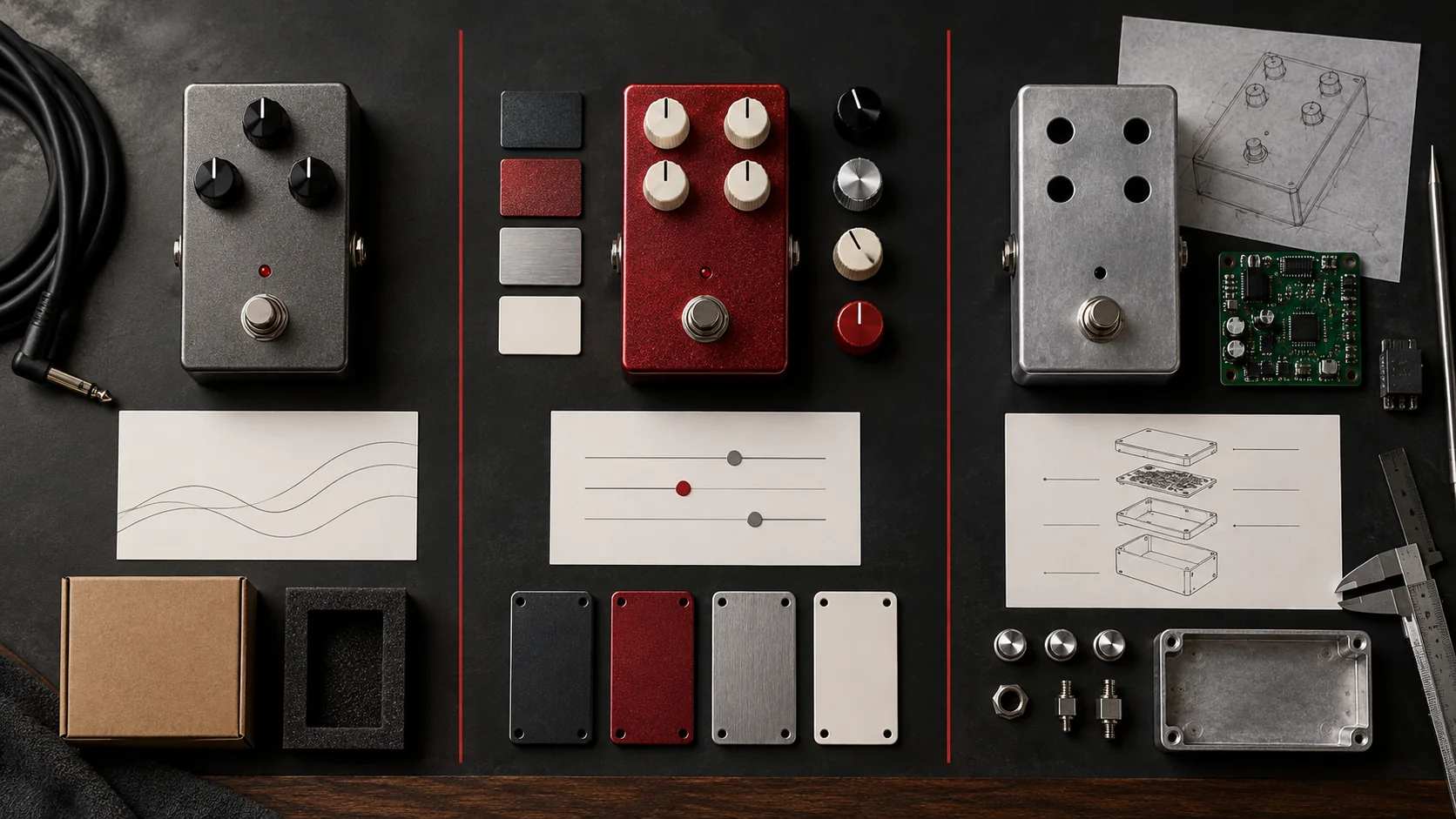
Editorial illustration: each development path carries a different validation and change-control burden.
Define the project before requesting a price
Send the target market, function set, quantity estimate, branding and packaging scope through Contact Us. Feasibility, MOQ, sampling and timing must be confirmed for the selected route.
Audit an existing pedal platform
Request the exact model and revision, then evaluate the product without assuming future changes. Check the signal path, control range, switching, power behavior, noise under representative setups, connectors, mechanical stability and any digital workflow. Record the guitar, amplifier, cables, power source and settings used.
For multi-effects platforms, review navigation, preset behavior, effect order, save/recovery behavior, display readability, headphone or recording functions and app connection if included. The current multi-effects processor bulk-order guide provides a wider purchasing checklist.
Document what already satisfies the brief, what can be configured and what would require development. Do not approve packaging claims for a requested function until the sample demonstrates the agreed version.
Translate differentiation into a functional specification
For configured or ODM work, replace descriptive adjectives with behavior. “Easy controls” can become maximum menu depth for common tasks. “Professional switching” can become a defined footswitch action, indicator response and preset-change behavior. “Low noise” needs a test setup and acceptance approach.
Create a function table with user action, expected result, indicator state, stored state, power-cycle behavior and exceptions. For every connector, identify type, position and supported role. For every control, define label, range, default and interaction with presets.
This document becomes the bridge between product concept, sample testing, manual copy and customer support. It also reveals contradictions before engineering work starts.
Control enclosure and interface development
Pedal enclosure decisions affect tooling, machining, printing, assembly, packaging and player ergonomics. Define dimensions, material or process, footswitch and jack positions, knob protection, display window, battery access if applicable, feet and label areas.
Evaluate the product on a pedalboard with typical plugs and neighboring devices. Check foot access, cable clearance, visibility and stability. A compact enclosure has little value if connectors prevent practical placement.
Artwork files should specify printable area, color reference, finish, logo size, control labels, legal marks and revision. Renderings are useful for layout, but a physical artwork sample may still be needed to judge color, registration, texture and readability.
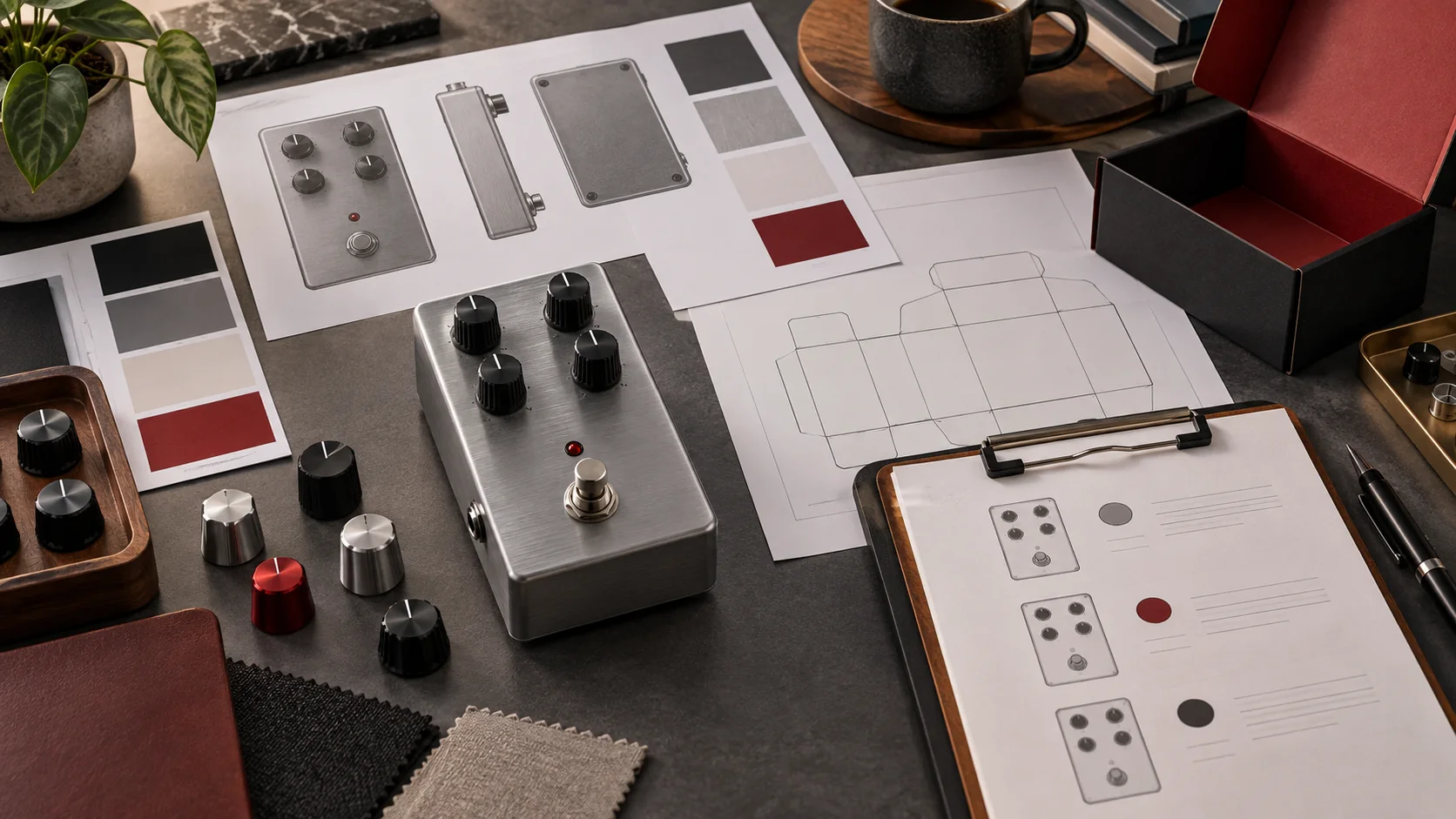
Editorial illustration: enclosure, controls, artwork and packaging should share one approved revision.
Evaluate sound without inventing tone claims
Define representative instruments, pickups, amplifiers and monitoring conditions. Use repeatable settings and reference phrases. Record observations such as control range, noise, level matching, bypass behavior, clipping, effect tails and preset transitions.
Avoid universal claims such as “studio quality,” “authentic tube tone” or “works with every pickup” unless a defensible basis exists. Sound preference is context-dependent. Product copy can explain controls and intended workflows without presenting an internal listening session as objective proof.
If a requested change affects algorithms, converters, gain structure or analog circuitry, identify which tests must be repeated. An artwork approval cannot substitute for a functional re-evaluation.
Plan prototype and sample gates
A deeper project may pass through concept confirmation, functional prototype, engineering sample, appearance sample, packaging sample and production-reference sample. The names vary; the purpose of each gate should not.
For every sample, record:
- Sample ID, date and hardware/firmware revision.
- Which requirements it is intended to prove.
- Known provisional parts or functions.
- Test setup and results.
- Required corrections and responsible party.
- Approval status and the next gate.
Use conditional approval carefully. If a correction affects sound, switching, power, mechanical fit, safety, labeling or destination documentation, request suitable evidence or another sample before production.
Separate unit price from development scope
A clear quotation separates recurring unit cost from project work. Potential categories include samples, engineering or firmware work, enclosure setup, tooling, artwork setup, packaging, requested testing, documentation, inspection and shipping to the agreed point. Not every project includes every category.
Ask what is refundable, reusable or tied to quantity, and what happens if the project stops or changes. Record currency, trade term, payment stages, quotation validity and tax treatment where relevant. Do not publish a generic MOQ or lead time; color, enclosure, electronics, packaging and material availability may change both.
Build a milestone schedule around specification freeze, prototype, corrections, appearance approval, packaging approval, production preparation, inspection and release. State which approval starts each quoted period.
Assess whether the supplier matches the chosen route
A supplier that can execute a logo and carton change is not automatically equipped for firmware, acoustic evaluation, mechanical development or long-term revision management. Match the supplier review to the project scope. Ask who owns product definition, electronics, firmware, mechanical files, artwork coordination, sample testing and quality records.
Request examples of the process rather than confidential customer claims. A useful response can show a blank specification template, revision log, sample report, change-notice format or inspection checklist. These materials reveal how decisions are controlled without requiring the supplier to disclose another brand’s product.
For a platform project, confirm continuing availability and the notice process if the platform changes. For ODM, identify the responsible project contacts and how technical decisions are approved. If important work is subcontracted, clarify communication and responsibility without assuming that subcontracting itself is a problem.
Evaluate response quality as well as response speed. A fast quotation with missing scope is less useful than a clear list of confirmed, optional and pending items. Keep unanswered critical requirements visible in the comparison sheet.
Clarify intellectual property and exclusivity
Do not infer ownership from who paid a development charge. Written terms should address buyer-supplied logos and artwork, supplier background technology, newly created files, tooling, firmware, reuse rights, confidentiality and any market or time-limited exclusivity.
The appropriate arrangement depends on the contribution and commercial agreement of both parties. Legal terms should be reviewed by qualified advisers. Product teams should at least identify which assets must be delivered at each milestone and who can authorize changes.
Approve packaging, manual and product claims together
Packaging must match the approved hardware and firmware. Verify product name, control labels, included accessories, power information, warnings, model identifiers, barcodes and destination-language requirements. A manual should describe the actual workflow rather than a generic platform.
Keep compliance statements model- and destination-specific. A logo on a reference sample or a document for another variant is not enough. Request exact document identifiers and scope where needed, and let the responsible importer or qualified adviser determine market obligations.
The online product page, carton and manual should use the same revision-controlled feature list. Remove prototype functions that did not enter production.
Establish production change control
The approved reference should combine the product specification, sample ID, firmware, artwork, color, accessory list, packaging and inspection criteria. A purchase order that names only the model is incomplete when the project contains custom elements.
Define which substitutions or revisions require notice, documentation, sample review or written approval. Components can become unavailable, but a change affecting sound, power, connectivity, user interface, labeling or documentation should not enter unnoticed.
For repeat orders, compare the current revision with the previous approved order. Retain issue records and corrective actions by batch and model so isolated problems do not become unsupported claims about all production.
Prepare launch and after-sales information
Product development is incomplete if the sales and support teams cannot identify the version or explain the controls. Prepare a controlled specification sheet, quick-start information, product photographs, included-items list and troubleshooting path for the exact production configuration.
Define the evidence required for an after-sales claim: model, serial or batch reference, photographs, video, setup, power source and description of the behavior. Agree how confirmed defects, missing accessories, firmware questions and replacement parts will be handled. The final warranty terms must be written for the specific commercial agreement rather than copied from a generic page.
Track early feedback by issue type and revision. A single player’s tone preference should not become a defect rate, and a repeated functional problem should not be dismissed as preference. Structured records help the buyer and supplier decide whether the response is instruction, inspection, corrective action or product revision.
Before a repeat order, review sales, returns, support questions and requested features against the original positioning. Add functions only when they strengthen the buyer proposition and can be validated; uncontrolled feature additions can make the interface harder to use and restart approvals.
The launch file should also distinguish a feature that exists in the technical platform from a feature enabled in the ordered configuration. A platform may support an app, recording mode or additional effect module without including it in every private-label version. Confirm the final firmware, included accessories and market-specific power information before a distributor copies product text into a listing.
If the project has multiple markets, approve the core specification once and manage each language’s packaging and instructions as a controlled variant. Local text should explain the actual controls in familiar terms, not mirror an English draft word for word. A translation error on a power input, warning or operating step is a product-support issue, not merely a style problem.
Frequently asked questions
Is private labeling the same as ODM?
No. Private labeling may change only brand presentation, while ODM may involve deeper product development. Define the actual changes rather than relying on the label.
Is an existing pedal platform always the fastest route?
It often limits technical work, but timing still depends on availability, artwork, packaging, samples and approvals. Confirm the project-specific schedule.
Does ODM guarantee product exclusivity?
No. Exclusivity, ownership and reuse rights depend on written agreements and the technology contributed by each party.
What should buyers test on a pedal sample?
Test controls, switching, audio behavior, power, connectors, mechanical fit, presets or app functions, accessories and packaging against the written brief under recorded conditions.
When should a new sample be requested?
Request suitable evidence or a new sample when a correction affects function, sound, power, safety, fit, firmware, labeling, branding or another approved requirement.
Conclusion
The best development route is the one that produces a clear buyer benefit with a manageable approval burden. Existing platforms can support efficient range building; configured platforms can add focused differentiation; ODM can address needs the platform cannot meet. All three require an exact specification, controlled samples and honest product claims.
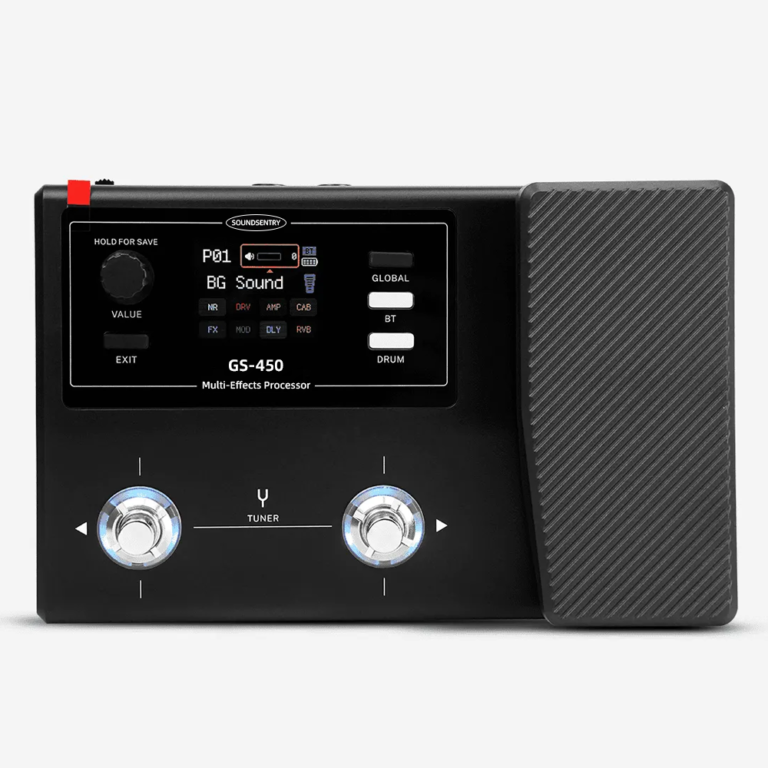
Review the listed GS-450 multi-effects pedal as a concrete product reference, then submit a project brief to ask which model, functions, branding, packaging and documentation options can be confirmed for your project. The product page does not establish availability of every route in this guide.
Plan Your OEM/ODM Project
Share your target product, market, estimated quantity, branding, packaging and certification requirements with the SoundSentry Technical Team.
View Related Products Request Product Information or a Quote