RMS vs Peak Power: How Wholesale Buyers Compare Guitar Amplifiers
A practical buyer framework for comparing guitar amplifier power claims, documenting test conditions and approving accurate product specifications.
Quick answer: RMS or continuous power and peak power are not interchangeable labels. A useful amplifier rating must identify what is being measured, under which load, at what distortion limit and with which test signal or method. Wholesale buyers should compare the stated basis first, then evaluate the complete amplifier sample for its intended use. Wattage alone does not prove loudness, tone quality or suitability.
Two portable guitar amplifiers may both be promoted with the same wattage while using different speakers, cabinets, power supplies and rating methods. Another pair may perform similarly in a shop demonstration but show very different numbers because one supplier reports continuous output and another emphasizes a short-duration peak. If a buyer compares only the largest number, the quotation process becomes misleading before price, packaging or product support are considered.
This guide gives importers, distributors, retailers and private-label product managers a repeatable way to question, record and approve guitar-amplifier power information. It is a procurement framework, not a substitute for model-specific engineering data or destination-market compliance review.
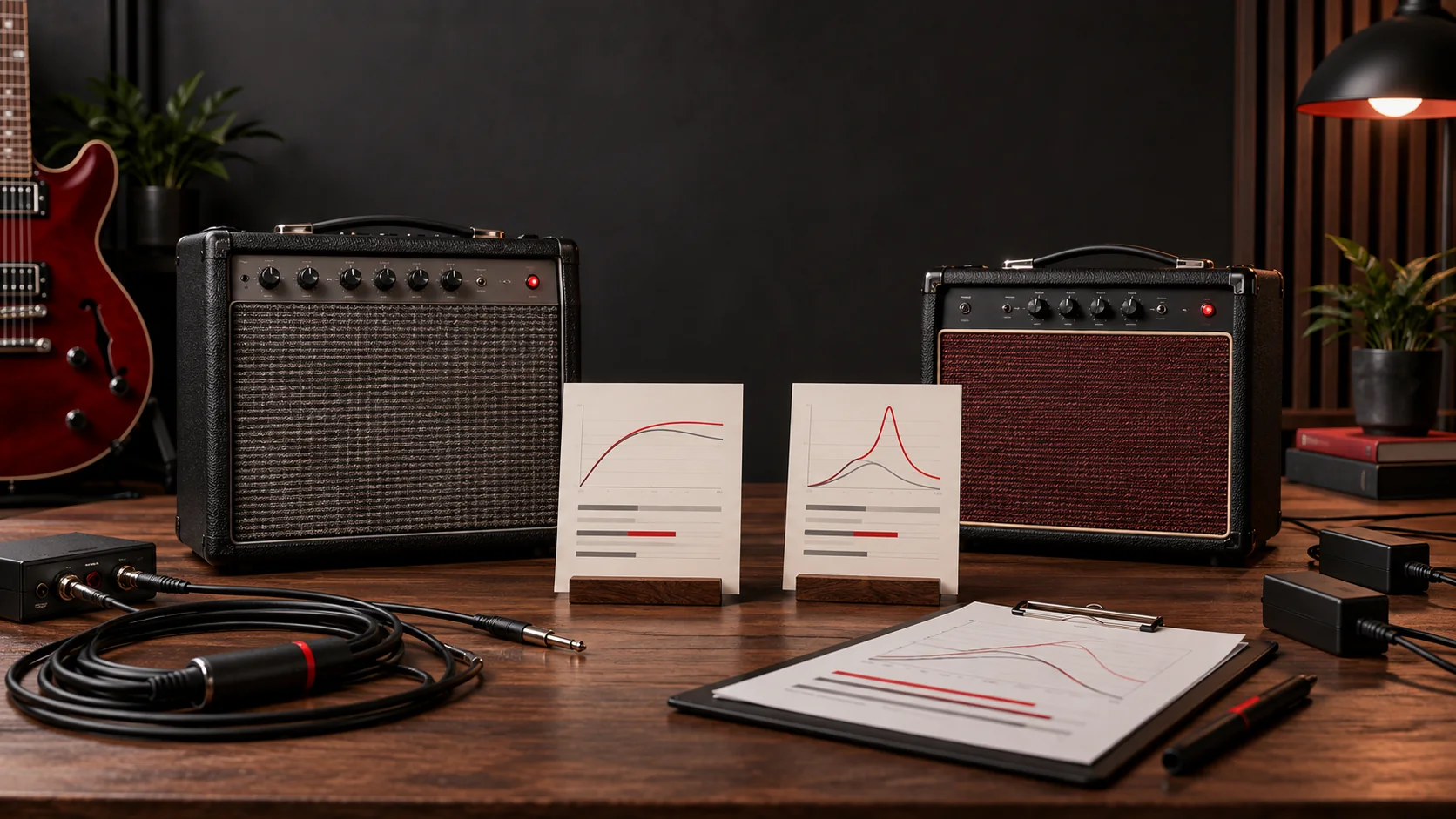
Editorial illustration: compare the definition behind each rating before comparing the number.
Why amplifier power labels create purchasing confusion
Power figures appear simple because they share a unit. The problem is that a number can describe different conditions. A continuous-output figure, a short-duration peak, electrical consumption and a marketing term are not equivalent measurements. Even when two suppliers both use “RMS,” their test load, frequency, channel arrangement or distortion threshold may differ.
The commercial consequences extend beyond the specification sheet. A buyer may build a price comparison around products that do not have the same configuration, place an unsupported claim on a retail carton, or train sales staff to promise a performance level the approved sample does not establish. Corrections made after artwork approval can delay a project and create inconsistent listings across distributors.
The solution is not to reject every power claim. It is to attach a definition and evidence status to the figure. A rating can be recorded as supplier-declared, document-supported, independently checked or still pending. This makes the purchasing file clear without overstating what a normal sample review can prove.
Understand the terms before requesting a quotation
Continuous or RMS output
In guitar-amplifier discussions, RMS is commonly used to indicate sustained output rather than a momentary maximum. Strictly, RMS describes a way of expressing an alternating electrical quantity; it is not automatically a complete test standard. Buyers should therefore ask what the supplier means by the term and how the value was obtained.
A useful answer identifies the output channel, load, signal or frequency range, power-supply condition and distortion limit. If those details are unavailable, treat the figure as a supplier-declared catalog value rather than a directly comparable laboratory result.
Peak power
Peak power normally describes a short-duration maximum under a defined condition. It may be useful for product engineering, but it should not be placed beside a continuous rating as if the two values had the same meaning. The relationship between them is not a universal conversion factor for complete guitar amplifiers.
Ask how long the peak can be sustained, what limited the result and whether the term refers to amplifier output, speaker handling or another component. If the supplier cannot define it, do not use the number as the main purchasing criterion.
Music power and other promotional terms
Terms such as music power, maximum power or dynamic power may follow a stated method, or they may be promotional shorthand. A buyer needs the method rather than an argument about the label. Record the exact wording, ask for its basis and decide whether the term is suitable for customer-facing content.
Power consumption
Electrical input or adapter consumption is not the same as audio output power. Both may be important, but they belong in different fields. The first helps describe the power system; the second describes an audio-output claim. A quotation or carton that mixes them can produce a false comparison.
Ask four questions about every output figure
Attach the following questions to the RFQ, sample record and artwork approval:
- What does the figure describe? Identify continuous output, peak output, speaker handling, adapter input or another quantity.
- Under what conditions was it obtained? Request load, signal, frequency range, channel configuration, supply state and any warm-up condition.
- What limit defined the result? Ask whether a stated distortion threshold, clipping point, protection behavior or another criterion was used.
- Which product revision does it cover? Connect the figure to an exact model, hardware or firmware revision, power accessory and approved sample.
These questions do not require a buyer to become an audio laboratory. Their purpose is to prevent one undefined number from moving unchanged through quotation, sample, packaging and product-page copy.
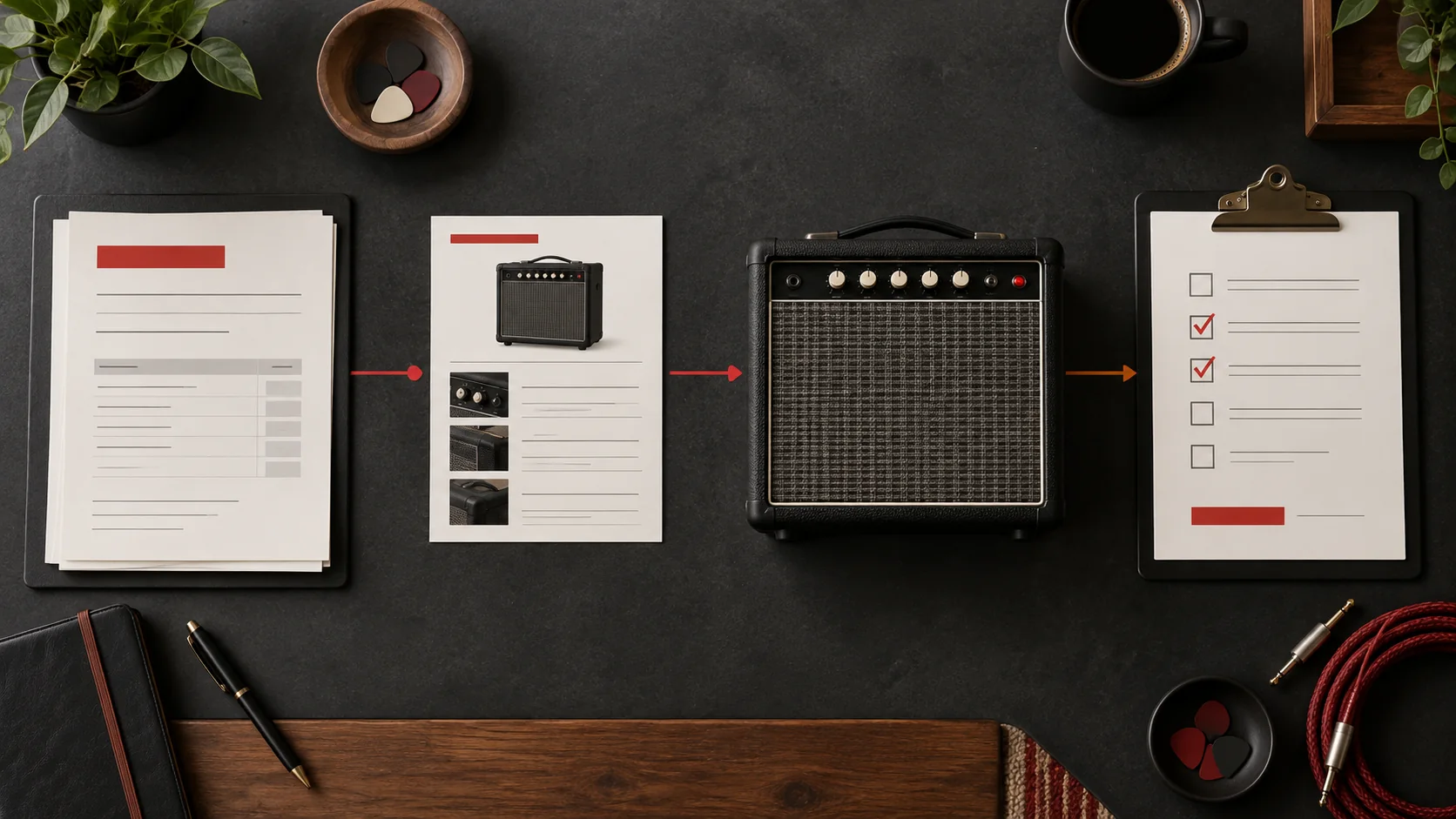
Editorial illustration: keep the declared rating, test basis, sample and approved wording in one traceable workflow.
Request a model-specific amplifier review
Send the model, destination, quantity, intended use and required documentation through Contact Us. Available specifications and commercial terms must be confirmed for the selected configuration.
Why wattage does not predict the whole listening result
Output power is only one part of an amplifier system. Speaker efficiency, driver size, cabinet construction, equalization, limiter behavior and power-supply stability can all influence what a player hears. The guitar, pickup output, control settings, room and distance also affect a demonstration.
This matters when a buyer compares samples. A model with a larger advertised figure is not automatically louder in every practical setting, and louder is not automatically more suitable. A small practice amplifier designed for home use may be judged on controllability, headphone behavior and low-level sound. A portable busking-oriented model may place more emphasis on projection, battery operation and input flexibility.
Define the use case before scoring the result. Otherwise, the team may reward the highest short demonstration level while overlooking noise, control range, thermal behavior, charging, portability or packaging requirements.
Build a comparable amplifier purchasing brief
Start with one brief that every supplier receives. Include the channel, intended user, typical instrument, destination market, target retail role and required functions. Separate required and optional features so each quotation has a clear base.
Record at least:
- Exact model and revision.
- Instrument, auxiliary, microphone and headphone connections required.
- Clean, overdrive and effect functions.
- Speaker and cabinet configuration.
- External power, battery or rechargeable arrangement.
- Included adapter and cables.
- Required labels, manual languages and packaging.
- Branding scope and approval method.
- Documentation requested for the destination.
- Sample status and unresolved questions.
If suppliers quote different feature sets, normalize them before comparing price. The existing guide on comparing guitar amplifier wholesale quotations provides a broader commercial framework.
Create a buyer-owned rating table
Do not leave power information inside email paragraphs. Use a structured table with one row per model and revision. Useful columns include supplier wording, numeric value, rating type, load, frequency or signal, distortion criterion, supply condition, supporting document, sample ID and customer-facing wording.
Add an evidence-status field:
- Declared: provided by the supplier but not accompanied by a method.
- Documented: supported by a model-specific specification or report.
- Observed: sample behavior recorded in a defined purchasing check.
- Independently measured: evaluated through an agreed qualified method.
- Pending: information requested but not received.
Observed performance must not be relabeled as an independent power measurement. A listening check can confirm whether a sample suits a use case, but it does not generate a defensible RMS value by itself.
The table should also show who supplied the information and when. A technical drawing, a sales quotation and a carton draft may each carry a different revision date. If a supplier corrects the rating, retain the earlier version and add the reason for the change. This history helps the purchasing team determine which artwork and distributor listing must be revised.
For an internal decision meeting, separate three questions in the table: Is the stated figure adequately defined? Does the sample meet the intended application? Is the proposed customer-facing statement supported? A model may pass the listening review while its rating documentation remains pending. That does not require rejecting the product, but it does mean the exact wattage wording should not be approved yet.
Plan a practical sample evaluation
Before testing, photograph the sample and record model, serial or sample code, revision, power accessory, firmware if applicable and date. Note whether it is a production-representative unit, an engineering prototype or a standard reference sample.
Use the same guitar, cable, playback material and room for comparative listening where practical. Set a repeatable distance and document control positions. Check the product at low, typical and demanding settings that remain appropriate for the intended use. Listen for control behavior, unwanted noise, abrupt limiting, distortion changes, overheating symptoms or power interruptions.
For battery-powered models, record charge state and the conditions of any running-time observation. Volume, Bluetooth playback, effect use and battery condition can all change the outcome. Do not turn one informal session into a universal battery-life claim.
Check headphone output, external playback, recording and charging functions when they are part of the brief. The portable guitar amplifier sample approval checklist can be adapted to the chosen model.
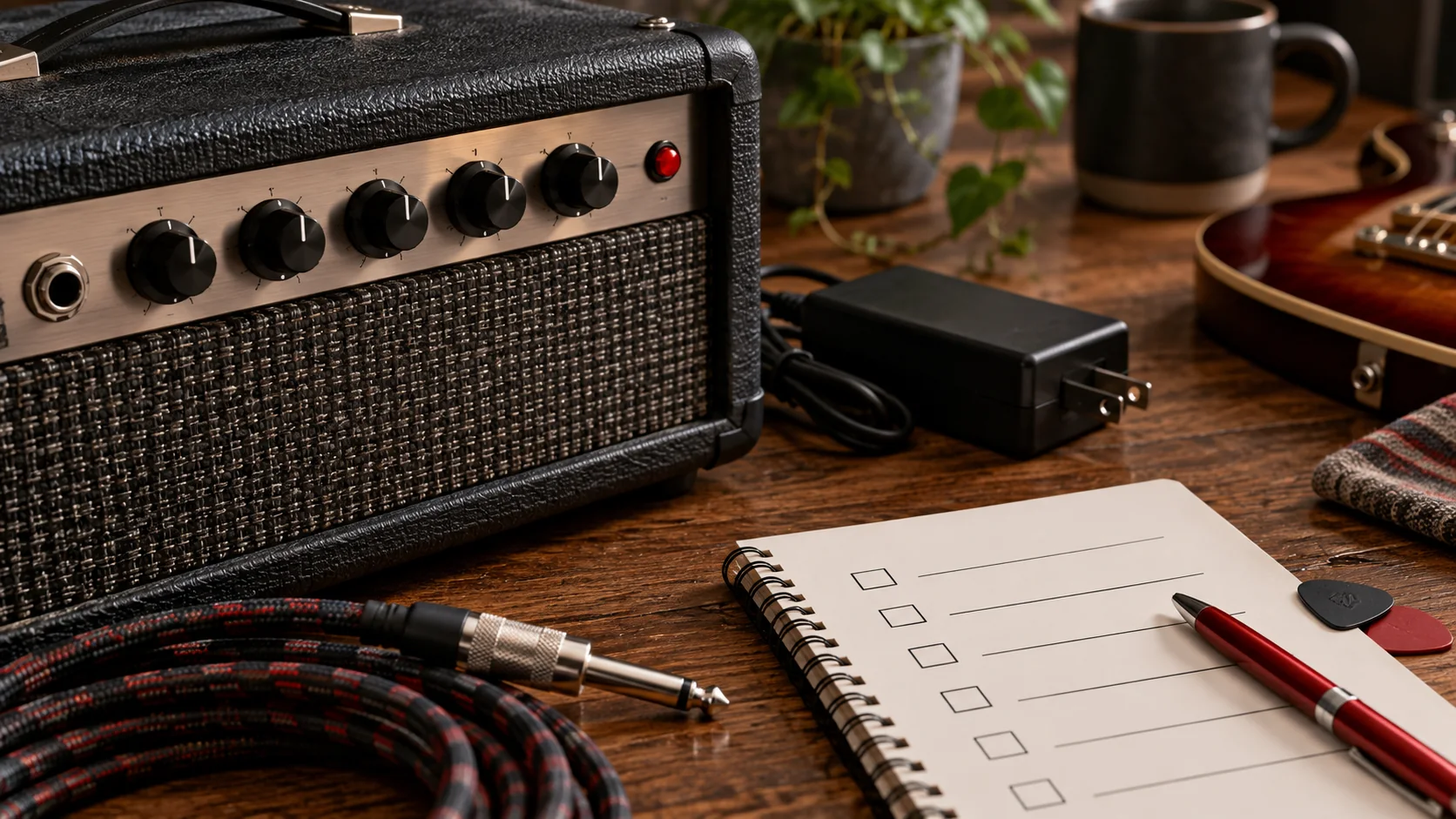
Editorial illustration: sample observations are meaningful only when the configuration and conditions are recorded.
When a technical measurement is necessary
A qualified measurement becomes more important when power is a key contractual specification, suppliers provide conflicting definitions, the destination requires a particular declaration, or the buyer intends to publish a precise comparative claim.
Agree the method before testing. Define the load, input signal, bandwidth, supply condition, channel arrangement, measurement point, distortion threshold and duration. Identify who performs the work and how the result will be reported. The acceptance rule should be written before the result is known.
Buyers should also decide how production consistency will be monitored. A precise prototype result has limited value if the production specification, component changes and inspection plan are not connected to it.
Detect common rating red flags
Investigate when:
- The same model shows different wattage on the quotation, sample label and carton.
- “RMS,” “peak” and “maximum” are used interchangeably.
- Power consumption is presented as audio output.
- The figure changes without a hardware revision.
- A speaker-component rating is used as the complete amplifier output.
- No one can identify the load or distortion basis.
- An unusually large number is emphasized while basic configuration details remain missing.
- Customer-facing artwork is approved before the specification owner confirms the wording.
A red flag is a request for clarification, not automatic proof of wrongdoing. Give the supplier an opportunity to identify the source and correct the record.
Approve accurate packaging and product-page language
Use the narrowest wording that the evidence supports. If a model-specific continuous output rating is documented, state it consistently and avoid placing an undefined peak number beside it. If only a supplier-declared catalog figure is available, internal teams should know that status before deciding whether to publish it.
Keep specification, artwork, manual, carton and online listing under revision control. When the amplifier electronics, speaker, power supply or firmware changes, review related claims again. Do not assume a document for one model automatically covers another enclosure or destination variant.
Also avoid claims such as “twice as loud,” “professional stage volume,” or “zero distortion” unless a suitable basis and context exist. Descriptive use-case language should remain proportional to actual evaluation.
Compare total purchasing value after aligning the facts
Once definitions and configurations match, the buyer can assess price, sample result, packaging, documentation, warranty process, change control and schedule. A lower unit price may exclude the adapter, printed packaging or requested documentation. A higher rating may rely on a different definition. Neither comparison is useful until scope is normalized.
Apply a weighted score only after required questions are answered. Keep critical unknowns as pending instead of awarding an average score that hides them. Procurement, product and sales reviewers should be able to trace each conclusion to the quotation, specification, sample record or written clarification.
An approval meeting should close with an explicit action list. For example, product management may accept the sample for a home-practice range, engineering may request a clarified continuous-output method, and marketing may hold the carton wattage until the document arrives. Assign an owner and date to each action. This prevents a conditional technical decision from being misread as permission to release every claim.
For repeat orders, ask whether speaker, amplifier board, power adapter, battery, firmware or cabinet has changed. A replacement that looks identical in a catalog image may affect practical behavior or the basis of an earlier power figure. Connect change notices to the same model and sample record used in the first approval.
Frequently asked questions
Is RMS power always lower than peak power?
Peak figures are often numerically higher, but the relationship depends on what is measured and how. Do not apply a universal conversion factor to finished guitar amplifiers.
Does higher wattage mean a guitar amplifier will sound louder?
Not by itself. Speaker efficiency, cabinet design, limiter behavior, power supply, settings and listening conditions affect the practical result.
Can a buyer verify amplifier power by listening to a sample?
A listening test can judge suitability and compare behavior under recorded conditions. It cannot establish a defensible electrical output rating without an agreed measurement method and equipment.
What should appear next to a power figure in an RFQ?
Record the rating type, load, test basis, distortion limit, supply condition, model revision and evidence source. Mark unanswered fields as pending.
Should peak power appear on retail packaging?
Only when the term is defined, accurate for the exact model and appropriate for the market. A buyer should prefer clear, consistently supported specifications over the largest promotional number.
Conclusion
The right question is not simply “How many watts?” It is “What does this figure describe, under which conditions, for which revision, and how will we use it?” Buyers who connect those answers to a controlled sample and approved copy can compare guitar amplifier quotations more fairly and reduce specification disputes later.
Review SoundSentry’s current guitar amplifier products and submit a model-specific RFQ to confirm the functions, sample scope, documentation and commercial terms available for the selected project.
Plan Your OEM/ODM Project
Share your target product, market, estimated quantity, branding, packaging and certification requirements with the SoundSentry Technical Team.
View Related Products Request Product Information or a Quote