Analog vs Digital Guitar Pedals: A Wholesale Buyer’s Guide
Compare analog and digital guitar pedals by customer role, sound workflow, testing, returns, assortment planning and private-label risk.
Quick answer: Wholesale buyers should not treat analog and digital guitar pedals as a winner-takes-all choice. Analog-style single effects can offer a focused function, immediate controls and a clear price ladder. Digital pedals can combine effects, presets, routing, recording and software functions in one product. The right assortment depends on customer segment, demonstration needs, support capacity, quality plan, update policy and landed cost—not on the technology label alone.
The analog-versus-digital debate is often framed around tone preference. For a retailer, distributor or private-label brand, the decision is broader. A simple drive pedal and a multi-effects processor have different packaging, training, return reasons, firmware responsibilities and merchandising roles. Even within one category, circuit design and implementation vary widely.
This guide provides a commercial and technical framework for comparing analog and digital guitar pedals for wholesale purchasing. It avoids assuming that every pedal with the same label behaves alike. Buyers should validate the selected model, revision and claims before placing a bulk order.
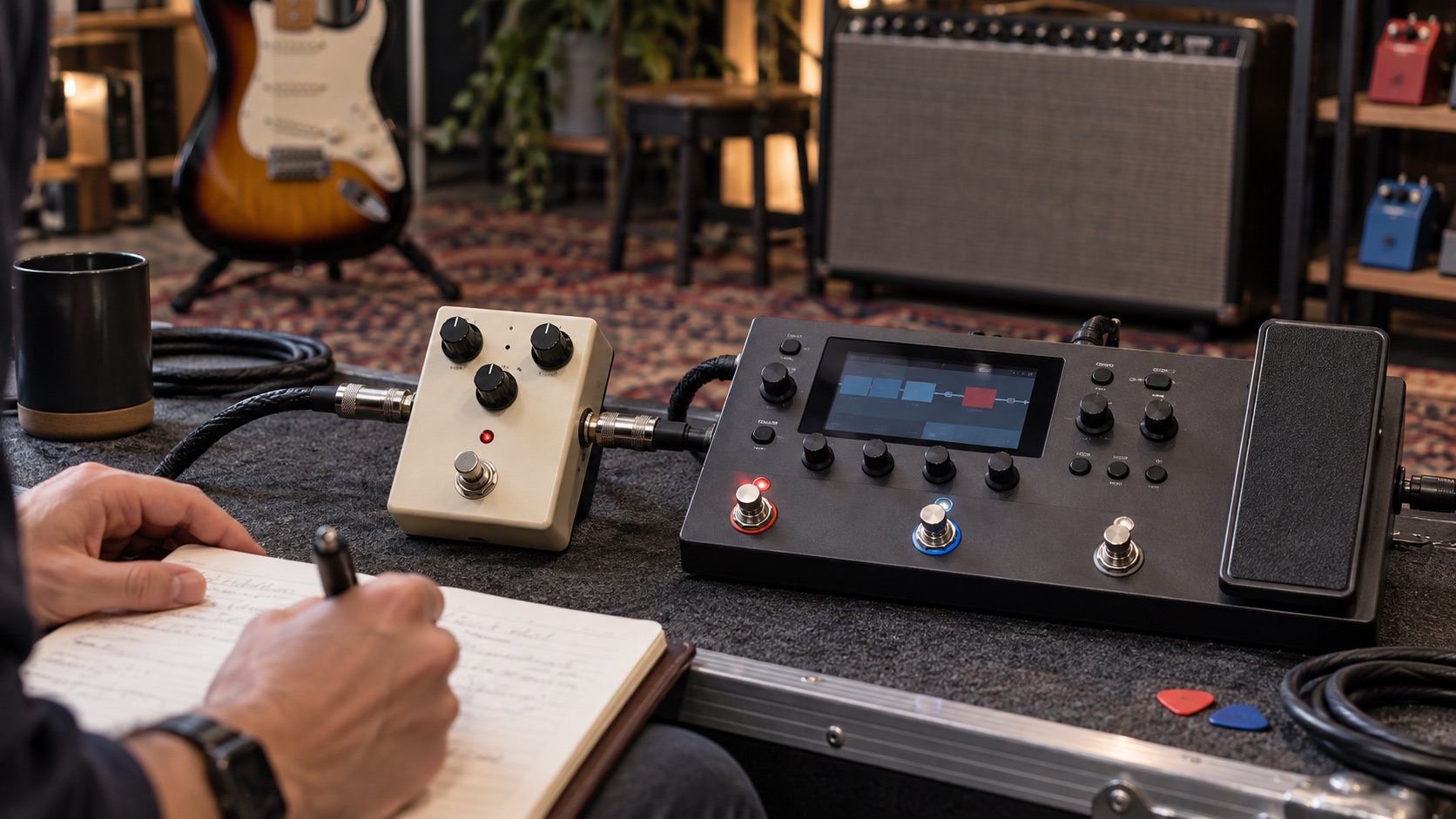
Editorial illustration: compare the customer job and support model before comparing technology labels.
Define “analog” and “digital” carefully
An analog pedal generally processes the audio signal through analog circuitry. A digital pedal converts audio for digital processing, although it still contains analog input and output stages. Many products are hybrids: analog dry paths with digital effects, digitally controlled analog circuits, analog gain stages combined with digital control, or multi-effects units with several processing blocks.
For sourcing, ask the supplier to describe the signal path and user functions rather than relying on one word. A customer-facing “analog” claim should match the actual design. A “digital” label also does not tell the buyer the conversion quality, latency, algorithm behavior, bypass method or firmware support.
The practical question is what the product does, how consistently it does it and whether the explanation is accurate.
Map each format to a retail role
Focused single-effect pedals
Single pedals can solve one clear need: overdrive, distortion, compression, modulation, delay or another effect. They are easy to place in a price ladder and can encourage repeat purchases as players build pedalboards. Retail staff can demonstrate a small control set quickly.
The risks include crowded categories, cosmetic similarity, inconsistent power behavior and subtle quality differences that may not be visible online. A range needs distinct use cases rather than many nearly identical enclosures.
Digital single effects
A digital pedal may still focus on one family, such as delay, reverb or pitch processing, while offering modes, tap tempo, presets or stereo functions. It can occupy a middle position between a basic stompbox and a full multi-effects processor.
Buyers should evaluate interface clarity. Extra modes create value only if the user can understand and recall them. Printed manuals, quick-start content and display behavior become part of the product.
Multi-effects processors
Multi-effects units can combine drives, modulation, delay, reverb, cabinet simulation, presets, drum functions, Bluetooth playback, USB or OTG recording and headphone practice. They can serve beginners, home recordists and players who want one compact rig.
The commercial opportunity is broad functionality. The operational burden is higher: firmware, preset navigation, app compatibility, driver or file support, screen content, translations and troubleshooting must be controlled.
Build the assortment from customer jobs
Start with customers rather than technology. Define several jobs the range should cover:
- First effect pedal for a beginner.
- Affordable drive or modulation add-on.
- Pedalboard utility with low learning effort.
- Home-practice solution with headphones and backing tracks.
- Compact recording or content-creation tool.
- Flexible rehearsal or stage processor.
- Giftable accessory at a clear price point.
Assign one or two products to each job. If several SKUs serve the same user at the same price, require a clear difference in sound, controls, format or bundled value. This prevents an assortment that looks broad in a spreadsheet but confusing on the shelf.
Compare total landed and support cost
Unit price is only one field. Include power adapter or cable, packaging, manual, app or firmware work, artwork, sample charges, tooling, testing, spare units, warranty allowance and training content. Digital products may require more pre-sale explanation and post-sale support. Analog products may require tighter component and noise consistency control depending on the circuit.
Estimate return causes. A single pedal may be returned for noise, switch behavior, power-supply confusion or mismatch with the expected sound. A digital processor may also generate questions about menus, presets, mobile connection, firmware, file formats or recording setup.
The product with more functions is not automatically more profitable if the channel cannot demonstrate or support them.
Planning a private-label effects range?
Send the target customer, channels, price ladder, required effects, branding scope and quantity through Contact Us. Platform functions and customization must be confirmed for the selected project.
Create an RFQ that separates required and optional features
For every candidate, record enclosure format, switch type, control layout, bypass behavior, input/output arrangement, power requirement, current draw, included accessories and packaging. Then add technology-specific fields.
For focused pedals, ask about circuit revision, component-control policy, noise target, gain range, switching behavior and tolerance management. For digital products, add sample rate or processing claims only when they matter commercially, plus latency definition, preset count, routing, firmware version, update method, app support, USB behavior, supported file types and operating-system scope.
Separate required features from options. If app control is not essential, do not let it become an uncontrolled promise. If third-party impulse response loading is central, define the file workflow, limits, memory behavior and user instructions.
Use a consistent audio evaluation method
Subjective tone matters, but the review should still be structured. Use the same guitars, pickups, cables, amplifier or audio interface, power supply and listening level. Record sample revision and settings.
Create a short program that includes:
- Clean single notes and chords.
- Muted attacks and dynamic picking.
- Sustained notes to reveal decay and artifacts.
- Low- and high-output pickup sources.
- Bypass versus engaged comparison.
- High-gain settings where noise is more obvious.
- Stereo, headphone or recording paths when included.
Ask reviewers to describe specific observations: control range, noise, attack, decay, level change, frequency balance, switching artifact and repeatability. “Warm,” “transparent” or “studio quality” should not become packaging claims unless the team defines and supports them.
Test noise, bypass and power behavior
Noise complaints can come from the pedal, power supply, cables, pickups, environment or gain staging. Establish a reference chain and test each candidate under identical conditions. Record whether the pedal is powered from the recommended supply or battery and whether several pedals share power.
Check idle noise at practical settings, switch noise, bypass level, unwanted oscillation, radio pickup and behavior as the supply approaches its allowed limits. Verify polarity, voltage and current information against the label and manual. Never connect an unapproved supply merely to see what happens.
Bypass terminology should be accurate. Ask whether the product uses true bypass, buffered bypass, relay switching, trails behavior or another method, and verify it on the selected revision. The preferred design depends on the signal chain and customer need; the important point is that the description matches the product.
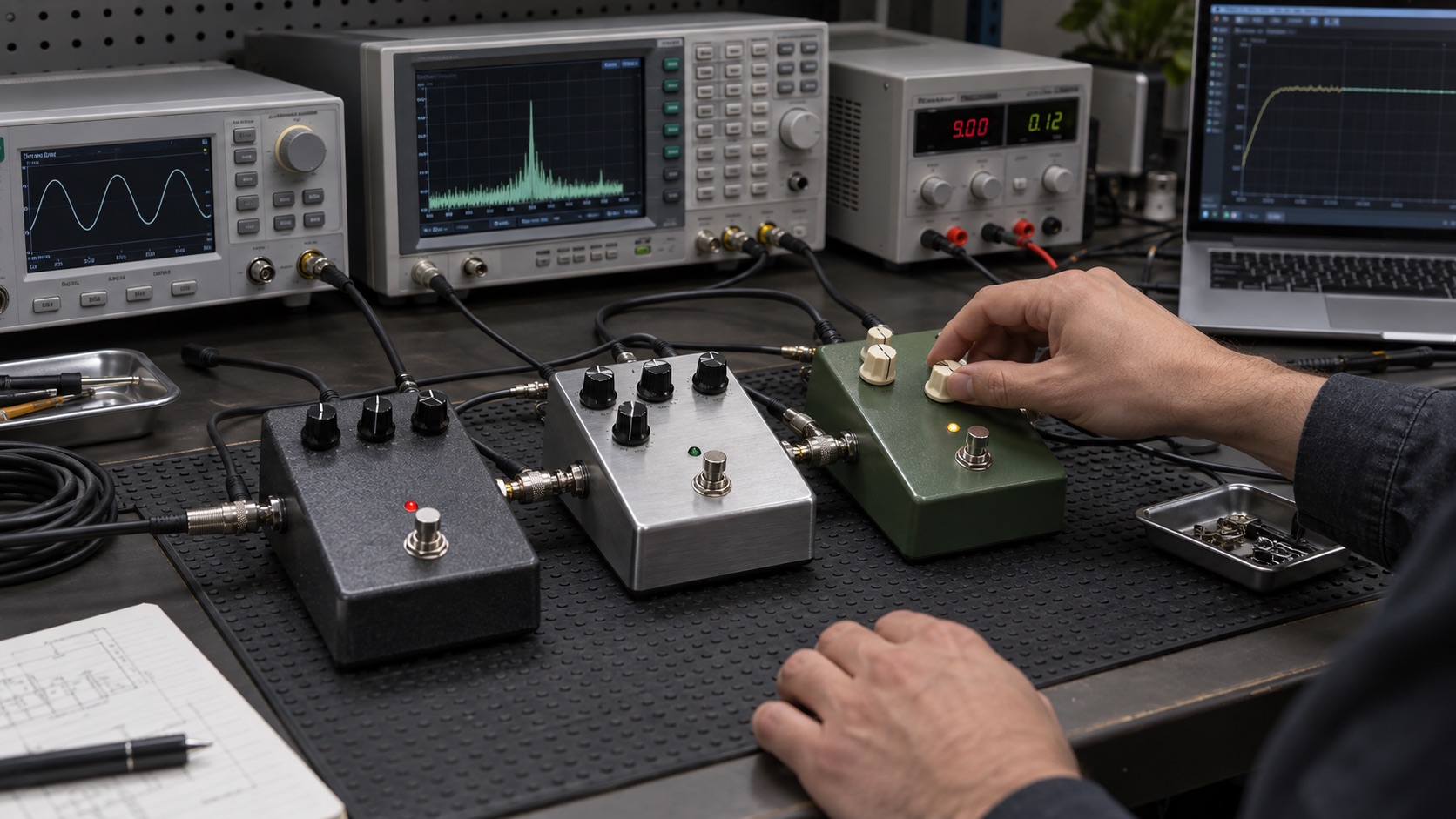
Editorial illustration: compare pedals through one controlled signal chain and record the exact power conditions.
Evaluate digital workflow beyond the demo preset
A digital product can sound impressive during a short demonstration while still creating user friction. Start from a reset state and perform the tasks a new owner will attempt: choose an effect, adjust a parameter, save a preset, recall it, change banks, connect headphones, play a backing track and record if supported.
Observe how easy it is to recover from a wrong menu or overwritten preset. Check whether critical actions require an app and what happens if the app is unavailable. Confirm mobile-platform support and whether the supplier has a realistic maintenance owner. Do not promise indefinite compatibility.
If firmware can be updated, document the procedure, file source, version identification, interruption recovery and responsibility for translated instructions. Freeze the shipping version and require approval before production changes it.
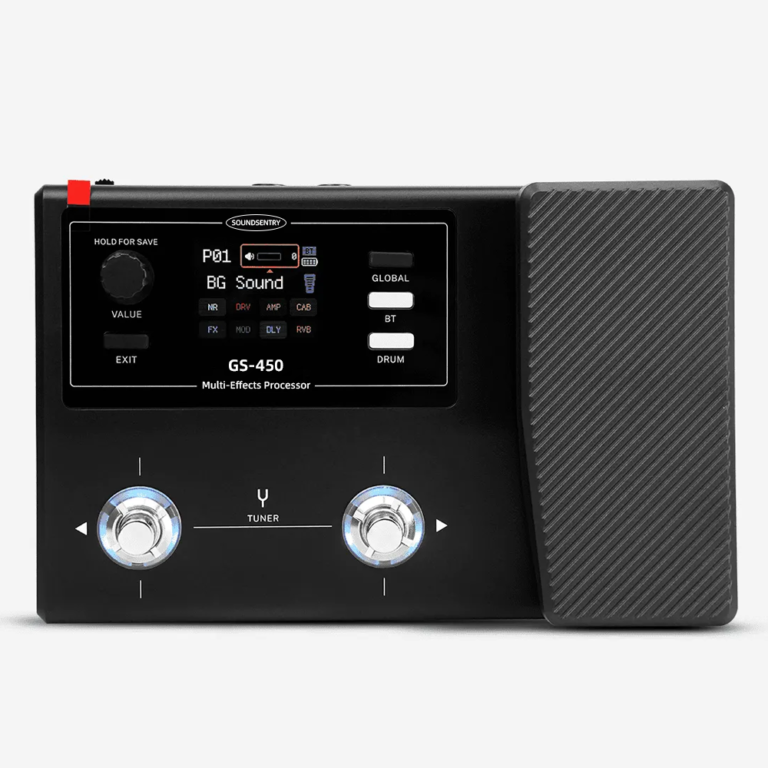
SoundSentry’s public GS-450 multi-effects pedal lists functions including third-party IR loading, eight effects modules, app control, Bluetooth backing tracks, stereo headphone monitoring, OTG recording, preset storage and a drum machine. A buyer considering this type of platform should verify each required workflow on the approved sample and distinguish standard functions from project-specific customization.
Evaluate analog-style products for repeatability
Simple controls do not remove quality risk. Compare several samples at matched settings. Listen for excessive variation in gain, tone sweep, output level, noise and switching. Review potentiometer feel, footswitch alignment, jack retention, enclosure grounding and label consistency.
If the sound depends on selected or tolerance-sensitive components, ask how production controls them and how substitutions are approved. Do not require the supplier to disclose proprietary design details that are unnecessary for purchasing, but do require a method for keeping the approved performance stable.
Analog-style pedals also need an accurate user expectation. An aggressive high-gain product, a low-gain boost and a vintage-voiced overdrive should not share interchangeable copy merely because they have three knobs.
Plan private-label customization in levels
Customization can be divided into controlled levels:
- Artwork and packaging: logo, color, labels, carton and manual on an existing platform.
- User-interface configuration: knob names, preset content, default settings or approved software resources.
- Feature modification: circuit, algorithm, routing, connectivity or enclosure changes.
- New development: a distinct platform with broader engineering and validation work.
Each level changes cost, schedule and risk. Confirm who owns artwork, firmware, app accounts, source files, molds, approvals and future maintenance. The guide to existing-platform versus ODM guitar pedal development offers a deeper decision framework.
Turn the golden sample into a purchase specification
Photograph the approved sample and record model, hardware, firmware, artwork, enclosure, knobs, switches, connectors, accessories and packaging. Attach approved sound settings or reference recordings only as supplementary evidence; keep observable functional criteria in the written specification.
Define change-notification triggers. For analog products, these may include key components, PCB, potentiometers, switches, jacks, power protection and enclosure. For digital products, include processor, converters, memory, display, firmware, algorithms, presets, app and USB implementation.
Approval should state what is final, what is conditional and what remains pending. A good-sounding engineering sample is not permission to print unsupported claims or ship a different revision.
Design production inspection around actual failure modes
A practical pedal inspection plan can include:
- Model, color, artwork and packaging.
- Enclosure finish, knob and footswitch alignment.
- Input, output, power and USB connector retention.
- Power-on, bypass and engaged audio checks.
- Control sweep, switch and expression-pedal behavior.
- Preset save/recall and reset for digital products.
- Headphone, Bluetooth, app, USB or recording functions when included.
- Noise or level comparison against an approved reference method.
- Accessories, manual, labels, barcode and carton.
- Hardware and firmware revision verification.
Not every audio characteristic can be judged in a few seconds at final inspection. Use incoming component control, production functional tests, periodic validation and change management in addition to shipment sampling.
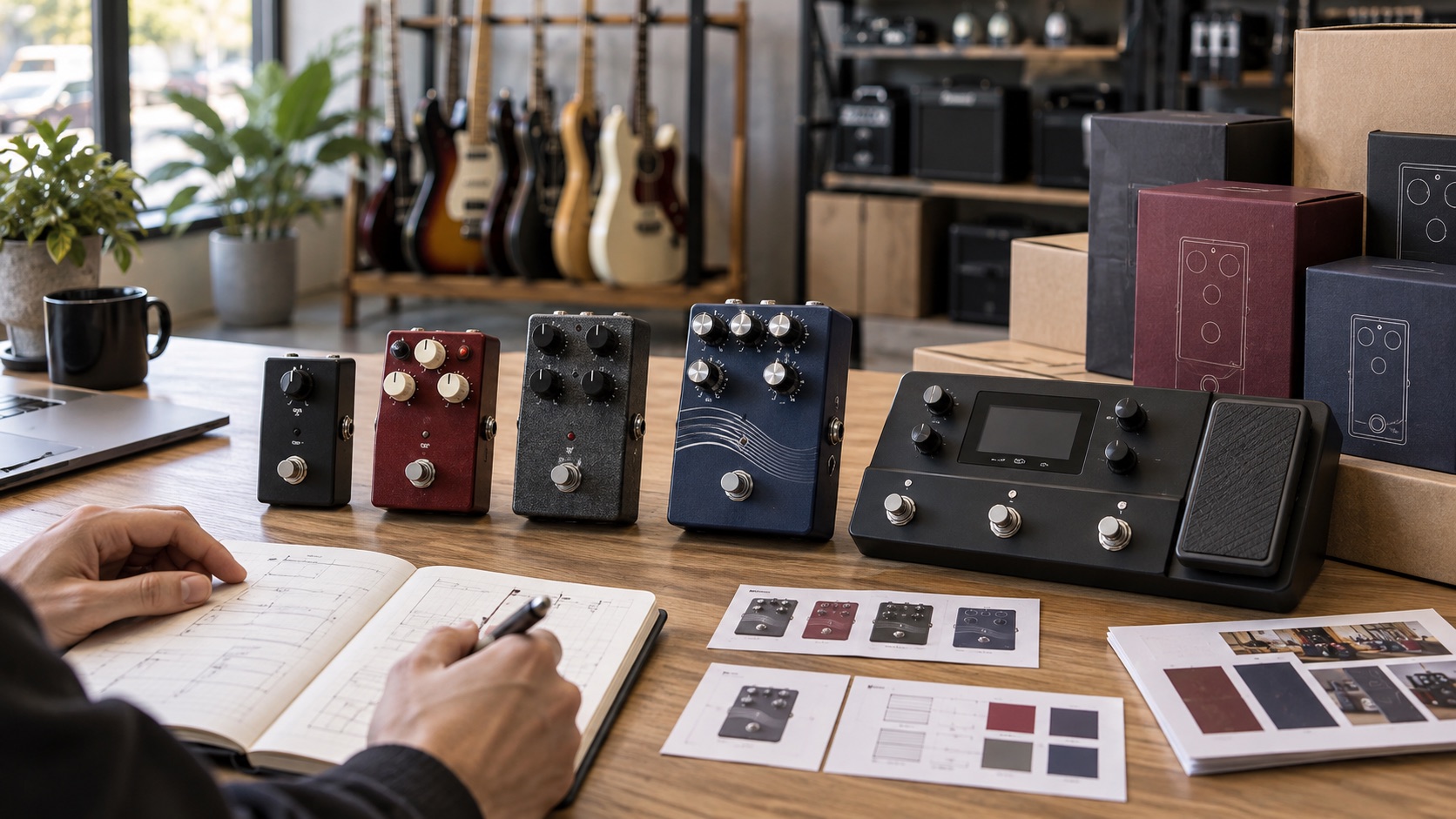
Editorial illustration: a strong range gives each format a distinct customer role and price position.
Plan merchandising and product education
Analog-style single pedals often benefit from short demonstrations, simple sound examples and pedalboard diagrams. Digital processors need task-based content: first preset, saving, headphones, backing tracks, recording and update procedures. Product pages should state what is included and what external devices or software are required.
Use consistent comparison fields across the range: effect type, target user, inputs/outputs, bypass, power, dimensions, weight, presets, connectivity and included accessories. Avoid ranking all products on the number of effects. A focused pedal may be valuable precisely because it does less with more immediate control.
Retail staff should know which customer questions indicate a single pedal and which indicate a processor. A player who wants one drive sound and an existing pedalboard may not benefit from a menu-rich device. A beginner who needs headphones, rhythm and several sounds may find a processor more practical.
Common buying mistakes
Treating analog as automatically premium
Analog describes an implementation approach, not build quality or sound preference. Evaluate the exact circuit, components, controls and production consistency.
Treating digital as automatically more versatile
Extra functions have value only when the interface, firmware and support make them usable for the target customer.
Comparing effect count instead of customer outcome
A long list can hide weak navigation or overlapping sounds. Test the workflows customers will actually use.
Ignoring power-supply details
Incorrect or unclear voltage, polarity and current information drives returns and can damage equipment. Align label, manual, packaging and product page.
Approving one sample without change control
The production revision must remain tied to the golden sample and written specification. Require notification for circuit, firmware and critical component changes.
Frequently asked questions
Are analog guitar pedals better than digital pedals for retailers?
Not universally. Analog-style single pedals can provide focused, easy-to-demonstrate choices. Digital products can cover more sounds and workflows. The best mix depends on customer segment, channel and support capacity.
Which format is easier for private label?
Artwork customization on an established platform can be straightforward in either format. Feature changes to digital firmware, apps or analog circuits add development and validation work. Confirm the exact customization level.
Do digital pedals always have noticeable latency?
No. Latency depends on the design and signal chain. Request a defined measurement when important and evaluate playing response on the approved sample.
Are analog pedals always simpler to support?
They often have fewer menus, but they can still generate questions about power, noise, bypass, gain staging and compatibility. Support requirements depend on the product and documentation.
What quality tests should be in a guitar-pedal purchase agreement?
Include appearance, connectors, power, bypass, control sweep, switching, audio function, noise reference, digital workflows where applicable, accessories, packaging and revision identification. Define sampling and acceptance criteria.
Should a retailer carry both single pedals and multi-effects processors?
Often yes, when they serve distinct customer jobs and price points. Build the range around use cases rather than adding overlapping SKUs.
Conclusion
Analog versus digital is not a shortcut for wholesale product selection. A defensible decision connects customer role, signal path, user interface, quality method, support plan, private-label scope and total cost. Buyers who test the real workflow and control the production revision can build a clearer, lower-risk pedal assortment.
Review SoundSentry’s guitar effects pedal category and send your range brief with target customers, effects, channels, branding and quantities. Available platforms, samples, customization and commercial terms must be confirmed for the selected project.
Plan Your OEM/ODM Project
Share your target product, market, estimated quantity, branding, packaging and certification requirements with the SoundSentry Technical Team.
View Related Products Request Product Information or a Quote