Active vs Passive Guitar Pickups for OEM Guitar Programs
Compare active and passive guitar pickups by output, noise, power, fit, wiring, testing and production control before an OEM order.
Quick answer: Passive pickups send the signal created by the coils and magnets without an onboard powered preamplifier, while active systems use powered electronics to shape or buffer the signal. Passive designs can offer familiar interaction with guitar controls and amplifiers. Active systems can provide more controlled output, buffering and noise performance in a defined circuit. Neither architecture is automatically better for an OEM guitar program. Buyers must match the pickup, electronics, cavity, battery access, control values, wiring, target player and production process.
For an OEM buyer, “active or passive” is not just a tone question. It changes the bill of materials, routing, battery provision, assembly instructions, final testing, packaging copy and after-sales support. A pickup sample that sounds convincing on a supplier’s test guitar may fail in the buyer’s instrument because of different string spacing, pickup height, pots, cable capacitance, shielding or mechanical fit.
This guide provides a practical framework for guitar brands, factories and distributors to specify, test and control active and passive pickup programs. It avoids universal tone claims because sound depends on the complete instrument and signal chain. Final specifications and test limits should be agreed on the actual guitar platform.
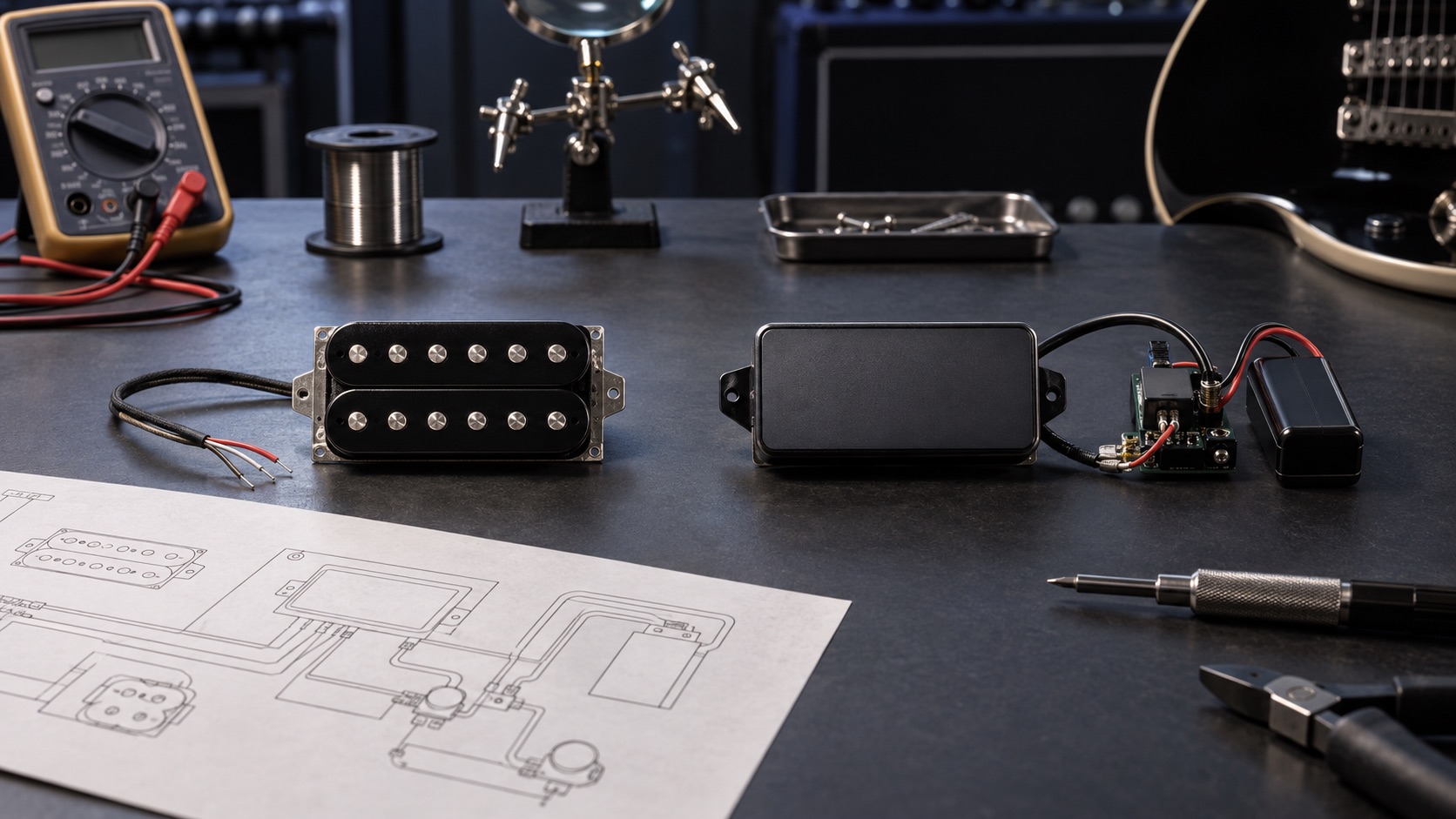
Editorial illustration: the pickup, electronics, wiring and installation space must be reviewed as one system.
Define the product position before choosing the circuit
Start with the guitar and customer, not the pickup label. A traditional single-cut guitar, an extended-range modern instrument, a beginner package and a stage-focused model create different requirements.
Document:
- Guitar type, scale length, string count and bridge spacing.
- Body and neck construction relevant to routing and pickup height.
- Music styles and expected gain range.
- Target output behavior and control layout.
- Clean-headroom, dynamic-response and noise priorities.
- Battery access and expected service method if active electronics are used.
- Target retail position and warranty approach.
- Destination markets, manual languages and packaging claims.
- Branding, covers, pole-piece appearance and color options.
This brief helps the pickup supplier propose a compatible platform. Without it, “high output” or “vintage tone” becomes an ambiguous marketing phrase rather than an engineering requirement.
How passive pickups work in an OEM context
A passive magnetic pickup typically uses magnets, pole pieces or blades, wire coils and mechanical parts to convert string movement into an electrical signal. The output is affected by magnet type and geometry, coil turns, wire, inductance, resistance, capacitance, metal covers, pole spacing, pickup height and the guitar’s control circuit.
Passive designs do not require a battery for the pickup itself. They can support familiar volume and tone circuits and often interact noticeably with pot values, cable capacitance and amplifier input. That interaction can be part of the product character, but it also means the buyer must control more than the pickup alone.
Do not compare passive pickups only by DC resistance. Resistance is easy to measure but does not independently describe output, frequency response or sound. Request the complete design specification and evaluate it in the target guitar.
How active pickups change the system
An active pickup or pickup system includes powered electronics. The circuit may be integrated with the pickup or provided as a separate preamp or control module. Active designs can buffer the output, create a defined gain structure and reduce sensitivity to some downstream loading conditions. They may also support equalization, switching or other functions.
The system needs a suitable power source, commonly a battery, and the guitar needs space, connectors and access for service. The buyer must define battery type, wiring, switching behavior, current consumption, expected life under stated conditions and what happens as the battery voltage falls.
An active system also changes packaging and customer support. The manual should explain battery installation, disconnection during storage where relevant, low-battery symptoms and safe replacement. A guitar that reaches the user with a loose connector or inaccessible battery can create a return even when the pickup electronics are technically sound.
Compare architectures without using vague tone stereotypes
It is common to describe passive pickups as organic or dynamic and active pickups as powerful or compressed. Those descriptions may fit some products, but they are not engineering rules. Passive pickups can be very high output. Active systems can be designed for wide dynamic range. Covers, strings, guitar construction, pickup height, amplifier and player technique all influence the result.
For procurement, compare observable behavior:
| Area | Passive system questions | Active system questions |
|---|---|---|
| Output | Level across strings and positions | Output level, gain structure and headroom |
| Frequency response | Interaction with pots and cable | Circuit voicing and load behavior |
| Noise | Coil design, shielding and grounding | Pickup noise plus powered circuit noise |
| Power | No pickup battery | Battery type, current and low-voltage behavior |
| Controls | Pot values, taper and capacitor | Compatible controls, connectors and switching |
| Installation | Cavity, height and wiring | Cavity, module, battery and service access |
| Service | Wiring and component replacement | Wiring, electronics and battery support |
The comparison should use the same guitar platform or carefully documented reference instruments. Otherwise, the buyer may attribute differences from the guitar to the pickup architecture.
Mechanical fit must be verified before tone approval
An electrical sample is not production-ready until it fits the instrument. Request dimensioned drawings and measure the actual parts. Confirm housing length, width, depth, mounting tabs, screw centers, height-adjustment range and connector clearance.
Check string spacing at the pickup positions, especially on bridge pickups, tremolo-equipped guitars and extended-range instruments. Pole alignment does not need to be visually perfect in every design, but the approved relationship should be intentional and tested.
For covered pickups, include the cover in the measurement and finish review. For active systems, include connectors and bend radius. A plug that fits on an open bench may collide with the cavity wall when installed.
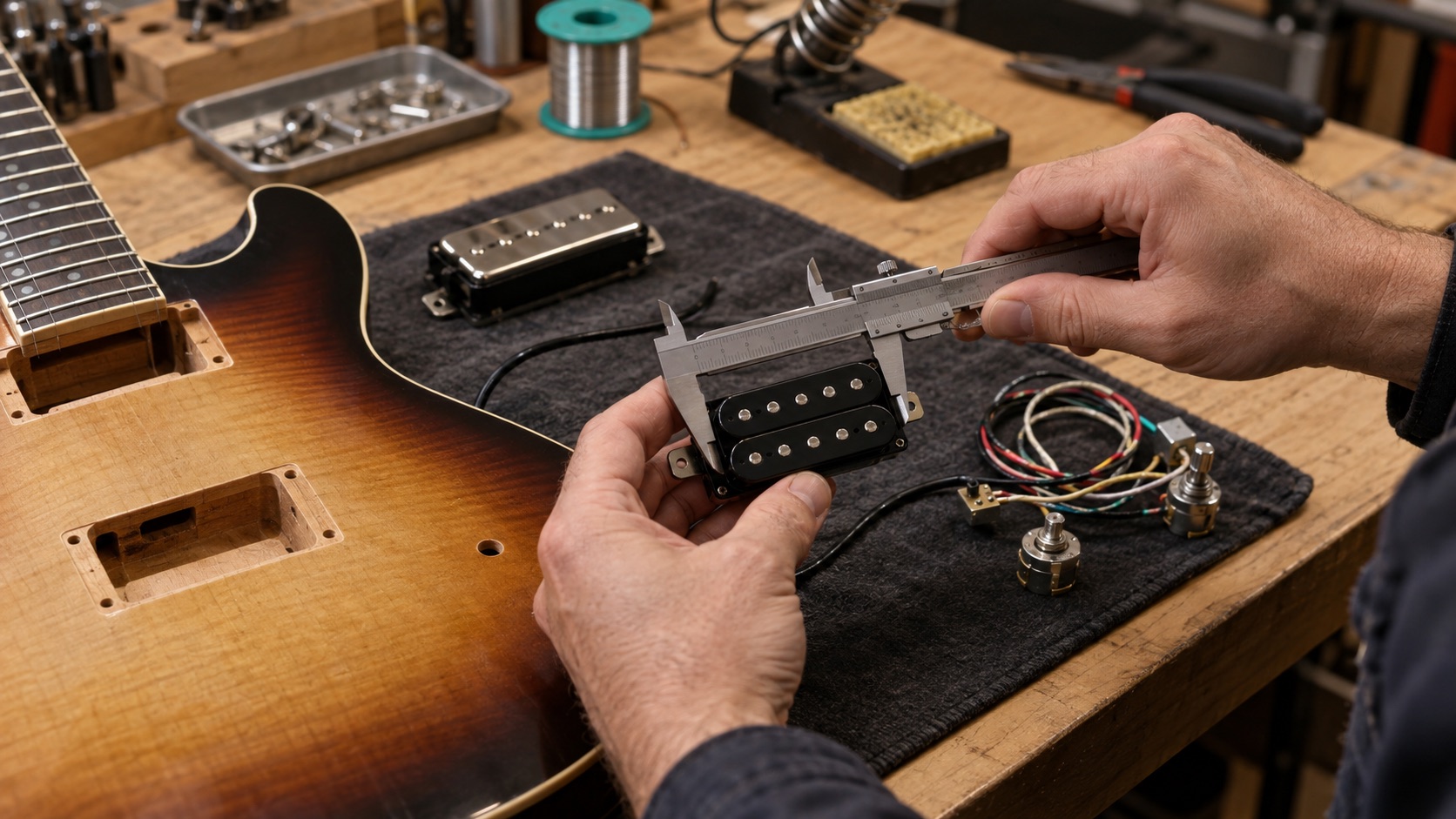
Editorial illustration: approve dimensions, connectors and cavity clearance before releasing production routing.
Planning an OEM pickup program?
Send the guitar type, string spacing, cavity drawing, control layout and target positioning through Contact Us. Pickup and preamp options must be confirmed against the actual instrument platform.
Specify the complete electronics package
The RFQ should identify every included component. A pickup quotation may cover only the pickup or a complete harness. Separate the following:
- Neck and bridge pickups or individual positions.
- Covers, rings, springs, screws and height hardware.
- Volume and tone pots with values and tapers.
- Capacitors, switches, output jack and wiring harness.
- Connectors and locking features.
- Active preamp or control module.
- Battery clip, compartment, door or rechargeable power provision.
- Shielding materials and grounding method.
- Installation drawing and test procedure.
- Retail or factory bulk packaging.
Agree whether wiring arrives as loose leads, quick-connect harnesses or a preassembled control set. Quick connectors can reduce assembly time, but they add orientation, retention and sourcing requirements. Loose wiring can support flexibility but demands controlled soldering and inspection.
Pot values, cable and load conditions
Passive pickups interact with the control circuit. Pot value and tolerance can change the load. Cable capacitance and amplifier input can also affect the measured and perceived response. Use the actual intended controls and a defined cable or test load when comparing samples.
Active systems may be less sensitive to some external loading, but the supplier still needs to specify compatible pots, output impedance, supply range and switching arrangement. Do not mix components from another active platform without review.
Record the full reference circuit. A pickup name without its circuit is not enough for production control.
Build a repeatable sound and function test
Listening is important, but an informal demonstration is difficult to repeat. Create a test that combines measurements and controlled playing.
Use a reference guitar or production-representative prototype. Record strings, tuning, pickup height, control positions, cable, interface or amplifier, gain structure and room. Use the same musical passages or controlled excitation for every sample.
Evaluate:
- Output balance between neck and bridge positions.
- String-to-string balance.
- Clean and driven behavior at relevant gain settings.
- Volume and tone control sweep.
- Switch noise, crackle, intermittent connections and microphonics.
- Hum and noise in several orientations and switching modes.
- Sustain and transient response without relying on one adjective.
- Active-system behavior at normal and reduced battery voltage.
Store short reference recordings, but keep the physical golden sample and written setup. A recording alone cannot show mechanical fit or later component substitutions.
Noise, shielding and grounding
Noise performance belongs to the complete guitar. Pickup construction, wiring, cavities, bridge grounding, shielding, power supply and test environment all matter. Define the reference setup and measure or compare samples consistently.
Single-coil designs may have different hum behavior from hum-canceling formats, but poor wiring can undermine either. Active electronics add their own circuit noise and power questions. Avoid claims such as “noise-free” unless the exact condition and limit are defined.
Inspect shield connections, ground continuity and cable routing. Keep signal wires away from avoidable interference sources. For quick-connect systems, test connector retention and orientation. The production work instruction should show where each wire runs and where grounds are attached.
Battery planning for active systems
Battery access is a product-design decision, not an afterthought. Decide whether the user reaches the battery through a dedicated door, control cavity or another approved method. A dedicated compartment can simplify service but adds routing, hardware and finishing work.
Specify battery type, connector polarity, retention, insulation and strain relief. Check that the battery cannot rattle or contact sharp conductive edges. Confirm how the circuit is switched, including whether inserting the output plug connects power. Customer instructions should explain storage behavior.
Request current-consumption information and verify practical operating life under stated conditions. Do not publish a single battery-life number without the battery, test method and end point. Test low-voltage behavior: gradual output change, distortion, intermittent function or sudden shutdown can lead to different support instructions.
Sample approval and change control
Approve a production-representative sample that includes the final magnet, coil, cover, wire, connector, circuit and hardware. Record serial or sample identifiers and sign the drawing and specification.
The change-control clause should cover:
- Magnet material or supplier.
- Coil wire, turns or winding method.
- Bobbin, baseplate, cover and plating.
- Pot, capacitor, connector or cable.
- Active circuit components or firmware where applicable.
- Battery hardware and wiring.
- Packaging and labels.
A component may appear interchangeable yet alter sound, fit, reliability or compliance. Require notice and reapproval before production changes.
Production consistency tests
Build a control plan around critical characteristics. Depending on the product, production checks may include resistance, inductance, continuity, polarity, phase, output, noise, functional switching and cosmetic inspection. Active systems may require supply-current and functional tests.
Define test fixtures and limits using engineering evidence, not arbitrary numbers. Separate critical failures from cosmetic variation. Confirm how failed units are identified, repaired and retested.
Batch sampling should compare several units with the golden sample. Track results by lot so field complaints can be connected to production records.
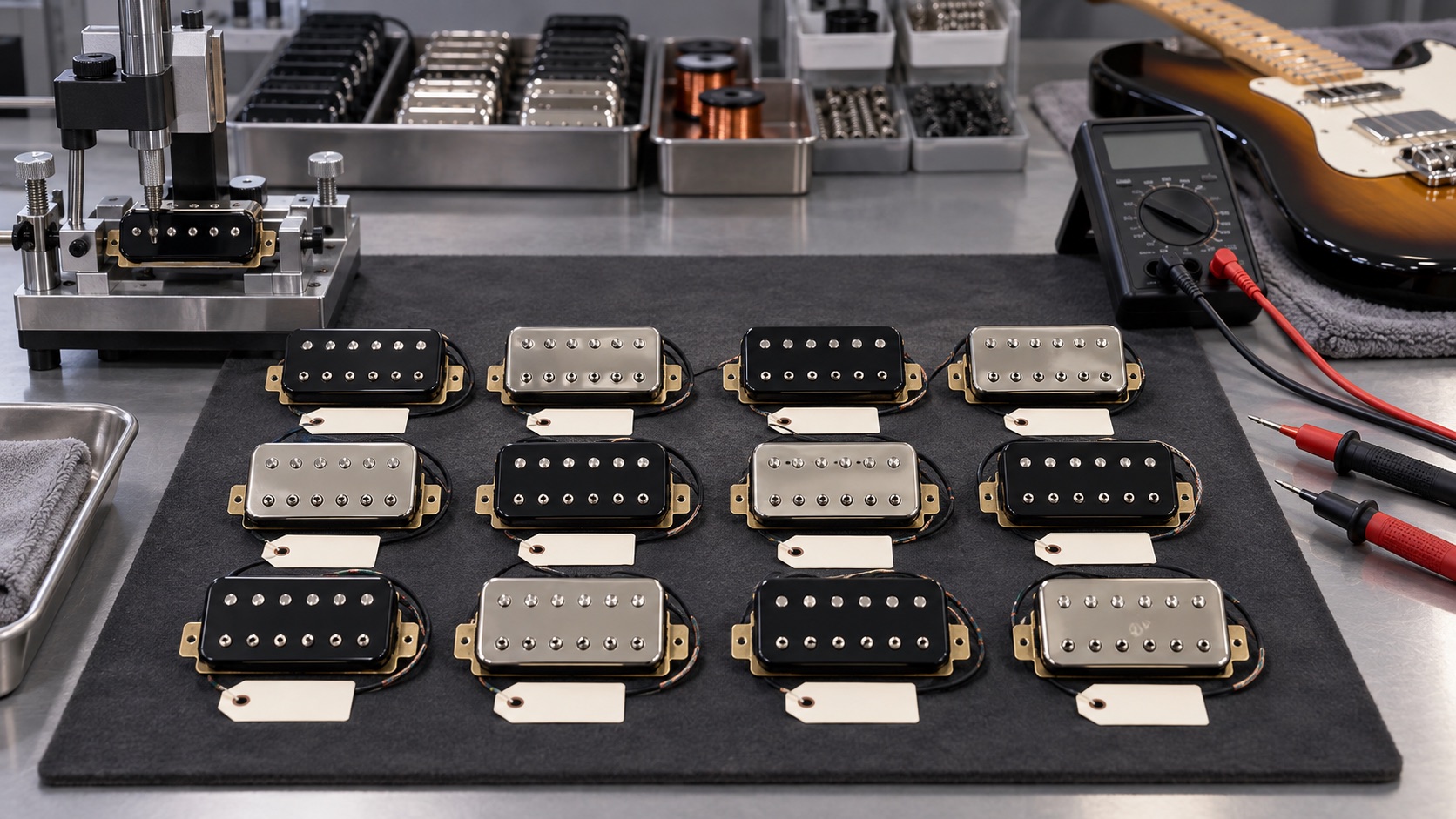
Editorial illustration: production approval requires controlled measurements across a batch, not one good sample.
Packaging and production-line preparation
Factory bulk packaging should protect leads, connectors, pole pieces and finished covers. Separate hardware so screws cannot scratch visible surfaces. Label neck and bridge positions clearly without relying only on similar wire colors.
Prepare work instructions before the first production run. Include routing dimensions, pickup orientation, spring or tubing installation, target height range, connector routing, solder points, ground locations, battery placement and final test steps.
Run a pilot build. Record assembly time, awkward steps, wire pinch risks and rework. The pilot often reveals issues that a bench sample hides.
Commercial comparison and warranty scope
Normalize quotations by included components and support. Separate pickup cost, covers, hardware, harness, pots, switch, jack, active module, battery hardware, packaging, tooling, samples and testing.
Confirm MOQ by pickup type, finish and artwork. Ask how spare parts are supplied and whether neck/bridge replacements can be ordered separately. Define the evidence needed for warranty review without asking users to modify energized electronics or perform unsafe work.
Traceability is valuable. A lot code connecting the pickup to its coil, magnet, circuit and assembly batch helps investigate a complaint more efficiently than visual inspection alone.
Common OEM sourcing mistakes
Comparing passive pickups only by DC resistance
Resistance does not independently define output or frequency response. Review the complete design and evaluate it in the target guitar.
Selecting active pickups without battery-service planning
The guitar needs safe access, retention, instructions and low-voltage support.
Approving sound before mechanical fit
Measure housing, tabs, screws, connectors and cavity clearance first.
Testing samples in different guitars
Instrument construction and setup can dominate the comparison. Use a controlled platform.
Allowing uncontrolled component substitutions
Magnets, coils, pots, connectors and circuits require change approval.
Frequently asked questions
Are active pickups always higher output than passive pickups?
No. Many active systems provide controlled high output, but passive pickups can also be designed for high output. Compare the specific products and test conditions.
Do passive pickups sound more natural?
“Natural” is subjective. Passive designs often interact more with controls and cable load, while active circuits can buffer and shape the signal. Evaluate the complete guitar for the target player.
What information should an OEM buyer send a pickup supplier?
Send guitar type, string count and spacing, pickup positions, cavity drawings, mounting method, control layout, target sound behavior, finish, included electronics and production volume.
Can active pickups use standard passive pots?
Not automatically. Active systems may require specific pot values, wiring and switching. Follow the approved circuit for the selected platform.
How should pickup consistency be checked?
Use controlled electrical and functional tests, batch sampling, a golden sample, defined fixtures and traceable lot records. Limits should be based on the approved design.
What changes require reapproval?
Changes to magnets, coils, covers, baseplates, pots, capacitors, connectors, active components, battery hardware or wiring should be reviewed for fit, sound, reliability and documentation impact.
Conclusion
An active-versus-passive decision becomes useful when it is connected to the actual OEM guitar, electronics, service model and production controls. Buyers should specify the complete signal system, verify fit before tone approval, use repeatable tests and control every component that can change performance.
Explore SoundSentry’s pickup and preamp category and send your guitar specification with drawings, string spacing, control layout and target positioning. Available pickup platforms, samples and commercial terms must be confirmed for the selected program.
Plan Your OEM/ODM Project
Share your target product, market, estimated quantity, branding, packaging and certification requirements with the SoundSentry Technical Team.
View Related Products Request Product Information or a Quote