How to Compare Guitar Amplifier Wholesale Quotations Without Missing Hidden Differences
Learn how to compare guitar amplifier wholesale quotations by configuration, sample scope, packaging, support and total purchasing cost.
Two guitar amplifier quotations can show the same wattage and still describe very different products. One may include a rechargeable battery, Bluetooth playback, headphone output and retail packaging. Another may quote only the amplifier with a basic power accessory. A third may use the same model name but refer to a different control layout, cabinet finish or sample version. For a distributor or music retailer, comparing unit prices before aligning these details creates a false comparison.
This guide explains how to compare guitar amplifier wholesale quotations on a like-for-like basis. It focuses on the information a buyer can define, verify on a sample and connect to the final order. Commercial terms such as price, MOQ, production time, warranty and available documentation remain specific to the selected model, quantity, destination and quotation.
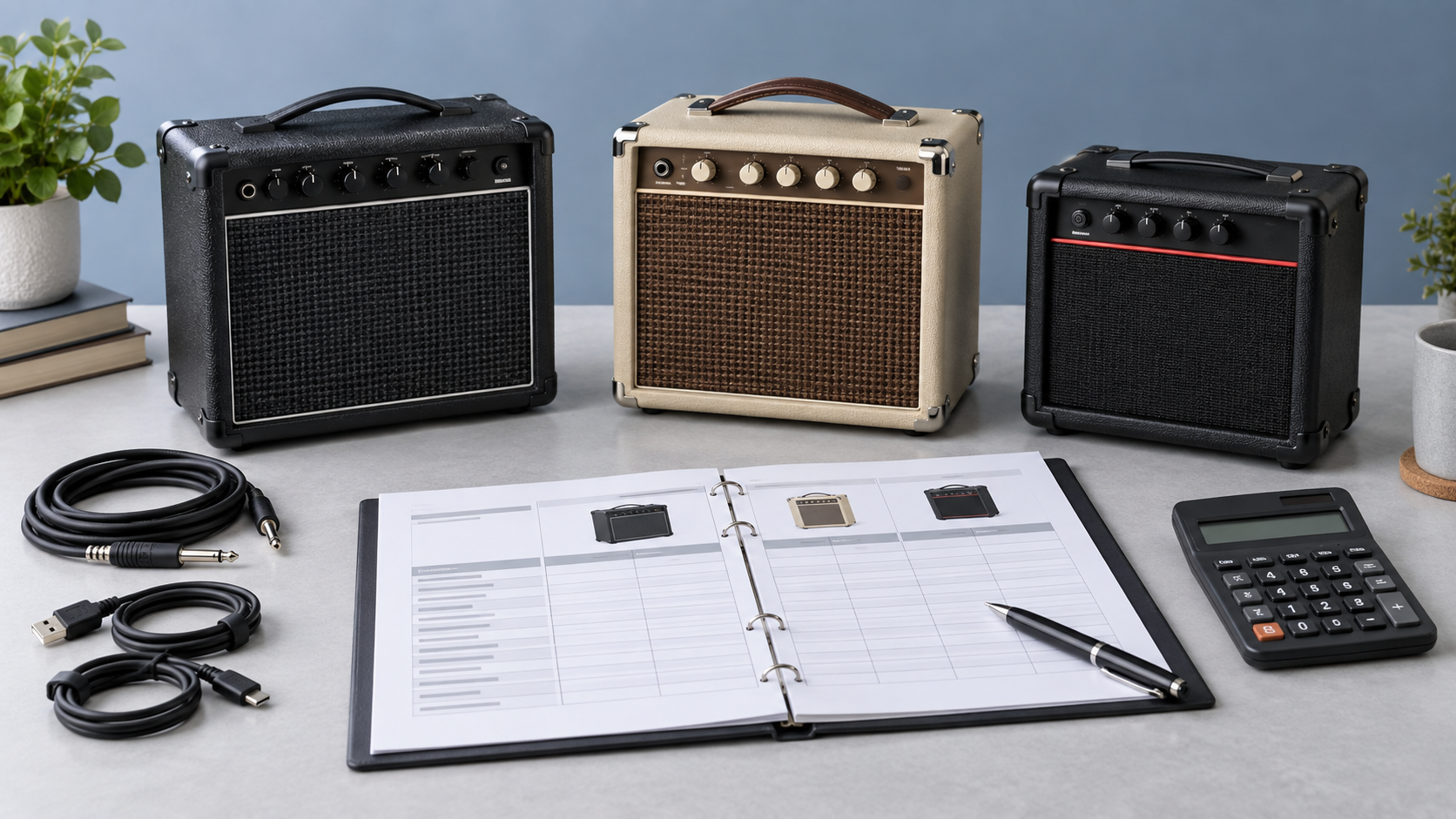
Editorial illustration: a buyer-owned comparison sheet keeps amplifier configurations and quotations aligned.
Start with one purchasing brief
Send each supplier the same brief. Identify the sales channel, customer use case, target market, estimated quantity and required product role. A portable practice amplifier for a music store is not the same purchasing project as an amplifier for a teaching studio, outdoor use or a private-label range.
The brief should separate required features from optional features. Required items may include instrument input, headphone monitoring, a selected power arrangement and the correct plug or charging interface. Optional items may include Bluetooth playback, onboard effects, recording functions, a microphone input or customized packaging. This separation lets a supplier quote a stable base configuration and price optional changes clearly.
Match the model and version
Record the exact model reference on every quotation, sample record and approval sheet. Do not rely only on a photograph. Products with a similar enclosure can use different electronics, speakers, batteries, controls or accessories. Ask the supplier to state whether the quotation matches the sample already reviewed and whether any revision is planned before production.
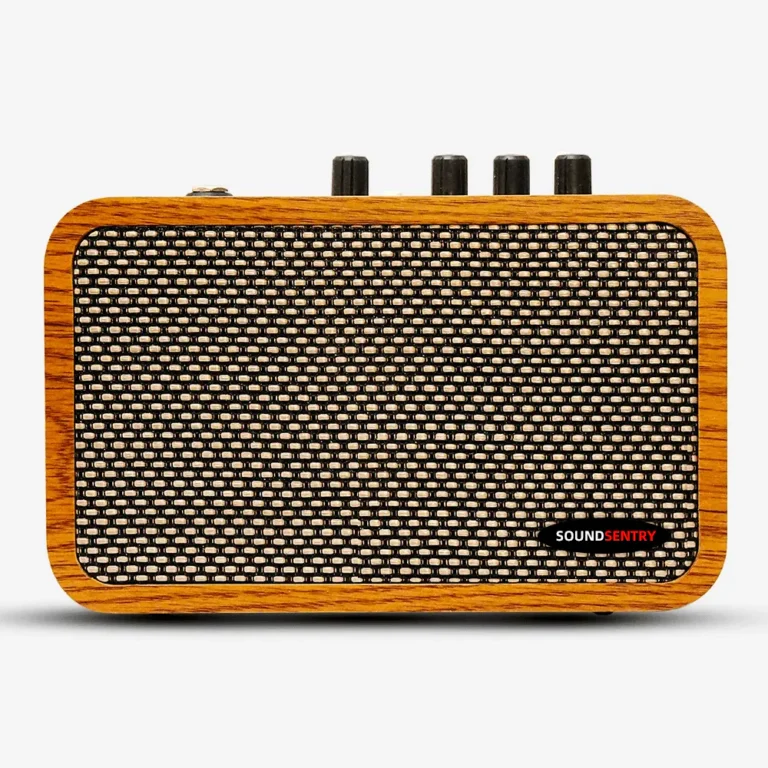
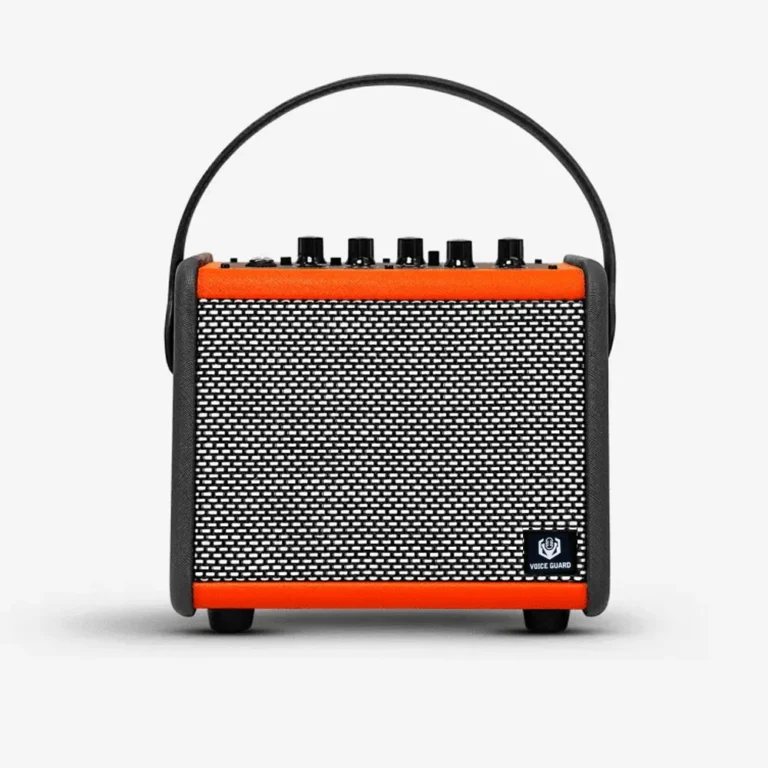
If a buyer is comparing current SoundSentry examples, the BlackNote10 and QG-15 pages describe different portable amplifier configurations. Those pages are useful starting points, but the selected functions, artwork, accessories and packaging still need to be confirmed against the quotation and approved sample.
Compare functions line by line
Create one row for each function rather than placing a general feature paragraph in the comparison sheet. Typical fields include:
- Instrument input type and location.
- Clean, overdrive or distortion channel arrangement.
- Available onboard effects and their controls.
- Bluetooth or external-audio playback.
- Headphone output and its operating behavior.
- Recording or OTG functions and supported connection method.
- External power, rechargeable operation or both.
- Charging interface and included charging accessory.
- Speaker size, cabinet format and stated output rating.
Mark each field as confirmed, optional, not included or pending. This is more useful than assuming that a missing line in a quotation means the feature is included. It also helps sales teams understand what they can describe to customers after the product enters the range.
Treat wattage as one specification, not the whole product
Advertised power alone does not define perceived loudness, tonal response or suitability for a use case. Speaker efficiency, speaker size, cabinet construction, limiter behavior, power supply and measurement method can all affect the result. A buyer should ask how the stated rating is defined and then listen to the sample at representative settings.
The goal is not to create a laboratory claim from a purchasing sample. The goal is to confirm that the model performs consistently enough for its intended role and that the description used in the catalog matches the agreed specification. If suppliers use different rating methods, note the difference instead of forcing the numbers into a direct ranking.
Request a Comparable Amplifier Quotation
Send SoundSentry the intended market, quantity, required functions, branding and packaging brief through Contact Us.
Define the sample scope before comparing prices
A sample fee or sample lead time means little unless the sample scope is clear. Confirm whether the sample represents the proposed production configuration, a standard reference model or a functional prototype. Record the enclosure, control layout, firmware or operating logic, battery arrangement, included accessories and packaging status.
Use the same listening and operating checklist for every candidate. Test the main guitar input, controls, effects, playback functions, headphone output, charging and any recording function included in the brief. Evaluate the product under practical use conditions and record the conditions. A battery result, for example, depends on volume, playback activity, effect use and battery condition.
The existing portable guitar amplifier sample approval checklist can support this step. It should be adapted to the exact functions and acceptance criteria in the buyer's project.
Compare the included accessory set
An attractive unit price may exclude items that another quotation includes. List the power adapter or cable, charging cable, audio cable, manual, warranty card, protective bag and any retail accessories separately. Confirm connector types, cable lengths and packaging positions where these details affect use or presentation.
For destination markets with different plugs, voltage expectations or labeling requirements, ask for model-specific confirmation. Do not infer that a power accessory supplied for one market is suitable for another. The approved accessory list should appear on the final purchase documents and packing reference.
Review cabinet, controls and product presentation
Portable amplifiers combine electronics with a visible retail product. Compare cabinet material, surface finish, grille, handle, feet, control-panel printing, knob alignment and label readability. If the project includes private labeling, specify the logo position, artwork file, color reference and approval method.
Small presentation differences can affect both cost and customer perception. A quotation for a standard enclosure should not be compared directly with a quotation that includes a custom finish, revised tooling, new control labels or a different grille treatment. Ask suppliers to separate standard product cost from one-time artwork, sampling or setup work when applicable.
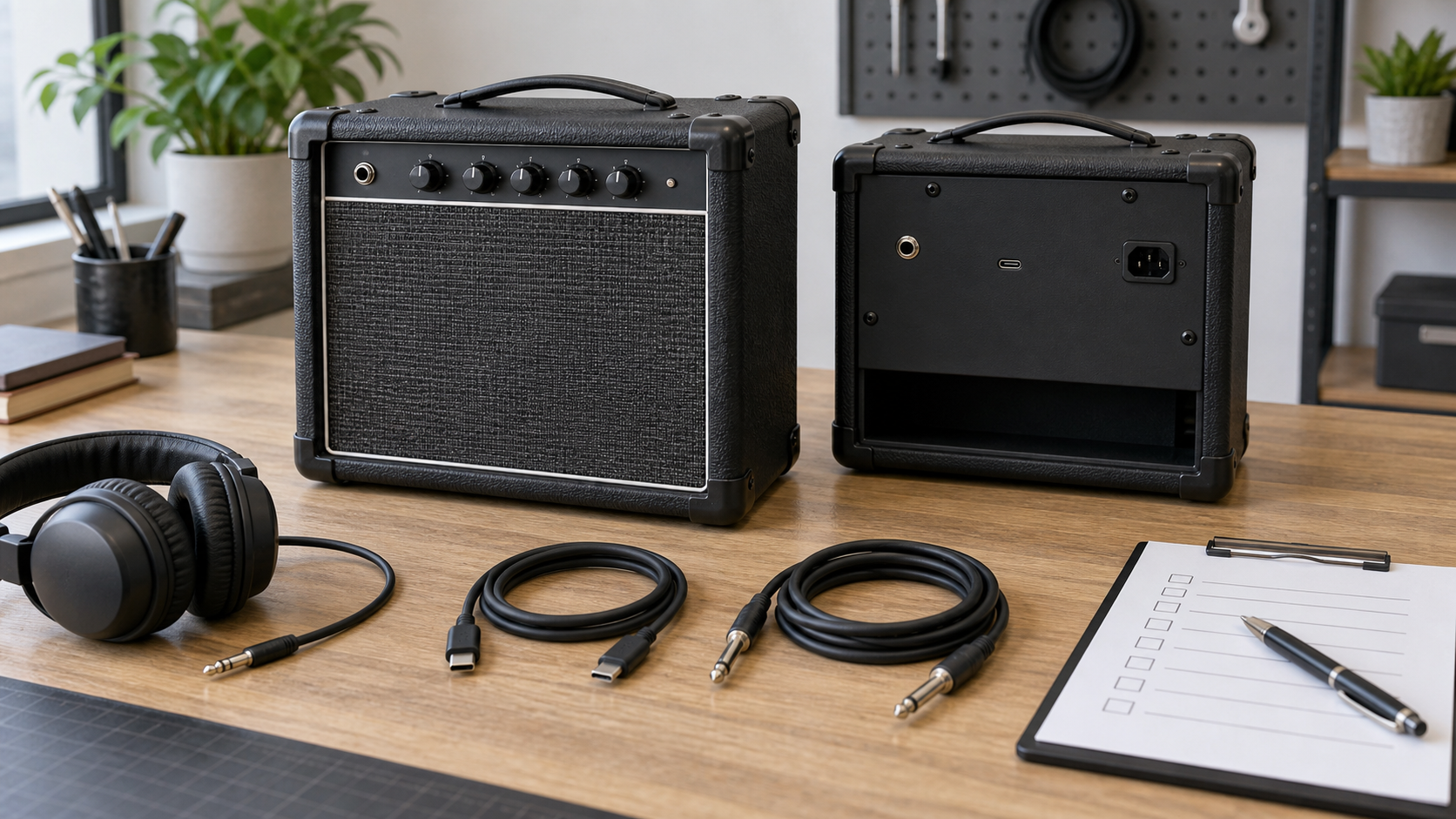
Editorial illustration: sample approval should cover controls, connections and the included accessory set.
Align packaging before judging the unit price
Packaging can change materials, carton volume, artwork work and protection. Define whether the quotation includes a plain box, printed retail box, sleeve, molded insert, foam protection, master carton labels or another format. State the number of units per master carton and request the packed dimensions and weight when available for the approved configuration.
Review packaging on a representative sample when the retail presentation or shipment risk is important. Check that the amplifier and accessories have defined positions, controls and corners are protected, and product labels match the contents. If artwork is not ready, mark the packaging quote as provisional rather than approved.
Separate product price from project costs
A clear comparison sheet distinguishes recurring unit cost from one-time or conditional costs. Possible lines include sample cost, customized artwork, packaging setup, testing requested by the buyer, documentation work, tooling, inspection and transport to the agreed delivery point. Not every project includes every line.
Avoid calculating a single landed cost until the trade term, destination, packed volume and included services are clear. A factory or supplier quotation is not necessarily a delivered-cost quotation. Currency, payment terms and quotation validity should also be recorded so that internal reviewers understand the basis of the comparison.
Connect MOQ to the actual configuration
MOQ can change when the buyer requests a special color, printed packaging, new accessories, modified controls or a mixed assortment. Ask the supplier to state the MOQ for the exact quoted configuration and to identify which option creates the constraint. This produces a more useful discussion than asking for a universal minimum order number.
For a trial order, buyers can ask whether a standard configuration and neutral packaging are available at a different quantity. The answer depends on current supply conditions and the selected model. It should be confirmed in writing rather than assumed from a previous order or a general website statement.
Compare production timing by milestone
Instead of recording only one lead-time number, map the milestones that affect the order: specification confirmation, sample preparation, sample approval, artwork approval, material preparation, production, inspection and shipment release. Ask which milestone starts the quoted production period.
This is especially important for customized projects. A production estimate may begin only after the buyer approves the sample and packaging artwork. If approvals are delayed or the configuration changes, the schedule must be reviewed. Keeping milestone dates in the order file makes later communication easier to audit.
Request documentation by model and destination
Electronic products may require product information, declarations, test reports, labeling details, manuals or other documents depending on the destination and sales channel. Buyers should identify their requirements and ask what is available for the exact model. A certificate name on a general page should not be treated as proof that every configuration or destination is covered.
Compare document identifiers, model references, issue dates and scope where relevant. If a supplier says a document will be prepared later, mark it as pending and define who must approve it before shipment. Legal or compliance decisions should be reviewed by a qualified party familiar with the destination market.
Evaluate warranty, spares and change handling
Warranty terms need an agreed period, coverage definition, claim process and remedy. Ask how the supplier handles confirmed defects, replacement units, spare parts or repair information. For a rechargeable model, clarify whether batteries, charging accessories or consumable items have different treatment.
Also ask how product changes are communicated. A component substitution, control change, firmware adjustment or packaging revision may affect the buyer's listing and support materials. The supplier should identify changes that require written notice or a new sample review. This is part of commercial risk management, not an optional technical detail.
Use a weighted comparison only after facts are aligned
A scoring model can help a buying team, but scores should not hide missing information. First align the configuration and mark open points. Then weight criteria according to the project: product fit, sample result, quotation completeness, packaging, documentation, communication, warranty or schedule.
Use an unavailable status when a required answer is missing. Giving a high numeric score to an incomplete quotation can make the result look more certain than it is. Procurement, product and sales teams should be able to trace every conclusion back to the quotation, sample record or written confirmation.
Normalize the quotation in a buyer-owned table
Supplier quotation formats are rarely identical. Build a buyer-owned table so that every proposal is translated into the same columns without changing the original source. Keep a link or reference to the supplier document, its date, version and currency. Use one row per model and configuration, not one row per supplier.
A practical table can include model reference, quantity basis, unit price, included functions, power and charging, speaker and cabinet, accessory set, packaging, branding, sample status, documentation status, trade term, quotation validity and open questions. Put conditional costs in separate columns. If a supplier has not answered a required point, use pending rather than guessing.
This table also exposes revisions. When a new quotation arrives, compare it with the previous version and identify whether the change comes from quantity, configuration, packaging, currency, transport basis or another condition. Retain both versions until the order is finalized so that internal approval does not rely on an outdated price.
Consider retail support and product information work
The buyer's cost continues after the product arrives. A model with unclear controls, incomplete instructions or an uncertain accessory list can create more questions for sales staff and customers. Compare the product information available for the exact configuration: specification sheet, product images, control descriptions, installation or charging guidance and troubleshooting information.
For private-label projects, agree who prepares and approves the manual, carton labels, product labels and online product copy. The buyer should not copy a standard supplier description if the ordered functions are different. Include this information work in the launch schedule and approval record.
After-sales planning also affects range decisions. Ask what evidence is needed for a claim, how confirmed defects are documented, and whether replacement accessories or parts can be quoted. These details do not create a universal warranty promise, but they help the distributor compare the operational burden of each proposal.
Prepare the final order reference
Before the purchase order is released, combine the approved model, specification, sample reference, artwork, accessory list, packaging, quantity, price basis, documentation and inspection requirements. Resolve conflicts between email messages and the formal order documents. If an option is excluded, say so explicitly.
The order reference should also identify the destination, agreed trade term, payment arrangement and requested schedule. This record gives both parties a stable basis for production and reduces the risk of comparing the delivered product with an earlier, different proposal.
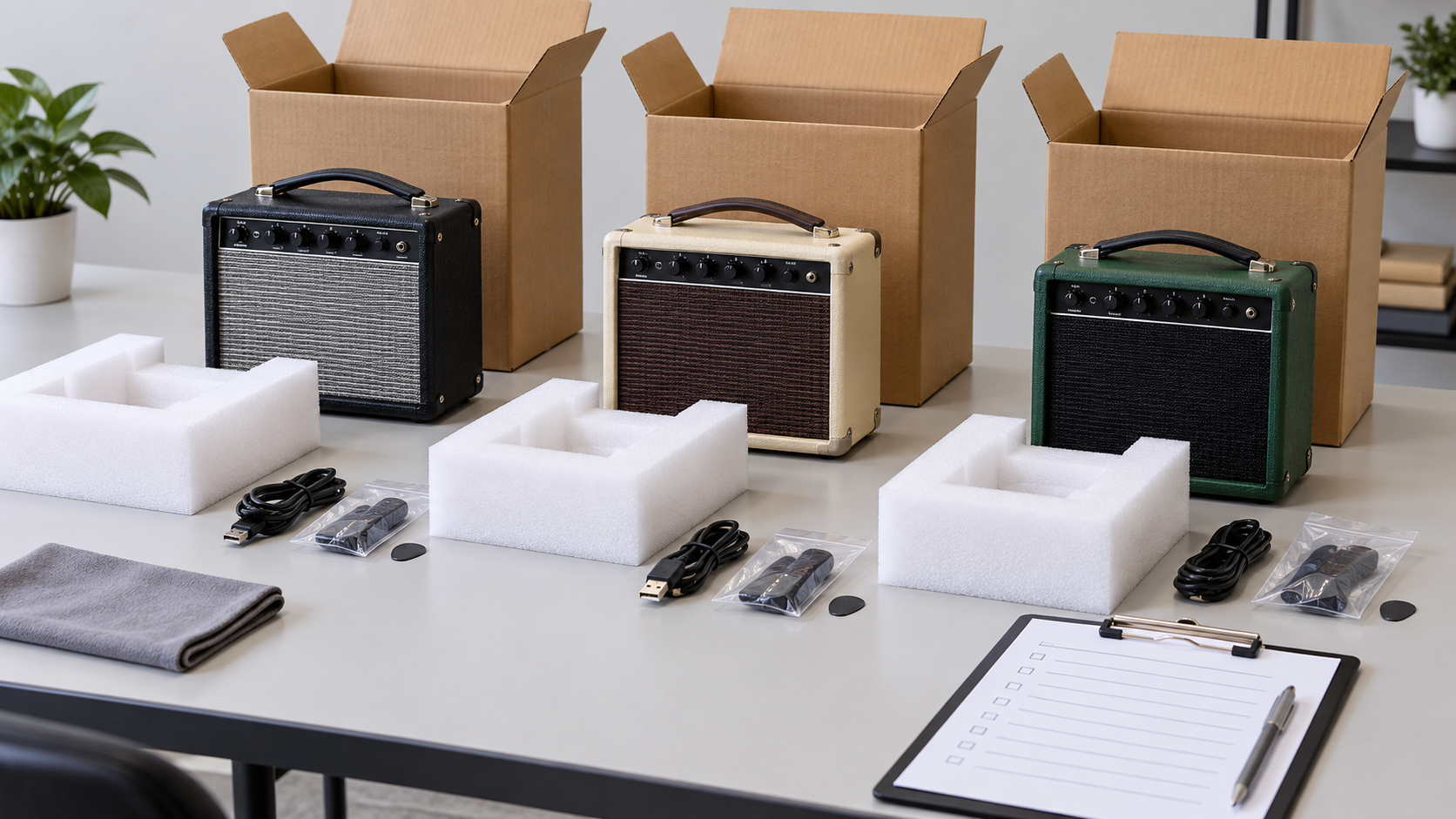
Editorial illustration: match each amplifier configuration with its approved accessories and packaging.
Frequently asked questions
What is the best way to compare guitar amplifier wholesale prices?
Compare prices only after matching the exact model, functions, power arrangement, accessories, packaging, quantity, trade term and required documentation. Separate recurring unit cost from one-time project costs.
Should buyers compare amplifiers with the same wattage directly?
Not without checking the rating basis, speaker, cabinet, power system and intended use. Wattage is one field in the comparison, not proof that two products will perform or present the same way.
What should be included in an amplifier sample approval record?
Record the model and version, controls, functions, connections, power and charging behavior, sample test conditions, enclosure, branding, accessories, packaging and unresolved items.
How should MOQ and lead time be compared?
Tie both to the same approved configuration, quantity, branding and packaging scope. Ask which project conditions affect the minimum quantity and which approval milestone starts the production period.
Conclusion
A useful guitar amplifier quotation is a controlled description of a product and project, not just a unit price. Buyers who align the brief, sample, functions, accessories, packaging and documentation can see which differences genuinely affect purchasing value. Review SoundSentry's current guitar amplifier products and contact the technical team to request a model-specific quotation.
Plan Your OEM/ODM Project
Share your target product, market, estimated quantity, branding, packaging and certification requirements with the SoundSentry Technical Team.
View Related Products Request Product Information or a Quote